Neil deGrasse Tyson on the Webb Telescope and the Big Bang
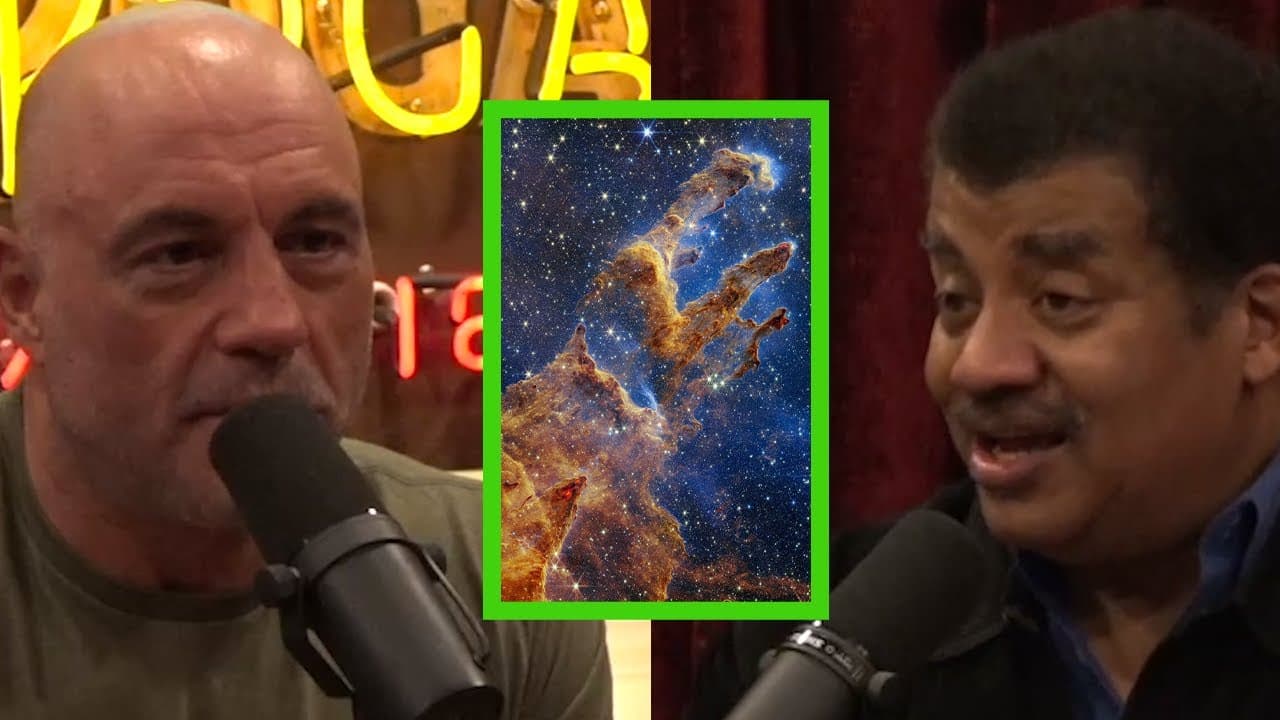
TL;DR
The James Webb Space Telescope enhances our understanding of the universe by refining existing knowledge rather than only making groundbreaking discoveries. Its mission includes discovering more exoplanets and exploring cosmic mysteries, while the concept of a Multiverse suggests the Big Bang is just one event in a larger cosmic framework. Scientific progress is achieved through consistent testing and revision of theories.
Transcript
The Joe Rogan Experience so what has changed in terms of our understanding the the web has been in the in the million mile orbit or however away it is for how long now all right well it got there and then we did some engineering so I I guess a year year and a half yeah and what has changed in our understanding so that's that's been people's first q... Read More
Key Insights
- ❓ The James Webb Space Telescope seeks to expand our cosmic knowledge through incremental advancements rather than groundbreaking discoveries.
- ❓ Exoplanet discoveries, like the first one found in 1995, provide crucial insights into the diversity of planetary systems beyond our solar system.
- 🙈 Scientific progress involves refining existing theories, as seen in the evolution from Newton's laws to Einstein's theory of general relativity.
- 🌥️ The Multiverse concept offers a framework where the Big Bang is a singular event among many in a larger cosmic landscape.
- 🥳 Energy transitions in a false vacuum scenario may explain the birth of universes in a Multiverse framework.
- 🥺 Different universes in a Multiverse could potentially have varied physical laws, leading to potential implications for cosmic exploration.
- ❓ The understanding of scientific theories progresses through consistent testing and refinement, rather than complete overturning of established knowledge.
Install to Summarize YouTube Videos and Get Transcripts
Explore YouTube Video Summarizer or Get YouTube Transcript Extractor
Questions & Answers
Q: How does the James Webb Space Telescope contribute to scientific understanding?
The James Webb Space Telescope focuses on deepening existing cosmic knowledge and improving understanding, aiming to refine current theories rather than revolutionize them.
Q: Why is the discovery of exoplanets significant?
The discovery of exoplanets, like the first one found in 1995, opens up possibilities for understanding planetary systems beyond our solar system and the potential for life elsewhere.
Q: How does the concept of a Multiverse connect with the Big Bang theory?
The idea of a Multiverse suggests that the Big Bang is just one event among many in a larger cosmic framework, indicating the possibility of other universes with different physical laws.
Q: What role does the James Webb Space Telescope play in exploring the concept of a Multiverse?
The telescope's observations could potentially offer insights into the Multiverse theory by uncovering unique phenomena or deviations in physical laws across different regions of space.
Summary
In this video, Neil deGrasse Tyson discusses how our understanding of the universe has deepened with the launch of the James Webb Space Telescope. He explains that while the telescope is expected to make new discoveries, its primary goal is to improve our understanding of the universe by building upon existing knowledge. Tyson also touches on topics like exoplanets, the Big Bang theory, Newton's laws of motion, Einstein's theory of relativity, and the concept of a multiverse.
Questions & Answers
Q: What has changed in our understanding of the universe with the launch of the James Webb Space Telescope?
The James Webb Space Telescope is expected to make great discoveries, but its main focus is to deepen our understanding of the universe by improving upon our existing knowledge. It targets areas of the sky that other telescopes have observed, aiming to advance and deepen our understanding rather than simply making new discoveries.
Q: How was the first exoplanet discovered?
The first exoplanet, known as Planet 1995, was discovered by observing the effect of the planet's gravity on its host star. Instead of directly observing the planet, astronomers measure the star's slight movements caused by the planet's gravitational pull. This method, called the Doppler shift, allows us to indirectly detect exoplanets.
Q: How do scientists improve their understanding of the universe when new discoveries are made?
When new discoveries are made, it doesn't mean that previous ideas are overturned or new things are constantly discovered. Rather, the new discoveries contribute to a deeper understanding of how things work in the universe. Scientists conduct multiple experiments and tests to confirm these discoveries, and they become part of a broader understanding that encompasses previously known information.
Q: Can Newton's laws of motion and gravity coexist with Einstein's theory of general relativity?
Newton's laws of motion and gravity are still accurate and valid within certain limits. Einstein's theory of general relativity expands upon Newton's laws and becomes necessary when dealing with high speeds and significant gravity, such as in the case of objects orbiting close to a massive celestial body like the Sun. Newton's laws become an approximation of Einstein's laws under low-speed and low-gravity conditions.
Q: What are the limits of Einstein's theory of general relativity?
Einstein's theory of general relativity breaks down when dealing with extreme conditions, such as the center of a black hole or the birth of the universe itself. At the center of a black hole, the equations reach a singularity where matter occupies zero volume and has infinite density. This singularity is a limit of Einstein's theory and currently unresolved. Similarly, the theory faces challenges when it comes to explaining the very beginning of the universe, leading scientists to explore new ideas and theories.
Q: Is the Big Bang theory being questioned or challenged?
The Big Bang theory is strongly supported by existing data and evidence, and it's unlikely to be overturned. However, scientists are always looking to deepen their understanding of the universe. While studying the singularity problem and exploring the concept of a multiverse, the idea that our universe is just one among many, some scientists have suggested that the Big Bang may just explain the size and scope of our technology rather than the entire scale of the universe.
Q: What is the Multiverse concept?
The Multiverse concept arises from combining quantum physics, general relativity, and string theory. According to this concept, our universe is just one of an infinite number of universes, some of which may have slightly different laws of physics. This idea suggests that everything that can happen or has happened in our universe has already played out in another universe in an infinite number of ways.
Q: Does the Multiverse concept make the Big Bang a smaller part of a larger whole?
Yes, according to the Multiverse concept, the Big Bang becomes a smaller part of a much larger whole. The Multiverse, which is older than our universe and gives birth to multiple universes, makes the Big Bang just one event among many. Our understanding of the Big Bang and its characteristics, such as the cosmic microwave background radiation, remains intact within this larger framework.
Q: What is the predominant theory behind the Big Bang?
The Multiverse concept offers a possible explanation for the Big Bang by considering the energetics of the system. According to this theory, the energy gained by rolling down energy hills, which exist in higher-dimensional spaces, ends up manifesting as an explosion that gives birth to matter and expands the universe. The idea is that our universe was in a false vacuum state, and its journey out of that state resulted in the Big Bang.
Q: What happens when energy is gained by rolling down energy hills in the universe?
When energy is gained by rolling down energy hills within a higher-dimensional space, it can lead to the birth of universes. This concept suggests that the universe we know is just one of many that have been created through this process. The energy gained is thought to manifest as an explosion that gives birth to matter and causes the universe to expand.
Takeaways
This video deepens our understanding of the universe by discussing the James Webb Space Telescope and its role in advancing our knowledge. The conversation delves into concepts like exoplanets, the Big Bang theory, Newton's laws, and Einstein's theory of relativity. It also explores the intriguing idea of a multiverse, where our universe is just one among infinite universes with slightly different laws of physics. Overall, this discussion highlights the continuous quest to improve our understanding of the universe and the interconnectedness of various scientific theories.
Summary & Key Takeaways
-
The James Webb Space Telescope aims to enhance our understanding of the universe by improving existing knowledge rather than solely seeking new discoveries.
-
The telescope has the potential to discover more exoplanets and delve into the mysteries of the universe beyond the Big Bang.
-
Scientific advancements evolve through testing and refining existing theories rather than completely overturning them.
Read in Other Languages (beta)
Share This Summary 📚
Summarize YouTube Videos and Get Video Transcripts with 1-Click
Try YouTube Summary with ChatGPT & Claude or YouTube Transcript Generator
Explore More Summaries from PowerfulJRE 📚






Summarize YouTube Videos and Get Video Transcripts with 1-Click
Try YouTube Summary with ChatGPT & Claude or YouTube Transcript Generator