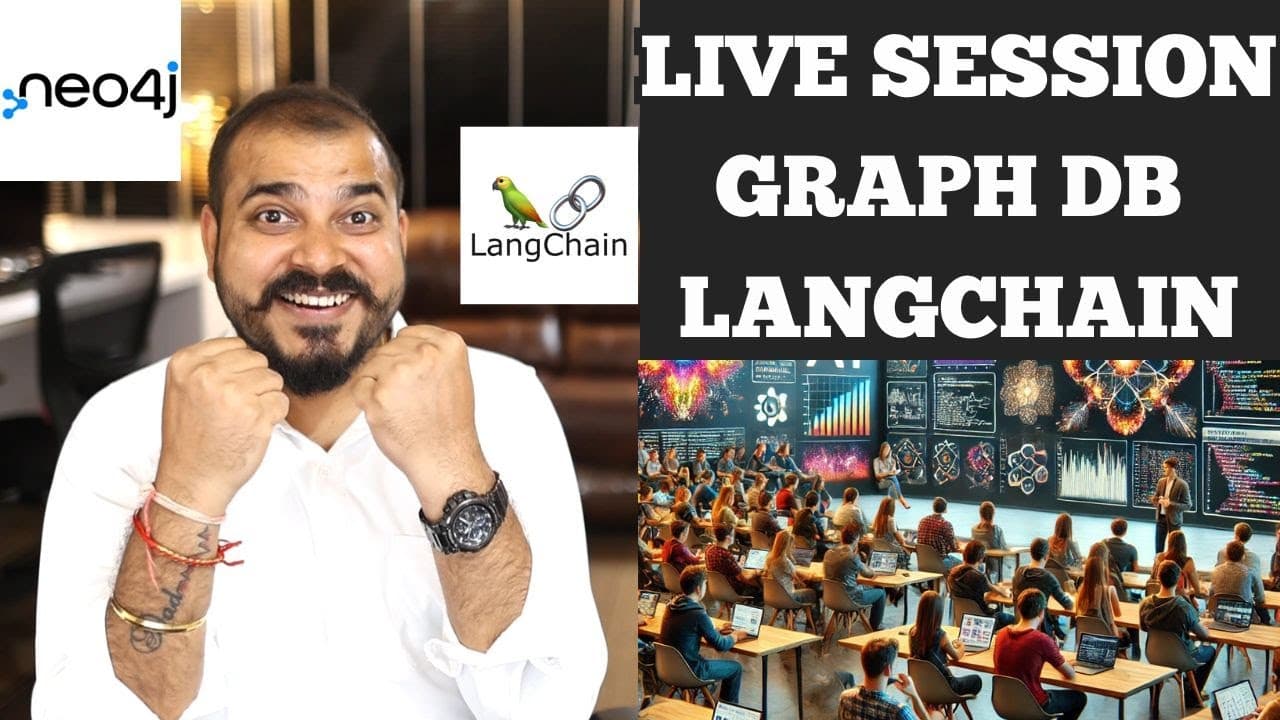
How to build a knowledge graph with LangChain and Neo4j
TL;DR
Knowledge graphs are semantic networks of real world entities and their relationships. The session explains converting specific data into a knowledge graph and storing it in a graph database like Neo4j or similar using LangChain, with end to end RAG project guidance. It also covers topics around graph databases, queries, and practical implementation.
Transcript
hello all my name is krishak and welcome to my YouTube channel so guys uh recently I had conducted a 3 hours live Workshop to explain about graph DB with Lang chain in this entire session we discussed about graph DB we discussed about knowledge graph we also discussed like if you have a specific data how you can actually convert that into a Knowled... Read More
Key Insights
- Knowledge graphs are defined as semantic networks of real world entities, with relationships illustrated between nodes
- Nodes represent objects, places, or people, edges encode relationships, and labels categorize nodes within a knowledge graph
- Edges define the relationships between nodes, enabling rich connections beyond single data points
- Knowledge graphs can derive new relationships by combining existing edges and nodes
- Natural language processing tools can help identify named entities to seed knowledge graphs
- Graph databases like Neo4j store the connected structure of a knowledge graph for fast queries
- LangChain can be used to build end to end AI workflows that interact with graph databases
- This session emphasizes practical, end to end understanding of transforming data into a knowledge graph using LangChain
- More videos from this channel:
- More from this channel: Krish Naik
Install to Summarize YouTube Videos and Get Transcripts
Explore YouTube Video Summarizer or Get YouTube Transcript Extractor
Questions & Answers
Q: How do you define a knowledge graph based on the video content?
A knowledge graph is described as a semantic network of real world entities and events where nodes represent objects such as people or places, edges represent relationships between those nodes, and labels help categorize the nodes. The examples of Rohit Sharma as captain and Rishabh Pant as wicket keeper illustrate how relationships like captain or keeper are encoded as edges linking entities.
Q: What are the core components of a knowledge graph according to the session?
The core components are nodes, edges, and labels. Nodes are the objects, places, or people involved. Edges describe the relationships between nodes, and labels are used to categorize or describe the types of nodes in the graph. This structure allows complex interconnections to be represented and queried.
Q: Why would you store a knowledge graph in a graph database like Neo4j?
Storing in a graph database enables efficient traversal of relationships and quick querying across connected data. The session shows how converting raw data into a knowledge graph and then persisting it in a graph database like Neo4j makes it feasible to explore indirect connections and derive insights from large, interconnected datasets.
Q: What practical workflow is demonstrated for building a knowledge graph?
The workflow involves taking data or sentences, extracting entities and relationships, forming nodes and edges, applying labels for categorization, and then storing the resulting graph in a graph database. LangChain is used to integrate AI workflows and end to end Rag projects for practical implementation.
Q: How does LangChain fit into building a knowledge graph with graph databases?
LangChain is used to connect AI capabilities with graph databases, enabling end to end workflows that create, query, and reason over knowledge graphs. It supports practical implementation by coordinating data extraction, graph construction, and AI driven processing within a cohesive pipeline.
Q: What examples are used to illustrate knowledge graph concepts in the video?
Examples include relationships in cricket such as Rohit Sharma being the captain of the Indian cricket team and Rishabh Pant as the wicket keeper. These simple sentences are used to illustrate how entities become nodes and relationships like captain or keeper become edges in a knowledge graph.
Q: What topics are covered in the session’s agenda?
The agenda covers understanding knowledge graphs, introducing the Neo4j graph database, discussing Cypher query language, and exploring graph databases with LangChain. The session promises in depth intuition and practical implementation of these topics with a focus on end to end understanding.
Q: What is the intended outcome of the live session on graph databases with LangChain?
The intended outcome is to equip attendees with practical knowledge on converting data into knowledge graphs, storing them in a graph database, and building end to end Rag projects using LangChain. The session aims to be interactive and useful for those wanting to implement these concepts in real projects.
Summary & Key Takeaways
-
The talk defines knowledge graphs as semantic networks of real world entities and relationships, illustrated with simple examples such as players and roles in cricket. It shows how sentences can be decomposed into nodes, edges and labels to form a graph. The approach scales with large data by connecting many related entities.
-
Neo4j and other graph databases are introduced as storage backends for knowledge graphs, enabling efficient querying and relationship traversal. The session demonstrates practical steps from data to a connected graph, emphasizing end to end implementation with LangChain for AI workflows.
-
The agenda covers foundational concepts, graph databases, Cypher query language, and LangChain integration to build multiple AI agents, with an emphasis on hands on, practical understanding and potential future live sessions for deeper learning.
Read in Other Languages (beta)
Share This Summary 📚
Summarize YouTube Videos and Get Video Transcripts with 1-Click
Try YouTube Summary with ChatGPT & Claude or YouTube Transcript Generator
Explore More Summaries from Krish Naik 📚


Summarize YouTube Videos and Get Video Transcripts with 1-Click
Try YouTube Summary with ChatGPT & Claude or YouTube Transcript Generator