10 Bizarre Deep Space Astronomical Objects
TL;DR
The universe is filled with strange deep space objects like moonmoons and rogue planets, while phenomena like the anti-matter fountain and Thorne-Zytkow objects remain hypothetical. There are also mysterious cases, such as the double quasar and Hoag's Object, that challenge our understanding of space.
Transcript
The universe is full of both verified and hypothesized objects that do not fit neatly into the humdrum world of standard classes of planets, moons, galaxies and well understood phenomena. So here are ten bizarre deep space astronomical objects that have either been discovered, or may well exist out there somewhere amongst the stars. Number 10. Moon... Read More
Key Insights
- 🥮 Moonmoons, or moons having their own moons, are a possible phenomenon that has yet to be observed but is deemed likely to exist.
- 🪐 Rogue planets, planets ejected from star systems, may have environments conducive to life despite their free-floating nature.
- ⛲ The anti-matter fountain, a mysterious phenomenon at the center of the galaxy, spews out positrons that annihilate upon contact with normal matter.
- 👾 The double quasar demonstrates the bending of space-time and the phenomenon of gravitational lensing.
- 🤩 Omega Centauri challenges our understanding of star clusters, potentially representing a nucleus of a cannibalized galaxy.
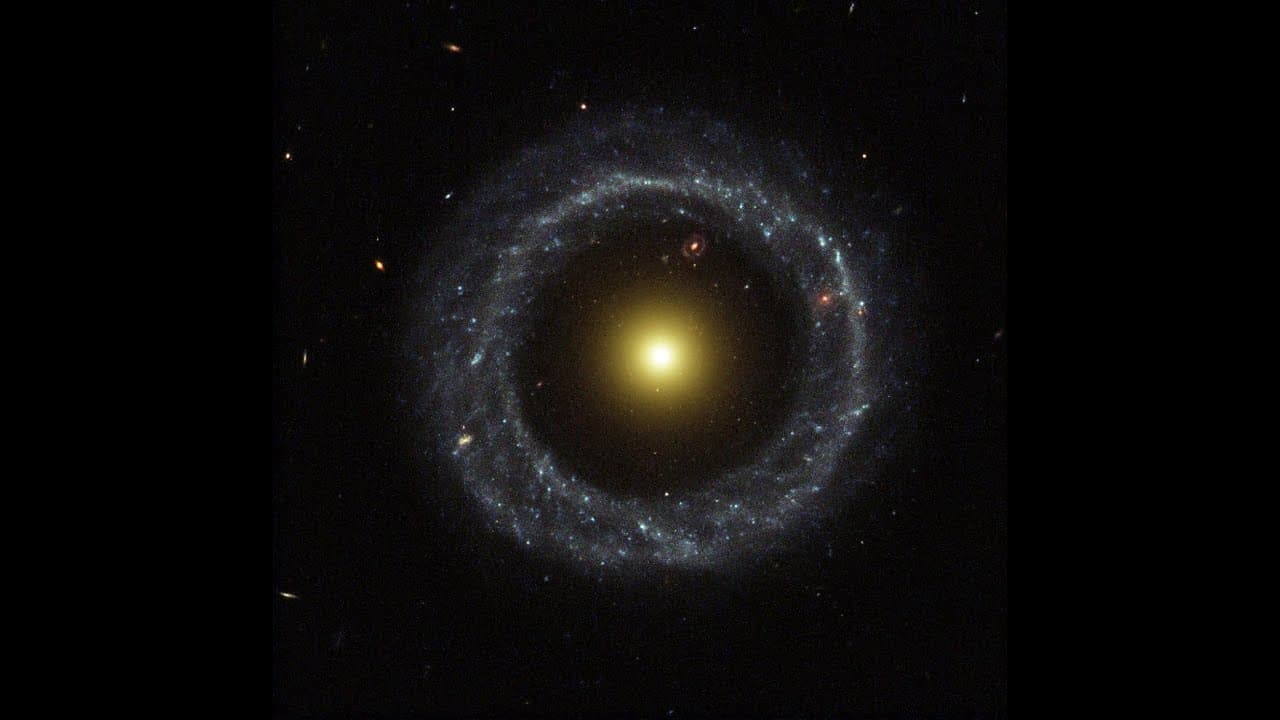
- 💁 Hoag's Object is a uniquely structured galaxy with an unknown origin, furthering our understanding of galactic formations.
- 🤩 SN2006gy and Eta Carinae are massive stars capable of creating hypernovas, which differ from typical supernovas and may provide spectacular celestial displays.
- 🤩 Thorne-Zytkow objects, while theoretical, offer a potential explanation for neutron star collisions with giant stars and the creation of different types of supernovas.
- 🤨 Stephan's Quintet raises questions about redshift and the interpretation of quasars, exploring the limits of our understanding.
Install to Summarize YouTube Videos and Get Transcripts
Explore YouTube Video Summarizer or Get YouTube Transcript Extractor
Questions & Answers
Q: Can a moon have its own moon?
While no example has been discovered, the concept of moonmoons, where a moon has its own moon, is possible. Saturn's moon Rhea and its potential ring system provide evidence for the existence of moonmoons.
Q: What are rogue planets?
Rogue planets are planets that have been ejected from their star systems due to instabilities. These free-floating planets may harbor life, potentially sustained by geothermal heating.
Q: How do Thorne-Zytkow objects form?
Thorne-Zytkow objects form when a neutron star collides with a giant star, resulting in a collapse into a black hole or the creation of a more massive neutron star.
Q: What makes Hoag's Object unique?
Hoag's Object has a core of older stars, a large gap, and a blue outer ring. Its origin remains a mystery, with potential explanations including a specific encounter with another galaxy or instability in barred galaxies.
Q: What is the significance of Stephan's Quintet?
Stephan's Quintet initially raised questions about red shift, but further investigation revealed an optical illusion. However, another mystery arose when a quasar in the same group appeared to interact with one of the galaxies.
Q: Could there be diamond planets?
Carbon-rich planets, potentially with surfaces made of graphite and diamond, have been hypothesized. While one candidate has been identified, no diamond planets have been confirmed.
Summary & Key Takeaways
-
Moonmoons: A moon having its own moon, known as a moonmoon, is a possibility, and Saturn's moon Rhea may have had a stable moonmoon in the past.
-
Rogue Planets: Rogue planets are free-floating planets ejected from their star systems, and they may harbor life due to geothermal heating.
-
The Anti-Matter Fountain: The center of our galaxy emits positrons, which annihilate on contact with normal matter, but the origin of this phenomenon is unknown.
-
The Double Quasar: Initially mistaken for two quasars, it was later discovered that it was one quasar gravitationally lensed by a foreground galaxy, confirming Einstein's theory of space-time warping.
-
Omega Centauri: This star cluster, unlike typical globular clusters, has millions of stars, a varied profile, and is spinning. It may be the core of another galaxy that the Milky Way cannibalized.
-
Hoag's Object: This unique galaxy has a core of older stars, a large gap, and a blue outer ring, but its origin remains unknown, with possibilities including a specific encounter or instability in barred galaxies.
-
SN2006gy: A hypernova, estimated to be 100 times more powerful than a normal supernova, exploded in 2006. Massive stars undergoing this type of supernova are entirely blown up, and Eta Carinae could be the next.
-
Thorne-Zytkow Objects: These theorized objects form when a neutron star collides with a giant star, potentially resulting in a black hole or a more massive neutron star.
-
Stephan's Quintet: This group of galaxies initially raised questions about red shift, but further investigations revealed optical illusions and a quasar potentially interacting with one of the galaxies.
-
Diamond Planets: Carbon-rich planets, potentially with surfaces made of graphite and diamond, have been hypothesized, but none have been confirmed. These planets may have diamond volcanoes and lack water.
Read in Other Languages (beta)
Share This Summary 📚
Summarize YouTube Videos and Get Video Transcripts with 1-Click
Try YouTube Summary with ChatGPT & Claude or YouTube Transcript Generator
Explore More Summaries from John Michael Godier 📚
Summarize YouTube Videos and Get Video Transcripts with 1-Click
Try YouTube Summary with ChatGPT & Claude or YouTube Transcript Generator