How to Get ChatGPT-5 Ready: Prompting Principles for o3, Claude Opus 4, and Gemini 2.5 Pro
TL;DR
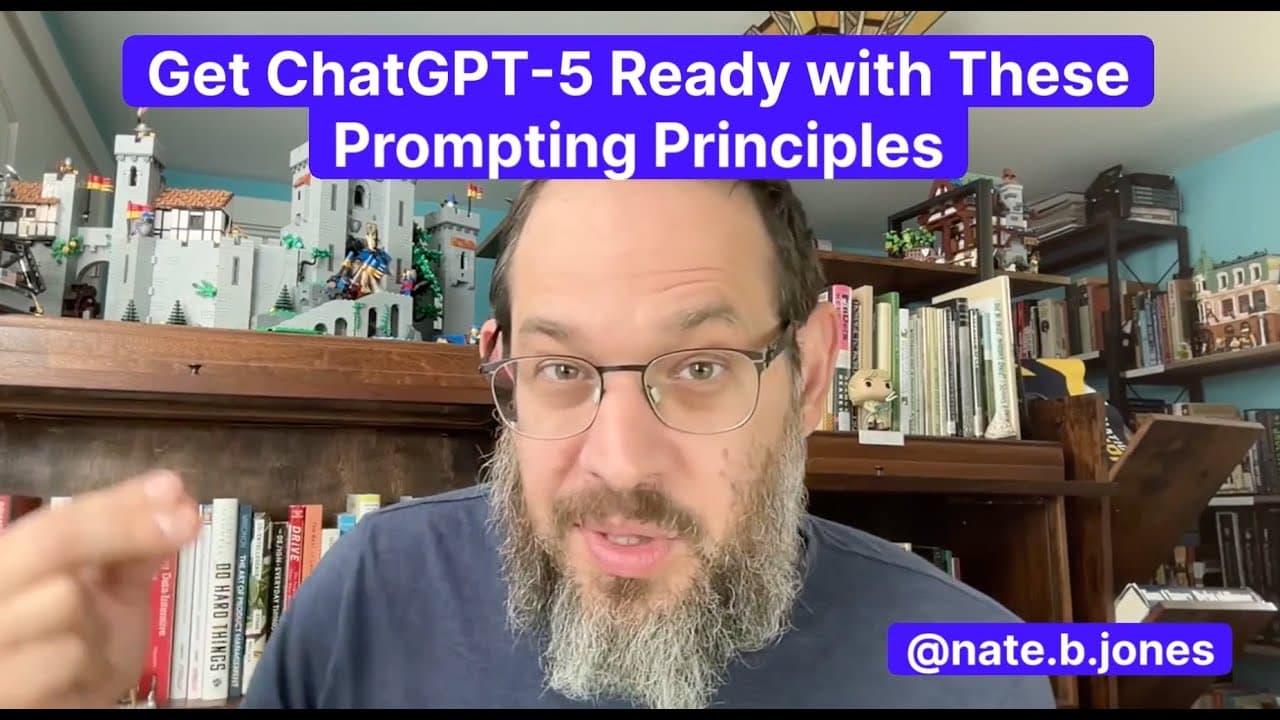
Prompt reasoning models by generating multiple answers and checking consistency, using code for numerical problems, and planning before execution. The presenter recommends moving from GPT-4o to o3, Claude Opus 4, or Gemini 2.5 Pro, then strengthening prompts with guardrails, context positioning, negative examples, and meta-prompting. Read on for eight practical ways to make these techniques work.
Transcript
We're going to do two things today. Number one, we are going to help you into a better model. I sound like a used car salesman, but we're going to get you into a better AI model, and I'm going to explain why it matters. And number two, we're going to talk about the state of prompting, and how prompting with that better model is something that you c... Read More
Key Insights
- The biggest AI upgrade for most people is switching off GPT-4o to a reasoning model. The presenter says o3 is his daily driver, Claude Opus 4 is a great writer that exposes tool use transparently, and Gemini 2.5 Pro is fast with a big context window.
- Self-consistency is a validated technique: ask the model to generate multiple responses to the same question, then check them for consistency. Producing extra solutions is cheap for reasoning models, and cross-checking captures the reflection benefit and reduces random incorrect answers.
- Program-of-thought means asking the model to solve a problem with math or code rather than prose. Instead of 'explain how you solve this', say 'write a function to solve this' so it calls a tool like Python, which makes it much more accurate with numbers.
- Plan-and-solve asks the model to create a step-by-step plan before executing. The presenter uses it for writing and software work, laying out the model's thinking first so he can critique it, which he says makes a big difference.
- Guardrails and edge cases matter more than the happy path. You must specify fallbacks like 'if unable to X, then do Y' and output structure. The presenter notes Claude's system prompt is roughly 90% guardrails and edge cases.
- Context positioning exploits that attention is not uniform. Put critical instructions in the first 10% of the prompt, place examples and data in the middle, and reiterate key constraints at the end, since the model takes the start and end most seriously.
- Negative examples are more critical than positive ones. Showing failure modes explicitly, like 'never use phrases such as in conclusion', teaches the model what bad looks like, though these should be couched inside a general statement of behavior to avoid.
- Meta-prompting uses the fact that models know themselves better than we know them. Techniques include a self-improvement loop ('how would you improve this prompt to get better results from you?') and an uncertainty check asking what parts are unclear or ambiguous.
Install to Summarize YouTube Videos and Get Transcripts
Explore YouTube Video Summarizer or Get YouTube Transcript Extractor
Questions & Answers
Q: How should you prompt reasoning models like o3 and Claude Opus 4?
Ask the model to generate multiple answers and check their consistency, use math or code when solving numerical problems, and create a step-by-step plan before execution. Strengthen the prompt with explicit guardrails, deliberate context positioning, negative examples, and meta-prompting.
Q: Which reasoning models does the presenter recommend instead of GPT-4o?
The presenter recommends OpenAI o3, Claude Opus 4, and Gemini 2.5 Pro. He uses o3 as his daily driver, describes Claude Opus 4 as a strong writer and reader, and says Gemini 2.5 Pro works fast and has a large context window.
Q: What is the self-consistency prompting technique?
Self-consistency means asking a model to produce several answers to the same question and then check them against one another. The presenter suggests generating five definitions or five solutions because comparison helps capture the reflection benefit of a reasoning model and reduce random incorrect answers.
Q: How does program-of-thought improve numerical accuracy?
Program-of-thought asks the model to solve a problem with math or code instead of relying on a prose explanation. For example, request a function and tell the model to call a tool; o3, Claude Opus 4, and Gemini 2.5 Pro can write Python code, which the presenter says makes them much more accurate with numbers.
Q: What is the plan-and-solve prompting workflow?
Ask the model to create a step-by-step plan before it begins executing the task. The presenter uses this approach for writing and software work, reviewing and critiquing the proposed thinking before proceeding.
Q: Why should prompts include guardrails and edge cases?
A prompt should explain what to do when the normal path fails, such as “if unable to X, then do Y.” It should also define fallbacks and the required output structure; the presenter notes that Claude’s system prompt is roughly 90% guardrails and edge cases.
Q: Where should critical instructions appear in a prompt?
Place critical instructions in the first 10% of the prompt, examples and data in the middle, and repeated key constraints at the end. The presenter says attention is not uniform and that models take the beginning and end most seriously.
Q: What is meta-prompting, and how can you use it?
Meta-prompting means asking the model to help improve the instructions given to it. You can ask how it would revise a prompt for better results or ask which parts are unclear or ambiguous and what assumptions it is making.
Summary & Key Takeaways
-
The video has two goals: get viewers onto a better AI model and distill the state of prompting into a few memorable, tested principles. The presenter researched guides from Anthropic, Google, OpenAI, and third parties to extract only techniques that are easy to remember and make a measurable difference.
-
The core move is abandoning GPT-4o for a reasoning model, with o3, Claude Opus 4, and Gemini 2.5 Pro all named as strong choices. The presenter argues that getting the 95% of people off GPT-4o would significantly improve collective perception of what AI can do.
-
Three evidence-based techniques are self-consistency, program-of-thought, and plan-and-solve. Three structural principles are guardrails and edge cases, context positioning, and negative examples. The final unlocking insight is meta-prompting: having the better model reveal what it knows to improve your prompts.
Read in Other Languages (beta)
Share This Summary 📚
Summarize YouTube Videos and Get Video Transcripts with 1-Click
Try YouTube Summary with ChatGPT & Claude or YouTube Transcript Generator
Explore More Summaries from AI News & Strategy Daily | Nate B Jones 📚






Summarize YouTube Videos and Get Video Transcripts with 1-Click
Try YouTube Summary with ChatGPT & Claude or YouTube Transcript Generator