What Does Google's Quantum Error Milestone Mean?
TL;DR
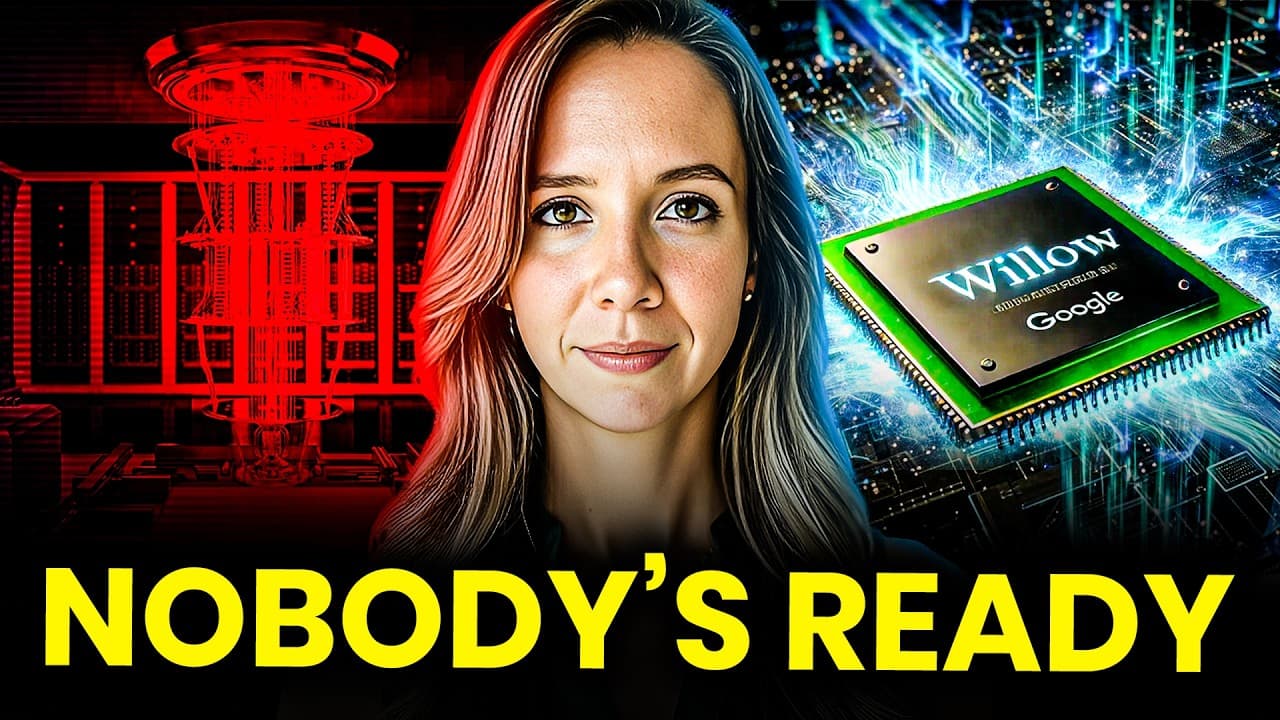
Below-threshold quantum error correction means that enlarging an encoded qubit can reduce errors instead of multiplying them, turning fault-tolerant quantum computing into a more concrete engineering challenge. The account predicts major opportunities in optimization, materials, medicine, and climate technology, while urging businesses to prepare for encryption risks, energy demands, unequal access, and possible workforce disruption.
Transcript
February 9th, 2026. While you were scrolling through social media, Google just quietly crossed a threshold that changes everything. And I mean everything. They didn't just make a faster chip. They didn't just add more cubits. They solved a problem that physicists have been calling impossible for decades. And here's what terrifies me. Most people ha... Read More
Key Insights
- Below-threshold quantum error correction is the point where adding more physical qubits to an encoded logical qubit reduces errors instead of creating additional failures. The reported experiment therefore reframes fault-tolerant quantum computing as a scaling and engineering challenge rather than an unresolved theoretical possibility.
- Google's reported scaling result is that moving from 3x3 to 5x5 and then 7x7 qubit grids cut errors in half at each step. One logical qubit also survived twice as long as the best single physical qubit from which it was constructed.
- The immediate competitive phase is described as a 2026–2027 race among major technology companies to scale qubit counts while maintaining low error rates. Below-threshold performance gives laboratories a clearer mathematical roadmap for estimating the resources required for future breakthroughs.
- Quantum advantage is projected to reach practical applications during 2027–2028, particularly in financial modeling, pharmaceutical research, materials design, logistics, superconductors, carbon-capture catalysts, and encryption. The defining benefit would be solving selected problems that classical supercomputers cannot practically handle.
- The quantum divide is projected to emerge during 2028–2030 as early adopters gain capabilities in optimization, materials science, and drug discovery that classical competitors cannot match. The account argues that access to superior computation could create a more rigid competitive gap than AI adoption.
- The energy paradox is that quantum processors may help address climate and infrastructure problems while requiring substantial electricity for cooling near absolute zero. Early cooling systems can consume more energy than computation, raising questions about grid capacity if corporate quantum demand expands.
- Current encrypted information is portrayed as vulnerable to harvest-now, decrypt-later attacks, in which adversaries collect protected data for future decryption. Businesses using RSA, ECC, or other vulnerable systems are therefore advised to plan migration toward the already published NIST quantum-safe standards.
- The practical preparation strategy is to audit encryption, locate optimization problems currently handled with heuristics or approximations, and begin learning about quantum providers. These actions target both defensive cybersecurity needs and commercial opportunities created by previously unaffordable exact computation.
Install to Summarize YouTube Videos and Get Transcripts
Explore YouTube Video Summarizer or Get YouTube Transcript Extractor
Questions & Answers
Q: What is below-threshold quantum error correction?
Below-threshold quantum error correction occurs when adding more physical qubits to encode a logical qubit lowers the overall error rate rather than increasing it. The transcript compares this process to multiple people passing a message and correcting individual mistakes. Crossing the threshold suggests that larger encoded systems can become more reliable, making fault-tolerant quantum computing a concrete scaling challenge.
Q: What result did Google's quantum experiment reportedly achieve?
Google's team reportedly expanded encoded qubit grids from 3x3 to 5x5 and then 7x7 while cutting errors in half at each scaling step. The account also says one logical qubit lived twice as long as the best individual physical qubit used to build it. These results are presented as evidence that the system operated below the quantum error-correction threshold.
Q: Why does the quantum error threshold matter?
The threshold matters because quantum hardware is extremely sensitive to disturbances, and adding qubits can introduce coordination overhead and additional errors. If larger error-correcting structures instead become more reliable, researchers gain a workable path toward fault-tolerant machines. The remaining problem then becomes scaling from the demonstrated logical qubit to the thousands described as necessary for practical applications.
Q: Which industries could benefit first from quantum computing?
The first commercial applications are expected in financial modeling and risk assessment, pharmaceutical research and development, advanced materials design, logistics, and supply-chain optimization. Other proposed uses include climate modeling, battery development, power-grid management, room-temperature superconductors, and carbon-capture catalysts. These areas share computational problems that are described as too complex or expensive for current classical systems.
Q: How could quantum computing threaten current encryption?
The account warns that sufficiently capable quantum computers could break encryption systems protecting bank accounts, medical records, and private messages. It specifically advises organizations using RSA, ECC, or other quantum-vulnerable systems to plan migration toward quantum-safe alternatives. The urgency comes from harvest-now, decrypt-later attacks, where adversaries store encrypted information today for possible decryption once stronger quantum systems arrive.
Q: What is the projected three-phase quantum timeline?
Phase one, covering 2026–2027, is described as a scaling race focused on increasing qubit counts while controlling errors. Phase two, during 2027–2028, brings practical quantum advantage for problems beyond classical supercomputers. Phase three, during 2028–2030, creates a quantum divide between organizations that integrate these capabilities and those unable to compete with their computational advantages.
Q: Why could quantum computing create an energy problem?
Quantum processors described in the transcript operate at a fraction of a degree above absolute zero, requiring cooling systems that can consume more electricity than the computation itself. Although some small systems may use less power than supercomputers for specific tasks, widespread corporate adoption could increase demand for quantum data centers and raise questions about grid capacity, climate effects, and access.
Q: How should businesses prepare for quantum computing?
Businesses should first audit encryption systems and plan migration away from quantum-vulnerable methods such as RSA and ECC. They should then identify problems where exact solutions are currently too expensive and heuristics or approximations are necessary. Finally, they should build quantum knowledge and relationships with providers while practical systems are still scaling, especially in optimization-intensive or research-driven industries.
Summary & Key Takeaways
-
Google's reported experiment scaled encoded qubit grids from 3x3 to 5x5 and then 7x7, with errors falling by half at each step. One logical qubit also lasted twice as long as the best individual physical qubit used to construct it, indicating operation below the quantum error-correction threshold.
-
The proposed three-phase timeline begins with a 2026–2027 scaling race, moves to mainstream quantum advantage in 2027–2028, and culminates in a 2028–2030 divide between organizations with and without quantum capabilities. Finance, pharmaceuticals, materials, logistics, encryption, climate technology, and power-grid optimization are presented as major application areas.
-
Businesses are advised to audit encryption, identify computational bottlenecks, and develop relationships with quantum providers. The account warns that RSA, ECC, and similar systems may be vulnerable, while cooling requirements could strain electricity grids. Preparation should begin while practical machines still require scaling from one logical qubit to thousands.
Read in Other Languages (beta)
Share This Summary 📚
Summarize YouTube Videos and Get Video Transcripts with 1-Click
Try YouTube Summary with ChatGPT & Claude or YouTube Transcript Generator
Explore More Summaries from Julia McCoy 📚

Summarize YouTube Videos and Get Video Transcripts with 1-Click
Try YouTube Summary with ChatGPT & Claude or YouTube Transcript Generator