What Is an Over-Engineered Magnetic Encoder Potentiometer?
TL;DR
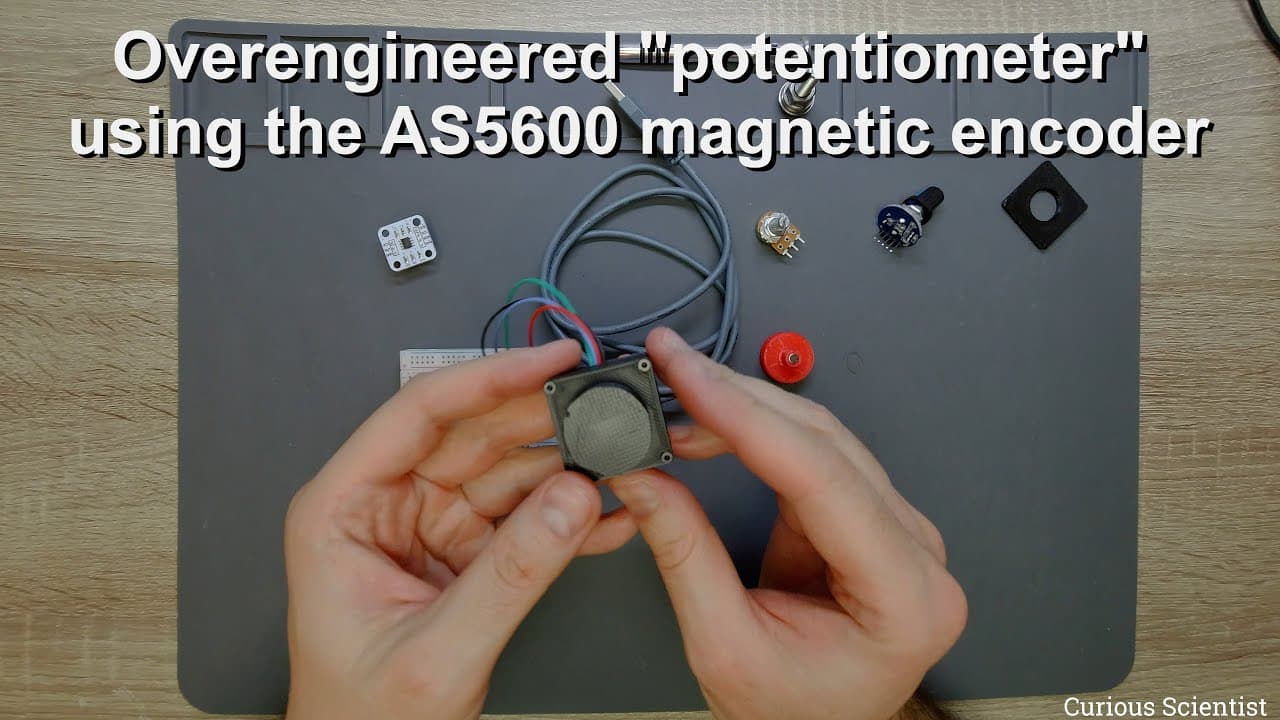
An over-engineered magnetic encoder functions similarly to a potentiometer by providing an absolute position reference using magnetic fields, allowing for precise 360-degree rotation with a resolution of 0.087 degrees. It utilizes a diametrically magnetized magnet and a 12-bit AD converter for accurate readings, making it suitable for various applications, particularly in projects involving Arduino.
Transcript
welcome everyone in this video i'm going to show you an over-engineered potentiometer which is technically not a potentiometer but an encoder but it can be used in the same fashion as a potentiometer but i will guide you to the differences between an encoder and a potentiometer so you will see how this thing can be applied and the subject of this v... Read More
Key Insights
- ✋ The magnetic encoder provides a unique solution that combines the benefits of both absolute and relative encoders, offering continuous rotation and high precision.
- 👻 It distinguishes itself with a compact design, featuring only a few essential components, allowing for efficient production and small form factors in applications.
- 🥅 Understanding the fundamental differences between potentiometers and encoders helps in selecting the appropriate device for specific projects and goals.
- 🎨 The circuit design and assembly process are simplified through 3D printing technology, enhancing accessibility for hobbyists and engineers alike.
- 🚙 With Arduino compatibility, the encoder can facilitate programming for various automation tasks, thereby expanding its utility across different domains.
- 🐿️ The need for a well-defined gap between the magnet and the chip emphasizes the importance of precision in the physical design of electronics.
- 👨💻 Thorough documentation and code availability on the creator's website encourage knowledge sharing within the electronics community, promoting further experimentation and innovation.
Install to Summarize YouTube Videos and Get Transcripts
Explore YouTube Video Summarizer or Get YouTube Transcript Extractor
Questions & Answers
Q: What distinguishes a magnetic encoder from a traditional potentiometer?
A magnetic encoder detects position using magnetic fields rather than resistance. While a potentiometer measures variable resistance to determine position, an encoder provides absolute positioning over a 360-degree range, allowing for continuous rotation without end limits. This makes encoders more durable and versatile compared to traditional potentiometers.
Q: How does the encoder in the video achieve high angular resolution?
The encoder features a 12-bit AD converter which divides a full 360-degree rotation into 4096 discrete steps, yielding a resolution of about 0.087 degrees. This high resolution enables users to detect very small rotational movements, making it suitable for applications requiring precise control, such as robotics or fine-tuned adjustments in machinery.
Q: What is the advantage of using a diametrically magnetized magnet with the encoder?
A diametrically magnetized magnet has its north and south poles on the sides rather than the ends, allowing it to maintain a consistent magnetic field as it rotates around the encoder's sensors. This configuration ensures accurate detection of the magnet's position throughout its rotation and enhances the encoder’s performance by avoiding dead zones typical in other magnet types.
Q: How can this encoder design be utilized in practical applications?
The encoder can be paired with an Arduino to control various devices, such as stepper motors or servo actuators, which need precise positioning. It can also be incorporated into user interfaces for volume controls, dials, or other rotational input devices where accurate feedback is essential, making it a versatile component in both DIY and professional electronics projects.
Summary & Key Takeaways
-
The video discusses a unique encoder that operates similar to a potentiometer but utilizes magnetic fields for precise position detection. It provides an absolute reference for the magnet's position, allowing for high resolution and infinite rotation.
-
A detailed explanation of the construction and components is provided, including the use of a diametrically magnetized magnet and the significance of a 12-bit AD converter in determining angular positions with an accuracy of 0.087 degrees.
-
The video concludes by demonstrating the encoder's practicality in various applications, including its integration with Arduino, showcasing how to build the setup and access the necessary software through the creator's website.
Read in Other Languages (beta)
Share This Summary 📚
Summarize YouTube Videos and Get Video Transcripts with 1-Click
Try YouTube Summary with ChatGPT & Claude or YouTube Transcript Generator
Explore More Summaries from Curious Scientist 📚
![Building a Peltier cooler-based cooling box - First iteration, improvements [Part 2/6] thumbnail](/_next/image?url=https%3A%2F%2Fi.ytimg.com%2Fvi%2F0YlNw0EGnzI%2Fhqdefault.jpg&w=750&q=75)
![Building a coil winder [Part 6] - A few improvements thumbnail](/_next/image?url=https%3A%2F%2Fi.ytimg.com%2Fvi%2F3eyxG_g2iUA%2Fhqdefault.jpg&w=750&q=75)

Summarize YouTube Videos and Get Video Transcripts with 1-Click
Try YouTube Summary with ChatGPT & Claude or YouTube Transcript Generator