How to Build a Squirrel-Proof Bird Feeder Obstacle Course

146.5M views
•
May 24, 2020
by
Mark Rober
YouTube video player
How to Build a Squirrel-Proof Bird Feeder Obstacle Course

TL;DR

Store-bought squirrel-proof bird feeders all failed: squirrels opened the wire cage door, unclipped the spring-loaded cage, and hung by a few toes past the baffle. The fix was an eight-part Ninja Warrior style obstacle course guarding the feeder, built over roughly a month with walnuts as bait, since walnuts won a seven-nut taste test all four times.

Transcript

  • This is a bird feeder, and everything to my left is my attempt at making it squirrel-proof. If they want the bird seed, they will first need to pass through what is basically an eight-part "Ninja Warrior" obstacle course for squirrels. This course is extremely challenging. It is not for the timid of heart. But out of the gate, I will admit that i... Read More

Key Insights

  • A wire cage around a bird feeder stops squirrels only until one learns the door opens. The cage was sized so birds could slip inside while squirrels could not reach the food, and it worked well right up until a squirrel opened the door and emptied the tube of seed that same day.
  • Spring-suspended cage feeders work on a weight principle: a light bird landing on the cage keeps the seed ports open, while a heavier squirrel's weight pushes the springs down and covers the ports. Every squirrel attempt produced the same blocked result, at first.
  • The spring feeder's defeat came from unclipping the springs holding the cage up, which locked the cage in its lowered position over the seed ports. That created a new opening at the lid, and since the lid did not hinge open, the squirrel knocked it off entirely instead.
  • A baffle is meant to stop squirrels descending straight down onto the seeds and cannot be ripped off, but a squirrel defeated it by hanging on with just a few toes. That feeder became the squirrels' favorite of the three tested.
  • Relocating the feeder post away from the fence did not help. The squirrels climbed the post directly, shimmied up and down both small and large metal poles, and, more decisively, simply jumped the gap, making pole material irrelevant as a defense.
  • Walnuts were selected as course bait through a repeated test. A buffet of seven different nuts and seeds was set out over the course of a week, and across all four repetitions of the experiment, walnuts were the food the squirrels ate first.
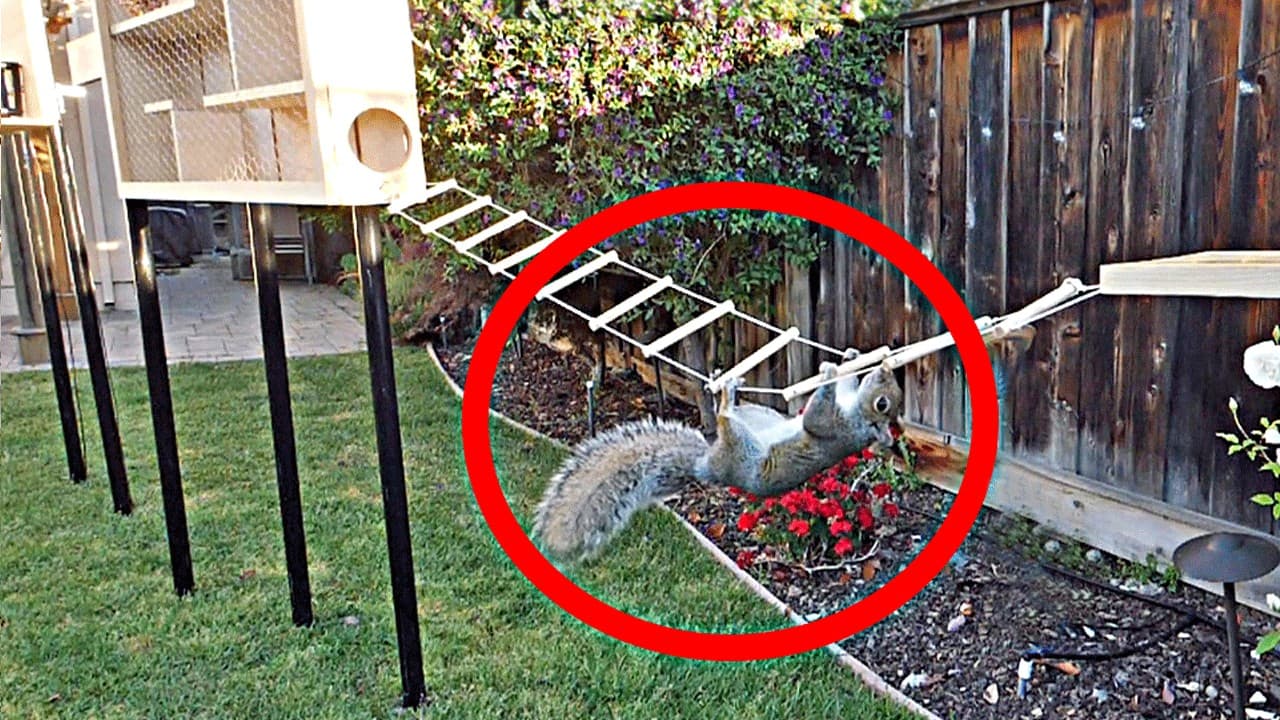
  • The Bridge of Instability is hard because it attaches at only a single point on each end, which from a physics standpoint makes crossing it equivalent to crawling along a tightrope, the same deceptive principle behind a notoriously impossible carnival game.
  • The Homewrecker and the final platform both use a three-second timing rule enforced by a pressure sensor, a microcontroller, a relay, a solenoid, and a pneumatic piston. Lingering too long on the Homewrecker restarts the course, and the piston pressure is adjustable to stay below any harmful launch force.

Install to Summarize YouTube Videos and Get Transcripts

Explore YouTube Video Summarizer or Get YouTube Transcript Extractor

Questions & Answers

Q: Why do squirrel-proof bird feeders fail?

Three commercially sold squirrel-proof feeders each failed for a different reason. The caged model was defeated once a squirrel figured out the door opened, and the whole tube of seed was cleared by the end of that day. The spring-suspended cage model, designed so a squirrel's weight would drop the cage over the seed ports, was defeated when a squirrel unclipped the springs and then knocked the lid off. The baffle model, meant to prevent a straight descent onto the seeds and built so the baffle could not be ripped off, was defeated by a squirrel hanging on by a few toes.

Q: How does a spring-loaded squirrel-proof bird feeder work?

It has an outer cage suspended by springs around the seed tube. When a bird lands on the cage, its weight is low enough that the springs hold the cage in its raised position and the seed ports stay exposed, so the bird can feed. When a heavier squirrel grabs onto the cage, its weight forces the springs down, which shifts the cage into a lowered position that covers all the seed ports and blocks access. In testing, the mechanism worked exactly as intended: birds fed normally, and every squirrel attempt produced the same blocked result.

Q: What are the eight obstacles in the squirrel Ninja Warrior course?

In order, they are the Bridge of Instability, which attaches at a single point on each end so crossing it is physically like a tightrope; the Maze of a Thousand Corridors, a more cerebral challenge; the Pitchfork Tumblers of Treachery, inspired by the show Wipe Out; the Homewrecker, a timed distraction platform; the Slinky Bridge of Deception, which suspends a walnut in the middle of a bridge that cannot support a squirrel's weight; the Tourist Trap, a painted photo-op board with a walnut incentive; the Quad Steps of Great Elevation, four smooth pads set at a 45-degree incline; and the Orbital Assist Platform, also called the Final Countdown.

Q: What food do squirrels prefer most?

Walnuts, based on a repeated preference test run before the course was built. Over the course of a week, a buffet of seven different nuts and seeds was put out, and the experiment was repeated four separate times. Walnuts were always the food the squirrels went for first, in all four repetitions. That result is why walnuts were chosen as the bait throughout the obstacle course, including the walnut suspended in the middle of the Slinky Bridge of Deception, the walnut placed at the Tourist Trap photo op, and the trapdoor release of walnuts below the final bird feeder.

Q: How does the Homewrecker obstacle work?

The Homewrecker is a distraction placed mid-course to tempt a squirrel into losing focus on the prize at the end. Underneath its pad is a pressure sensor, which connects to a microcontroller, which has a relay, which connects to a solenoid, which connects to a pneumatic piston, which connects back to the platform holding the pressure sensor. If a squirrel stands on the pad for more than three seconds, the mechanism triggers and the squirrel has to start the entire course over from the beginning. To pass, the squirrel simply has to not linger.

Q: Is the squirrel obstacle course safe for the animals?

Yes, by design. All of the contraptions are described as squirrel-friendly: the Pitchfork Tumblers, for example, break away and stop spinning under even a little back force, unlike the Wipe Out obstacles that inspired them. For the launching platform, the pressure on the pneumatic piston is adjustable, and it was deliberately set well below any launch force that could hurt the squirrels. The builder notes he has five pets, a child, and a wife who was among the animal lovers likely to be concerned, and states the squirrels who complete the course have earned the right to eat as long as they want.

Q: Why is the Bridge of Instability so difficult to cross?

Because it attaches at only a single point on each end rather than being fixed along its length. From a physics standpoint, that single-point attachment makes crossing it no different from trying to crawl across a tightrope: the bridge rotates freely underneath the squirrel instead of resisting its weight. It is the same deceptive principle behind a carnival game that seems easy but is essentially impossible, which the creator analyzed in a separate video about which carnival games are basically scams and the science behind beating them.

Q: Who are the four squirrels competing on the course?

Rick, who weighs 500 grams as measured on a custom-made scale, is very clever but spooks easily. Marty is basically indistinguishable from Rick in appearance; the two are inseparable and spend nearly all their time together as a pair. Frank comes in at around 500 grams and is described as very gutsy but also kind of dumb. Phat Gus is the creator's personal favorite at 800 grams, charming enough to strike a pose for a camera, and unlike the more particular squirrels who deliberate before selecting and then leap away gracefully, he goes for things hands-free and makes himself comfortable.

Summary & Key Takeaways

  • A bird feeder installed eight weeks earlier turned into a squirrel problem. The first feeder had a wire cage sized to let birds slip in and keep squirrels out, and it worked until a squirrel learned to open the door. That squirrel cleared the whole tube of bird seed by the end of the day, despite the feeder being advertised as squirrel-proof.

  • Two replacement designs also failed. A spring-suspended outer cage was meant to drop under a squirrel's weight and cover the seed ports, and it did, until one squirrel unclipped the springs and then knocked off the lid. A third feeder with a baffle meant to block a straight descent was defeated by a squirrel hanging on by a few toes.

  • The response was an eight-part obstacle course built with a friend named John over roughly a month. Stations include the Bridge of Instability, the Maze of a Thousand Corridors, the Pitchfork Tumblers, the Homewrecker, the Slinky Bridge of Deception, the Tourist Trap, the Quad Steps of Great Elevation, and the Orbital Assist Platform.

  • Four named squirrels attempt the course: Rick at 500 grams, his near-identical companion Marty, the gutsy Frank at around 500 grams, and Phat Gus at 800 grams. Weights come from a custom-made scale. Early runs show Rick failing the Bridge of Instability twice, Marty copying Rick's strategy and nearly succeeding, and all of them mastering the maze quickly.


Read in Other Languages (beta)

Share This Summary 📚

Explore More Summaries from Mark Rober 📚