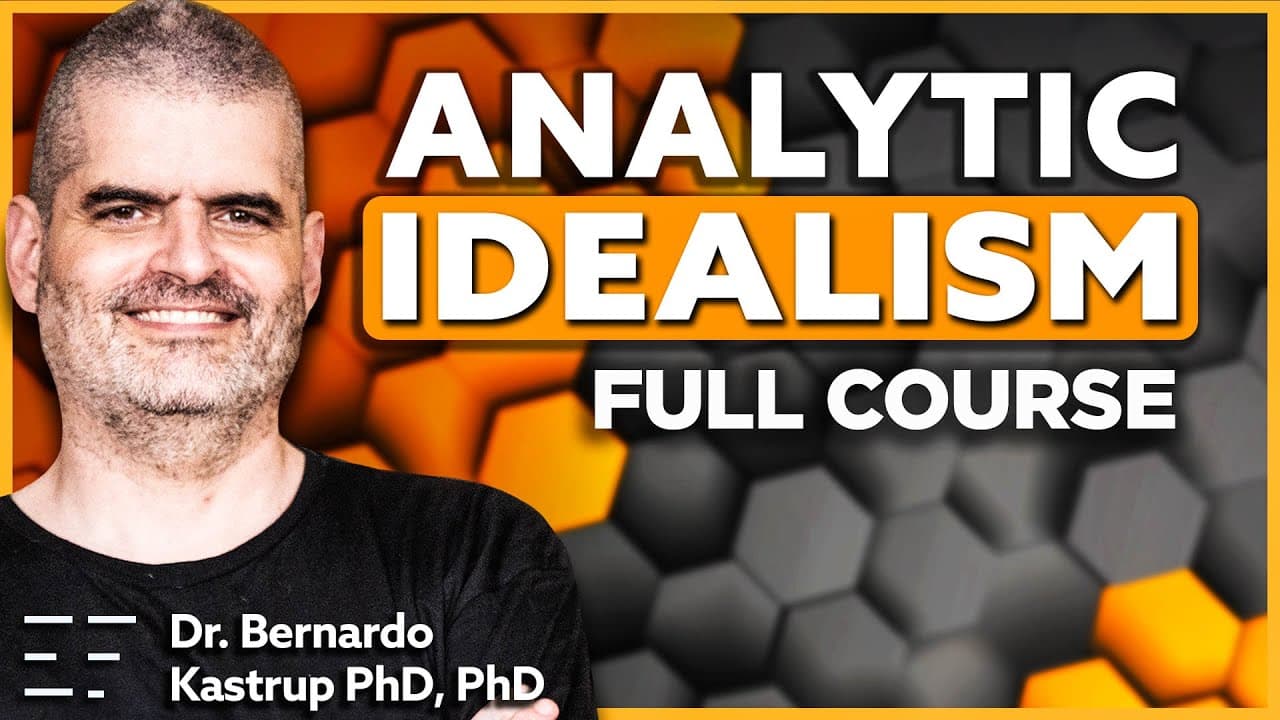
The incoherence of our ordinary intuitions (Part 1) | Analytic Idealism with Bernardo Kastrup
TL;DR
Our ordinary intuition is mistaken: perception does not transparently reveal the world as it is in itself. Bernardo Kastrup introduces two independent, converging lines of argument and begins with entropy, explaining that organisms must spend energy to preserve their structural and dynamical integrity. He contrasts this view with analytic idealism, which proposes that reality is fundamentally mental. Read on to understand why perception may be an encoded interface rather than a window.
Transcript
welcome everyone to the essentia foundation course on analytic idealism this is a course with several parts several modules if you wish we will start today with module one which is about our ordinary intuitions about what the world is and how we relate to it and we will look at how these intuitions have been disproven by the latest understanding co... Read More
Key Insights
- 💝 Our ordinary intuitions about the world as physical are disproven by the latest understanding from neuroscience, analytic philosophy, and evolutionary theory.
- ❓ Mainstream physicalist metaphysics is criticized for being incoherent, conceptually parsimonious, and empirically inadequate.
- 🤯 Analytic idealism proposes that the world is fundamentally mental, existing in an extended mind, and presents an alternative to mainstream physicalist metaphysics.
- 🌍 Perception is not a transparent window into the world, but an encoded and inferential representation.
- ❓ Instruments and technology enhance our perception, but they still rely on the paradigm of the dashboard or the interface.
- 👾 Space and time may not be objective dimensions of the world, but rather part of the dashboard paradigm of perception.
- 👋 Our perception is evolutionary best guesses that help us survive, but they are not literal representations of reality.
Install to Summarize YouTube Videos and Get Transcripts
Explore YouTube Video Summarizer or Get YouTube Transcript Extractor
Questions & Answers
Q: Why are our ordinary intuitions about reality incoherent?
Our ordinary intuition treats perception as a transparent window that reveals the external world as it is in itself. Kastrup says this cannot be true and introduces at least two independent but converging lines of argument, beginning with one based on entropy.
Q: Does perception show the world as it is in itself?
According to Kastrup, it does not. The colors, shapes, sounds, smells, and tangible objects on the screen of perception should not be assumed to disclose reality exactly as it exists independently of us.
Q: How does entropy challenge the idea that perception is transparent?
If perception transparently mirrored the world, our internal perceptual states would have to reflect the enormous variety and dispersion of external states. Kastrup argues that this internal dispersion would undermine our ability to maintain structural integrity, leaving us to dissolve into an entropic soup.
Q: Why does the body need energy to remain alive?
The body must preserve its structural and dynamical integrity instead of allowing its components to mix freely. Kastrup uses the example of the liver and lungs remaining distinct and says that eating and breathing provide the energy required for this local resistance to increasing entropy.
Q: What does the coffee-and-milk example explain about entropy?
Coffee and milk spontaneously mix, but they do not spontaneously separate again. Kastrup uses this example to illustrate the tendency for an initially ordered state, separate coffee and milk, to become more disordered.
Q: What is analytic idealism?
Analytic idealism is the metaphysical hypothesis that the world is fundamentally mental. It does not place reality solely in one person's mind; instead, it proposes an extended, transpersonal, natural mind whose experiential contents present themselves as the physical or material world.
Q: How does the course evaluate physicalism and constitutive panpsychism?
The course says mainstream physicalism is arguably incoherent, conceptually unparsimonious, poor in explanatory power, and empirically inadequate. It later examines constitutive panpsychism and argues that it is physically incoherent, among other shortcomings.
Q: What is the difference between consciousness and metaconsciousness?
Phenomenal consciousness means having experience, while metaconsciousness is a higher-level, self-reflective or metacognitive function built on top of experience. Kastrup says philosophers and neuroscientists often conflate the two, creating confusion.
Summary & Key Takeaways
-
The course explores our ordinary intuitions about the world and how they have been disproven by neuroscience, analytic philosophy, and evolutionary theory.
-
It argues that mainstream physicalist metaphysics is incoherent, conceptually inadequate, and empirically insufficient.
-
It presents alternative hypotheses, including constitutive panpsychism and analytic idealism, which proposes that the world is fundamentally mental.
Read in Other Languages (beta)
Share This Summary 📚
Summarize YouTube Videos and Get Video Transcripts with 1-Click
Try YouTube Summary with ChatGPT & Claude or YouTube Transcript Generator
Explore More Summaries from Essentia Foundation 📚
Summarize YouTube Videos and Get Video Transcripts with 1-Click
Try YouTube Summary with ChatGPT & Claude or YouTube Transcript Generator