What Is the Friedel-Crafts Acylation Mechanism?
TL;DR
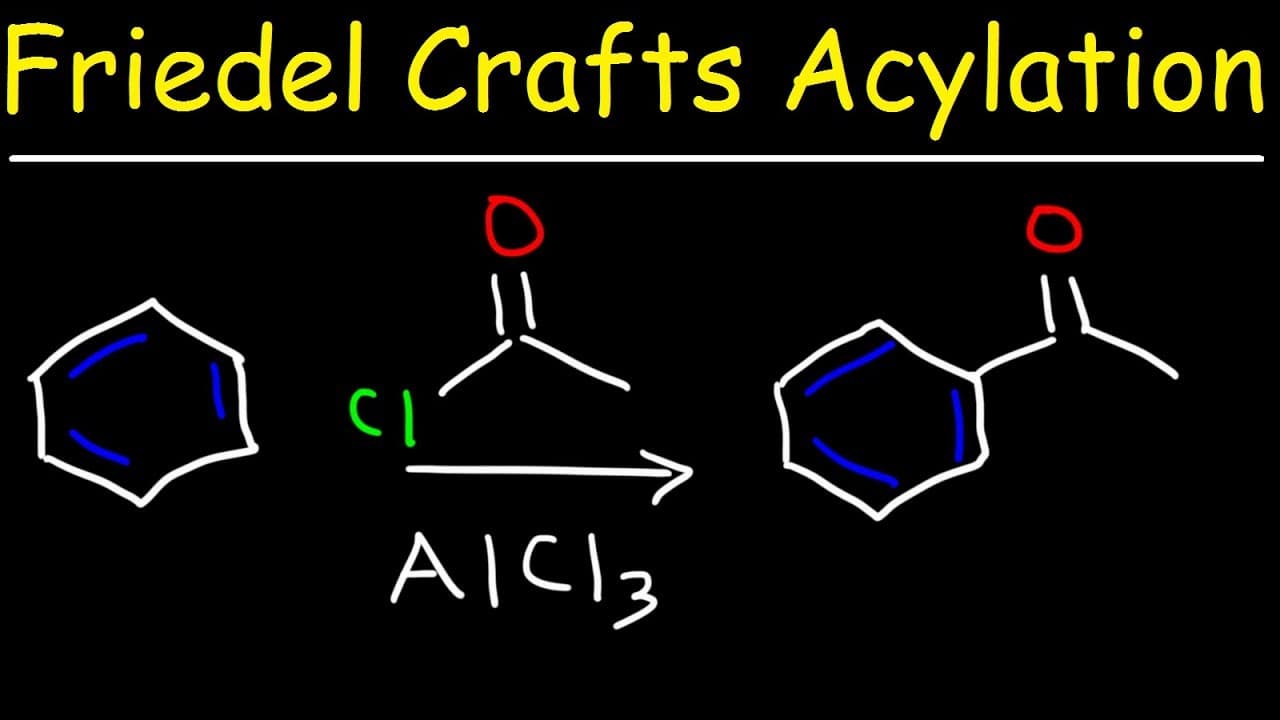
The Friedel-Crafts acylation mechanism involves reacting a benzene ring with an acid chloride in the presence of a Lewis acid catalyst like aluminum chloride. The reaction generates an acylium ion, which then interacts with benzene to form acetophenone. To finalize the reaction, water is added to remove the Lewis acid catalyst, enabling potential reduction of the ketone product through various methods.
Transcript
in this video we're going to focus on the frito crafts isolation reaction mechanism so let me give you an overview of this reaction so here we have the benzene ring and we're going to react it with an acid chloride let's use acetyl chloride as our example and we need to catalyze the reaction with a lewis acid so the lewis acid catalyst that we're u... Read More
Key Insights
- 😋 The Friedel-Crafts isolation reaction involves the reaction of a benzene ring with an acid chloride and a Lewis acid catalyst, followed by the addition of water to obtain a ketone product.
- 💁 The reaction proceeds through the formation of an acylium ion intermediate, which is stabilized by resonance.
- ❓ Reduction of the ketone product obtained from the Friedel-Crafts isolation reaction can be achieved using methods such as the Clemmensen reduction, Wolf-Kishner reduction, or catalytic hydrogenation.
- 💦 The addition of water in the reaction is necessary to remove the Lewis acid catalyst from the ketone product.
Install to Summarize YouTube Videos and Get Transcripts
Explore YouTube Video Summarizer or Get YouTube Transcript Extractor
Questions & Answers
Q: What is the role of the Lewis acid catalyst in the Friedel-Crafts isolation reaction?
The Lewis acid catalyst, such as aluminum chloride, activates the acid chloride by accepting lone pairs from the chlorine atom, allowing it to react with the benzene ring and form an acylium ion intermediate.
Q: Why is the acylium ion stabilized by resonance?
The positive charge on the carbon atom in the acylium ion is delocalized over the adjacent oxygen atom through resonance, making it more stable and less prone to rearrangements.
Q: How does the acylium ion react with the benzene ring?
The double bond of the benzene ring attacks the carbon atom with the positive charge in the acylium ion, forming an intermediate with a double bond to an oxygen atom and a methyl group.
Q: How is the aromatic ring regenerated after the reaction with the acylium ion?
A base is used to remove a hydrogen atom from the intermediate, allowing the aromatic ring to regenerate and form the final product, acetophenone.
Q: What is the purpose of adding water in the reaction?
Water is added to remove the Lewis acid catalyst from the ketone product, ensuring its purity.
Q: How can the ketone product be reduced after the Friedel-Crafts isolation reaction?
The ketone can be reduced using methods such as the Clemmensen reduction, Wolf-Kishner reduction, or catalytic hydrogenation, which replace the oxygen atom with two hydrogen atoms, resulting in the formation of an alkane.
Q: What reagents are needed to produce ethylbenzene from benzene?
To produce ethylbenzene, an acid chloride with an ethyl group needs to be reacted with a Lewis acid catalyst, such as aluminum chloride. Water is then added to remove the catalyst. Reduction can be achieved using the Clemmensen reduction or catalytic hydrogenation.
Q: How can butylbenzene be synthesized from benzene?
Butylbenzene can be synthesized by reacting a specific acid chloride with aluminum chloride as a Lewis acid catalyst, followed by the addition of water. After obtaining the ketone intermediate, reduction can be achieved using the Wolf-Kishner reduction method.
Summary & Key Takeaways
-
The Friedel-Crafts isolation reaction involves reacting a benzene ring with an acid chloride, using a Lewis acid catalyst such as aluminum chloride. Water is added in the second step to obtain the product, acetophenone.
-
The reaction proceeds through the formation of an acylium ion, which is stabilized by resonance. The acylium ion then reacts with the benzene ring to form an intermediate, which is further reacted with a base to regenerate the aromatic ring.
-
After the Friedel-Crafts isolation reaction, reduction of the ketone product can be achieved using methods such as the Clemmensen reduction, Wolf-Kishner reduction, or catalytic hydrogenation.
Read in Other Languages (beta)
Share This Summary 📚
Summarize YouTube Videos and Get Video Transcripts with 1-Click
Try YouTube Summary with ChatGPT & Claude or YouTube Transcript Generator
Explore More Summaries from The Organic Chemistry Tutor 📚


Summarize YouTube Videos and Get Video Transcripts with 1-Click
Try YouTube Summary with ChatGPT & Claude or YouTube Transcript Generator