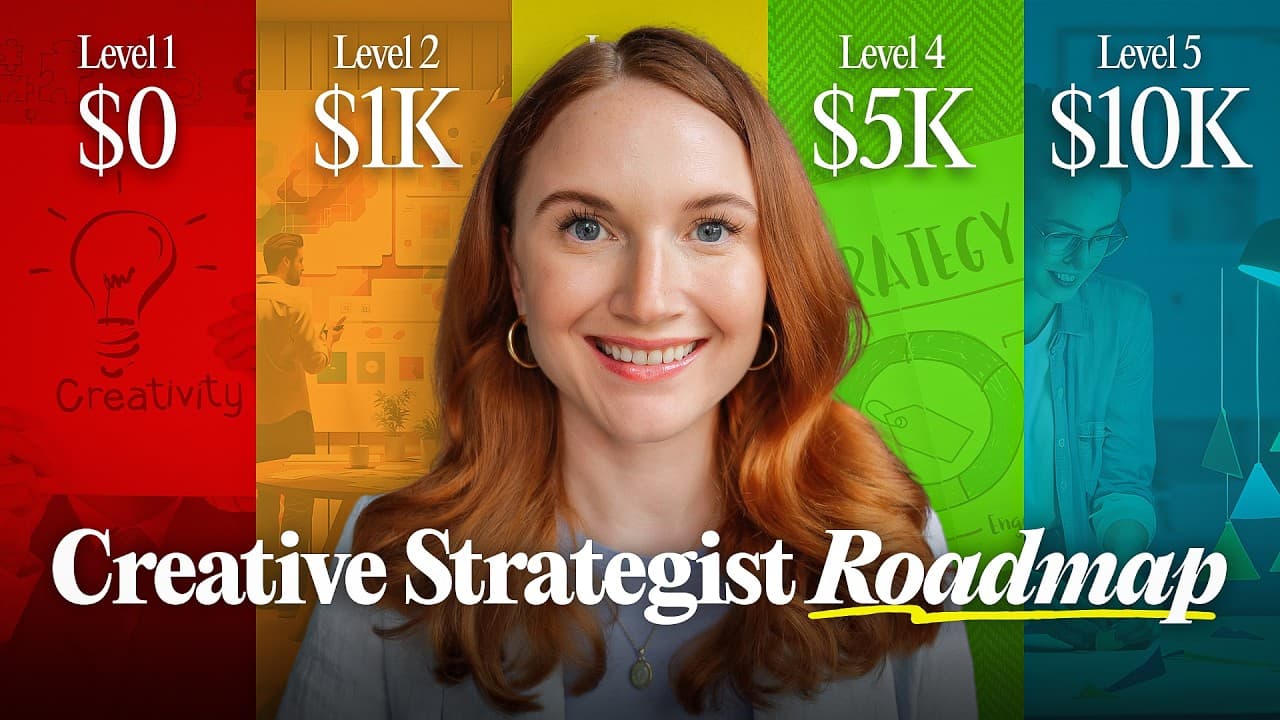
How to Become a $10K/Month Creative Strategist
TL;DR
Creative strategists grow revenue by deciding which paid-social ad concepts to run based on customer insight and performance data. Reaching premium income requires strong research, consumer psychology, hooks, concepting, project management, and data analysis, plus the motivation to keep improving creative performance rather than simply producing briefs.
Transcript
So, I've been working as a media buyer and creative strategist for the last 10 years. And in this video, I'm going to show you everything that you need to know today to become a real creative strategist. I'm going to take you through the skills that you actually need to have and the tools that brands and agencies expect you to know and use and how ... Read More
Key Insights
- Creative strategy is a revenue-focused discipline that selects paid-social ad concepts using customer insight and performance evidence. Although creativity can be part of the work, the central responsibility is determining which messaging and executions can attract suitable customers and contribute to business growth.
- Paid-social creative now performs much of the targeting previously handled through manually assembled lookalike and interest audiences. Consequently, decisions about an ad's message and appearance strongly influence which viewers respond, making the creative strategist a highly leveraged member of a growth team.
- Research is a core creative strategy skill that involves examining customer reviews, Reddit conversations, organically popular content, competitor activity, and comments on successful ads. The objective is to uncover motivations, language, emotions, and overlooked insights that can guide stronger concepts and useful iterations.
- Effective strategy connects consumer psychology with execution by identifying customer desires, motivators, awareness levels, personas, and promising angles. A strategist must recognize content that genuinely resonates, including material that does not follow familiar problem-and-solution formulas but still captures the audience's emotional reality.
- Hooks and concepts are designed to stop scrolling and prompt a direct response from the intended audience. Strong strategists use words, visuals, audio, and the opening moment deliberately, then apply suitable story structures and formats that guide attention toward conversion.
- Project management is part of creative strategy because briefs and concepts must move efficiently through creators, video editors, and designers. Clear communication and a dependable process keep production progressing, making operational discipline necessary alongside research, psychology, writing, and analytical judgment.
- Performance analysis turns advertising results into insights that inform subsequent creative. Strategists should comfortably interpret hook rate, hold rate, and click-through rate while recognizing that the relevance of a metric can vary by ad, and that spend, purchases, and revenue remain primary performance indicators.
- Creative strategy is substantial enough to be a dedicated full-time role rather than an added responsibility for an editor, designer, or media buyer. Creative practitioners can transition successfully, but they must recognize that strategy requires a distinct combination of psychology, marketing, analytics, direction, and increasingly content creation.
Install to Summarize YouTube Videos and Get Transcripts
Explore YouTube Video Summarizer or Get YouTube Transcript Extractor
Questions & Answers
Q: What does a creative strategist do for paid social?
A creative strategist grows a business by deciding which paid-social ad creative to run based on customer insight and performance. The work includes researching audiences and competitors, choosing messages and angles, writing hooks and briefs, guiding execution with creators and production specialists, and analyzing campaign data so that each round of advertising informs the next.
Q: Why is creative strategy increasingly important for paid social?
Creative strategy is increasingly important because paid-social targeting now depends heavily on the creative rather than the manual use of lookalike audiences, interest audiences, and intricate audience stacks. The person choosing the ad's message and appearance therefore helps determine whom it reaches and whether those people convert, tying creative decisions closely to revenue.
Q: What skills does a creative strategist need in 2026?
A creative strategist needs research, consumer psychology, strategic thinking, hook writing, concept development, briefing, project management, communication, and performance analysis. The role also requires understanding personas, awareness levels, story structures, proven and trending formats, and the opening experience of an ad. These abilities must work together to produce creative intended to drive revenue.
Q: How should a creative strategist research customers?
Customer research should examine reviews, Reddit discussions, organic content that the audience enjoys, competitor activity, and comments beneath top-performing ads. The strategist mines these sources for recurring desires, motivations, objections, emotional language, and unexpected insights. A repeatable personal research process helps convert scattered observations into angles, hooks, concepts, and future creative iterations.
Q: What do agencies look for when hiring creative strategists?
Hiring evaluations focus first on whether the candidate is genuinely motivated to improve performance and drive revenue. Agencies also look for interest in why people buy, knowledge of consumer desires and awareness levels, an established research process, skill with hooks and concepts, recognition of emotionally resonant content, familiarity with effective formats, and confidence analyzing advertising data.
Q: Can a video editor or designer become a creative strategist?
A video editor, designer, or creator can transition into creative strategy, and practical creative experience can provide a useful foundation. However, creative strategy is a different role rather than an extra task attached to production. The transition requires building capabilities in customer research, psychology, strategic decision-making, briefing, project management, revenue-focused analysis, and cross-functional creative direction.
Q: Which advertising metrics should a creative strategist understand?
A creative strategist should be able to discuss hook rate, hold rate, and click-through rate, including why click-through rate can matter for some creative and be less informative for others. The strategist must also distinguish supporting diagnostic metrics from primary performance indicators. The transcript identifies spend, purchases, and revenue as the primary indicators used to judge business performance.
Q: Why should creative strategy be a dedicated role?
Creative strategy should be dedicated because its responsibilities can occupy a full working week even for one brand. Combining it with video editing, design, or media buying risks treating strategy as another checklist item. The role requires sustained research, concepting, briefing, production coordination, and analysis, all focused on developing advertising creative that contributes to revenue growth.
Summary & Key Takeaways
-
Creative strategy has gained leverage because paid-social targeting increasingly happens through the creative itself rather than manually constructed lookalike and interest audiences. The strategist determines the messaging and presentation intended to reach people likely to convert, connecting customer research and advertising concepts directly to business growth and revenue performance.
-
The role combines research, strategy, briefing, concepting, project management, and performance analysis. Daily work can include studying reviews, Reddit discussions, organic content, competitors, personas, awareness levels, hooks, ad copy, and performance metrics. Strategists then coordinate creators, editors, and designers while turning campaign results into lessons for future creative.
-
Strong candidates understand consumer psychology, recognize emotionally resonant content, and follow a repeatable research process. They can distinguish durable ad formats from trends, design the opening seconds of an ad, apply story structures, and discuss metrics such as hook rate, hold rate, click-through rate, spend, purchases, and revenue with appropriate context.
Read in Other Languages (beta)
Share This Summary 📚
Summarize YouTube Videos and Get Video Transcripts with 1-Click
Try YouTube Summary with ChatGPT & Claude or YouTube Transcript Generator
Explore More Summaries from Dara Denney 📚



Summarize YouTube Videos and Get Video Transcripts with 1-Click
Try YouTube Summary with ChatGPT & Claude or YouTube Transcript Generator