How Claude Opus 5.5 compares with GPT-6 Sol for creators
TL;DR
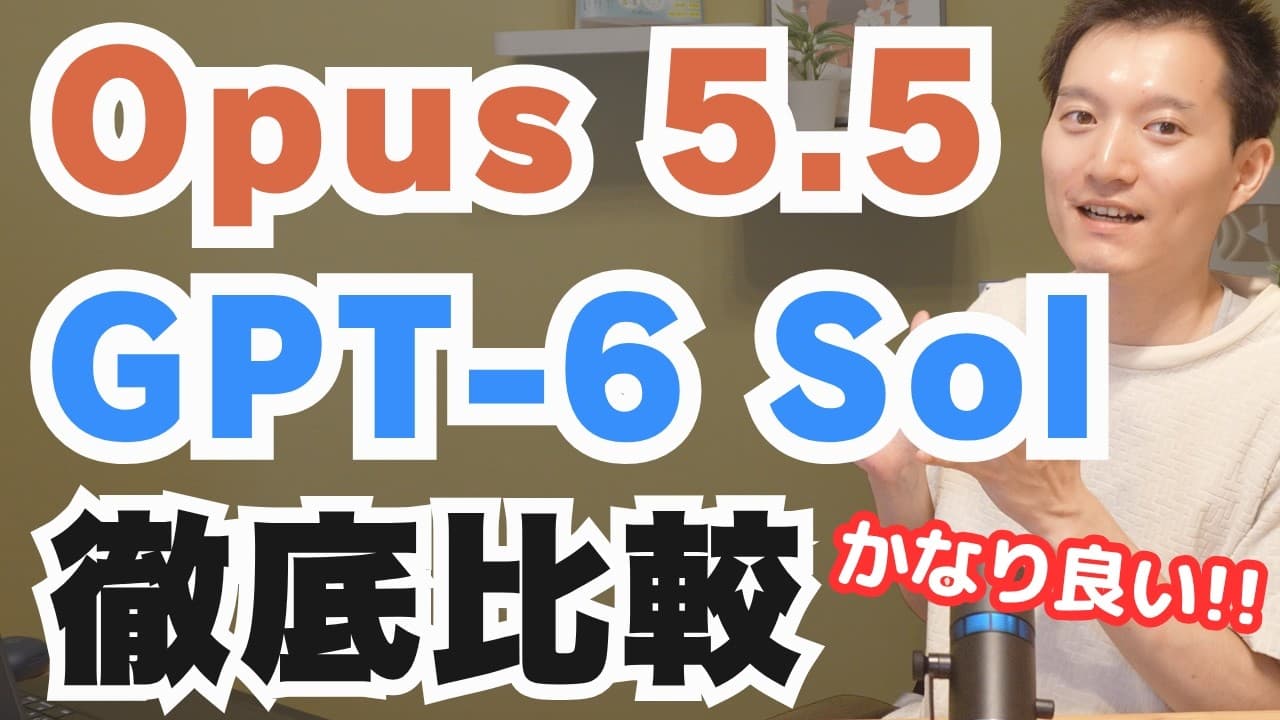
Opus 5.5 offers cheaper input and output costs while delivering strong performance in coding and animations, often outperforming Fable 5.1 in quality. GPT-6 Sol provides robust capabilities but comes with higher costs; the video analyzes multiple tasks across animation, design, and web outputs to show practical tradeoffs and where each model excels.
Transcript
Hi, hello there. I'm Keto. This channel introduces the latest information and use cases for generative AI. Please be sure to subscribe to the channel. The theme for this episode is the new model releases for major AI services ChatGPT and Claude: Claude 3.5 and GPT-6 have arrived, so I'd like to explain them, discuss how they've evolved, and... Read More
Key Insights
- Opus 5.5 reduces price compared with Opus 3.5, making it cheaper for input and output tasks. It shows strong performance in practical coding work and website creation, often outperforming Fable 5.1 in benchmarks. The video argues Opus 5.5’s cost performance balance is advantageous for developers.
- GPT-6 SOL emerges as a lower-cost option within the GPT-6 family, aiming to maintain usability while reducing token usage and expense. It remains distinct from the Astra tier, offering a different cost/performance profile that suits long-running projects.
- The comparison site AI Shiro Kurabo is used to frame a head-to-head between Opus 5.5 and GPT-6 Sol, plus Claude Fable 5.1, to illustrate how design, animation, and web outputs vary across models.
- Animation quality varies by model, with Opus 5.5 often delivering smoother, higher-quality results that can be used as is. GPT-6 Sol and Luna show strong performance but with different strengths and slower or faster tradeoffs.
- Design tasks show Opus 5.5 producing magazine-like and brand design outputs that appear more polished than GPT-6 Sol and Fable 5.1 in several showcased examples.
- Speed and cost are highlighted as major factors: Opus 5.5 may be slower but cheaper, while GPT-6 Sol can be faster but costlier depending on usage patterns.
- The video stresses that model upgrades and name changes (Terra, Luna, Astra, etc.) create a complex landscape, but practical testing across tasks provides guidance for real-world use.
- Viewers are encouraged to experiment with multiple models to extract best features for each task rather than relying on a single model for all needs.
Install to Summarize YouTube Videos and Get Transcripts
Explore YouTube Video Summarizer or Get YouTube Transcript Extractor
Questions & Answers
Q: What is the main takeaway about Opus 5.5 vs GPT-6 Sol for developers
The main takeaway is that Opus 5.5 offers a favorable balance of cost and performance for practical development tasks, including programming and web creation. It tends to be cheaper than alternative models while delivering strong output quality, making it a practical choice for ongoing projects. GPT-6 Sol provides strong capabilities as a companion option for tasks where its strengths matter, but it may incur higher costs. Viewers are encouraged to choose based on task type and budget rather than seeking a single best model.
Q: How does Opus 5.5 compare to Fable 5.1 in design and animation tasks
In the reported comparisons, Opus 5.5 generally delivers higher quality animations and more polished magazine-like design outputs than Fable 5.1. It also shows a stronger aesthetic alignment and layout handling, which translates into more usable results for design-focused tasks. The differences are demonstrated through side-by-side demonstrations of animations and brand designs, where Opus 5.5 consistently appears superior.
Q: What role does cost play in choosing between Opus 5.5 and GPT-6 Sol
Cost is a central consideration, as Opus 5.5 has shown lower input and output costs than earlier Opus versions and often lower than GPT-6 Sol in similar tasks. The video emphasizes practical tradeoffs: if budget and efficiency are priorities, Opus 5.5 is attractive; if the user needs specific GPT-6 ecosystem advantages, Sol may be preferred despite higher costs.
Q: Which models were compared in the AI Shiro Kurabo site used in the video
The video mentions a head-to-head comparison on the AI Shiro Kurabo site between Opus 5.5 and GPT-6 Sol, with Claude Fable 5.1 also included as a benchmark. The aim is to evaluate differences in animation, design, and web production outputs across these models to illustrate practical strengths and weaknesses.
Q: What kinds of outputs were tested in the comparisons
The tests included animations, web-style magazine and brand design outputs, and other design-oriented tasks. The demonstrations show how different models handle layout, typography, color contrast, and overall aesthetic, with Opus 5.5 often delivering more polished and magazine-like results compared to GPT-6 Sol and Fable 5.1.
Q: What is said about the evolution of model naming like Terra and Luna
The video notes that model naming and structure have evolved rapidly, with Terra being restructured or eliminated and Astra, Sol, and Luna forming a hierarchy. This reflects ongoing changes in how models are marketed and organized, which can affect user expectations and workflow planning.
Q: What is the suggested approach to model usage according to the video
The suggested approach is to use a mix of models and leverage the strengths of each: Opus 5.5 for cost-effective, high-quality base results, GPT-6 Sol for capabilities where it shines, and other models like Claude Fable 5.1 as needed. The emphasis is on practical testing and task-specific selection rather than relying on a single model for all work.
Q: What kind of tasks did the creator test across models
The creator tested across about 20 different patterns, including animation creation, design generation, and website or production outputs. The goal was to reveal differences in speed, output quality, and cost across Opus 5.5, GPT-6 Sol, and Claude Fable 5.1, showing practical strengths in various domains.
Summary & Key Takeaways
-
Opus 5.5 is cheaper than prior Opus versions and competitive with other models while delivering high-quality results, especially in programming tasks. The video demonstrates cost and performance differences across several tasks. It emphasizes practical use over claiming a single best model.
-
GPT-6 Sol is positioned as a strong alternative with broad capabilities that can outpace certain rivals in some tasks, but its cost and ecosystem differ from Opus 5.5. The comparison highlights tradeoffs in speed, output quality, and usability across animations and design.
-
The overall message is that model choice depends on the task and cost considerations, with Opus 5.5 often delivering a favorable balance for development work, animation, and web design, while GPT-6 Sol offers flexibility and strength in other scenarios.
Read in Other Languages (beta)
Share This Summary 📚
Summarize YouTube Videos and Get Video Transcripts with 1-Click
Try YouTube Summary with ChatGPT & Claude or YouTube Transcript Generator
Explore More Summaries from KEITO【AI&WEB ch】 📚






Summarize YouTube Videos and Get Video Transcripts with 1-Click
Try YouTube Summary with ChatGPT & Claude or YouTube Transcript Generator