How to Build and Sell a No-Code AI App Online
TL;DR
Build a micro-niche AI app that solves one specific problem, then charge customers a monthly subscription for continued access. AI tools such as Base44 can handle app creation without coding or developers, while a website can serve as the product’s sales hub. The model offers recurring revenue, no physical inventory or shipping, and low operating costs beyond software and payment processing.
Transcript
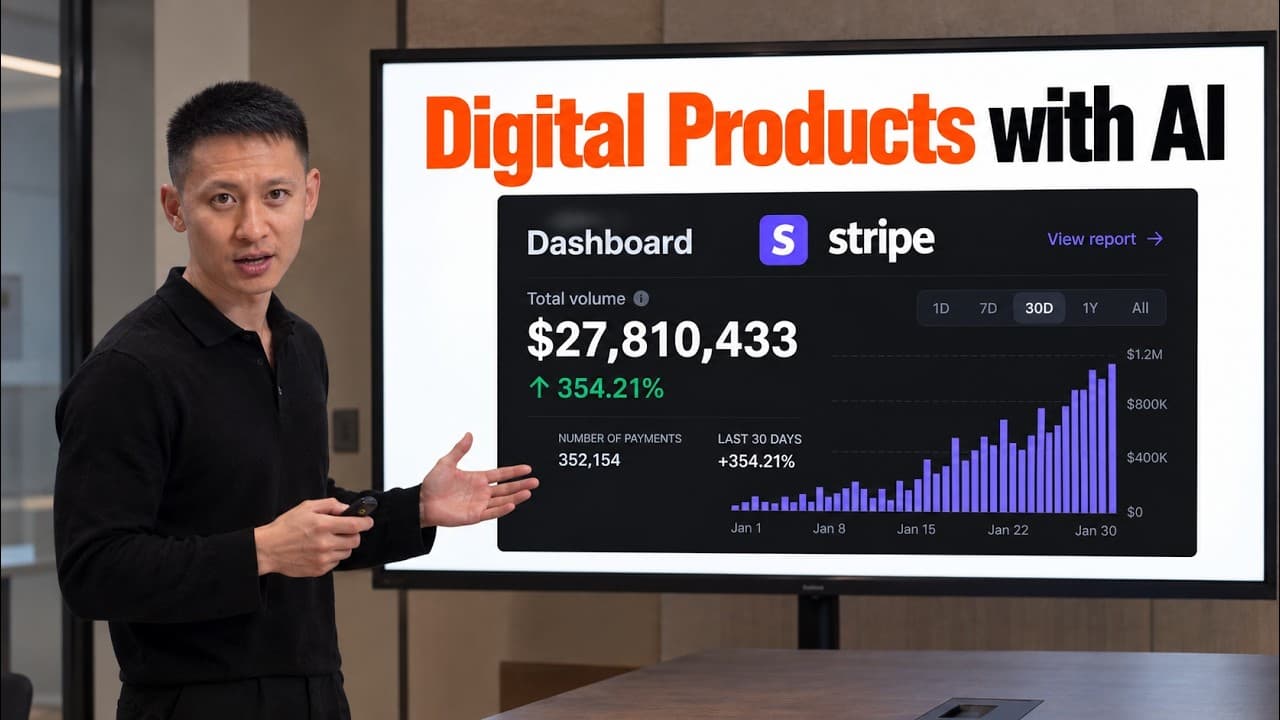
Watch this. I just told AI what I wanted and it's going to build me an entire app right now live while you watch. There's no code, no developer, no engineers. I don't have any technical skills. And in a few minutes, this is going to turn into something that I can charge people every single month. In fact, in the last 12 months, I have consistently ... Read More
Key Insights
- Digital products are intangible offers such as courses, guides, coaching programs, consultation calls, and software applications. They can teach customers how to achieve an outcome instead of requiring the seller to perform the underlying activity repeatedly for each buyer.
- Digital products eliminate physical inventory and shipping because nothing must be stored, manufactured, or delivered as a physical item. The presenter says a product can be built once and sold repeatedly, making most revenue profit after payment processing and modest software expenses.
- AI has reduced the difficulty of creating digital products by assisting with writing, design, presentation, and technology. According to the course, these production tasks previously caused many beginners to stop before launching, but an AI builder can now generate an application from written instructions.
- A micro-niche app is a small application designed to solve one specific problem for a clearly defined audience. Examples given include a fitness app for busy mothers and a content-planning app for creators, rather than a broad and technically complex platform like Netflix or Spotify.
- Recurring revenue comes from charging customers repeatedly while they remain subscribed to an app. A guide normally produces one payment, whereas an application may generate monthly payments from the same customer without requiring the product to be rebuilt for every billing cycle.
- Subscription mathematics connects pricing, customer count, and monthly revenue. The course illustrates that an app priced at approximately $30 per month would generate $300 per month from 10 customers, before accounting for processing fees, software expenses, cancellations, or other business costs.
- Base44 is the AI application-building tool demonstrated in the course. The presenter says it can create an app without coding, engineers, or developers, and directs viewers to a promotional link offering a stated 30% discount on annual plans.
- A complete digital-product business requires more than generating the application. The course also emphasizes creating a website as a home base, selecting hosting, setting a price, positioning the offer, and attracting suitable customers through free methods without paid advertising or an existing audience.
Install to Summarize YouTube Videos and Get Transcripts
Explore YouTube Video Summarizer or Get YouTube Transcript Extractor
Questions & Answers
Q: How can a beginner build an AI app without coding?
A beginner can use an AI application builder such as Base44 and describe the desired product through written instructions. The course presents the tool as handling the technical construction without requiring coding skills, engineers, or hired developers. The recommended starting point is a simple micro-niche app that solves one narrowly defined problem rather than a large platform with many complex features.
Q: What is a micro-niche AI app?
A micro-niche AI app is a small digital product focused on solving one specific problem for a clearly defined group. The course gives examples such as a fitness app for busy mothers and a content-planning app for creators. Its purpose is not to compete with complex billion-dollar applications, but to provide a focused service that customers find useful enough to access through a monthly subscription.
Q: Why can an AI app generate recurring revenue?
An AI app can generate recurring revenue when customers pay a subscription fee each month for continued access. The seller earns from the same customer repeatedly while that person remains subscribed, rather than receiving only a single payment. The course contrasts this arrangement with a guide or PDF, which is generally purchased once and does not automatically produce continuing monthly payments.
Q: How much revenue can a $30 monthly app make?
Revenue depends on the number of paying subscribers. The example in the course uses a price of approximately $29.99, rounded to $30 per month. At that price, 10 customers would produce $300 in monthly revenue before costs. The presenter also discusses possible app income ranging from $300 to $50,000 per month, but these figures are examples and claims, not guaranteed outcomes.
Q: Why are digital products cheaper to operate than physical products?
Digital products do not require physical inventory, garage storage, shipping, materials for every sale, or coordination with overseas manufacturers. Once created, the same product can be sold repeatedly without manufacturing another copy. The presenter says the main ongoing expenses can be a small payment-processing fee and software costing less than $100 per month, leaving most sales revenue as profit under that described setup.
Q: What types of digital products can someone sell?
The course identifies several digital-product formats. A seller can offer a low-priced guide or short course for about $20 to $40, sell a higher-priced premium program or coaching offer, promote an existing product through arbitrage, or build a subscription application. The presenter favors micro-niche AI apps for beginners because they can combine focused problem-solving with recurring monthly payments.
Q: What steps turn an AI app into a sellable business?
The process begins by selecting a specific audience problem and defining a focused application that addresses it. The app is then built with an AI tool, hosted, priced, and connected to a website that serves as the business’s home base. The course also calls for positioning the offer clearly and helping relevant customers discover it through free methods, without relying on paid advertisements or an existing following.
Q: Can someone sell an AI product without showing their face?
Yes, the course states that showing your face is not required. The proposed business can be built around a focused application, a website, and free customer-discovery methods rather than the creator’s personal on-camera presence. The essential work is choosing a useful problem, building the product, explaining its value, setting up a place where customers can purchase it, and reaching the appropriate audience.
Summary & Key Takeaways
-
Digital products include courses, guides, coaching programs, consultations, and apps. Unlike physical products, they require no stored inventory, shipping, or overseas manufacturing. A product can be created once and sold repeatedly, with costs largely limited to payment processing and software that the presenter says can total less than $100 per month.
-
The recommended opportunity is a micro-niche AI app that solves one narrowly defined problem, such as fitness for busy mothers or content planning for creators. Unlike a guide purchased once, an app can generate recurring revenue because customers pay monthly while they continue using the service. The goal is usefulness, not billion-dollar complexity.
-
The proposed workflow covers choosing an app idea, building it with Base44, creating a website with Wix, and positioning the product so relevant customers can discover and purchase it without paid advertising or an existing following. The presenter recommends building alongside the course gradually instead of attempting the entire process in one sitting.
Read in Other Languages (beta)
Share This Summary 📚
Summarize YouTube Videos and Get Video Transcripts with 1-Click
Try YouTube Summary with ChatGPT & Claude or YouTube Transcript Generator
Explore More Summaries from Richard Yu 📚

Summarize YouTube Videos and Get Video Transcripts with 1-Click
Try YouTube Summary with ChatGPT & Claude or YouTube Transcript Generator