How Does Surfactant Keep Alveoli from Collapsing?
TL;DR
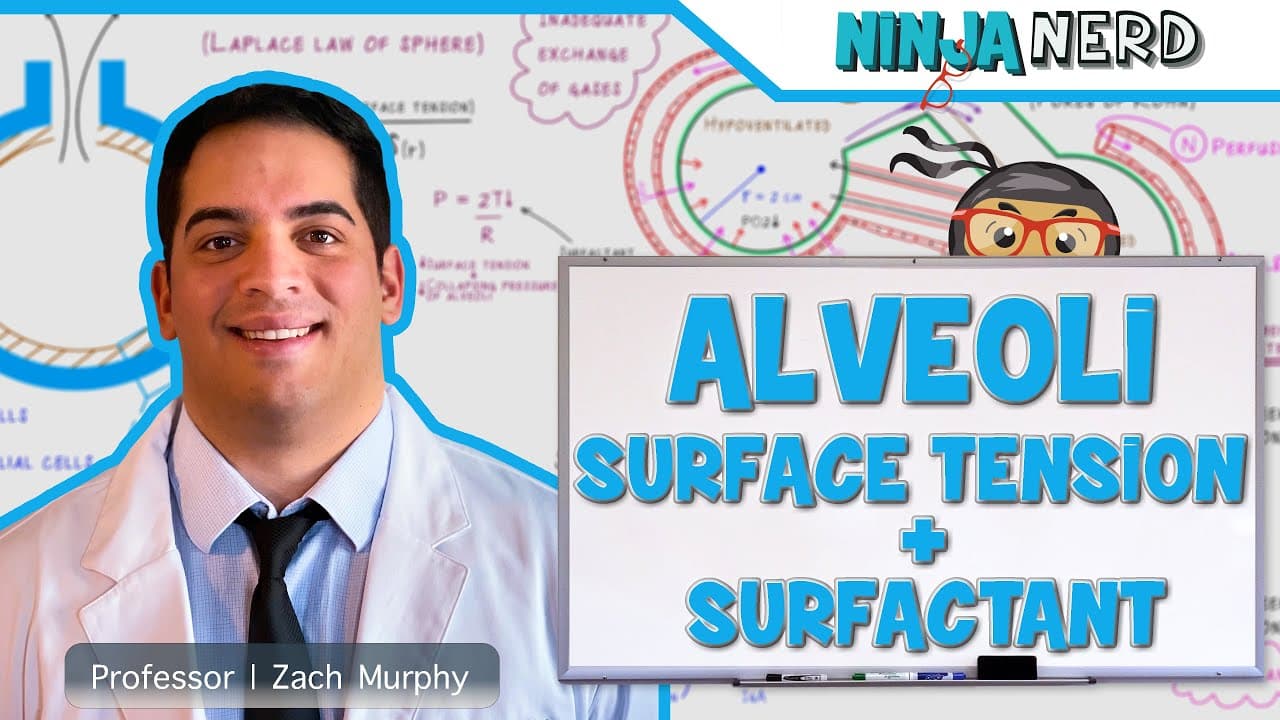
Surface tension pulls the alveolar water layer inward, increasing collapsing pressure and encouraging alveoli to shrink and expel air. Surfactant, a lipid-protein complex produced by type II alveolar cells, decreases this tension, while type I squamous cells primarily support gas exchange between alveoli and blood. Low surfactant production and high surface tension can contribute to infant respiratory distress syndrome.
Transcript
all right ninine nerds in this video we're going to talk about surface tension and surfactant all right what is surface tension how would you define surface tension so surface tension is really actually better defined when we look at it inside of this actual alviola here but right now we'll put like a little definition for right now surface tension... Read More
Key Insights
- Surface tension is created by the air-water interaction inside an alveolus and by cohesive intermolecular attractions among water molecules. It encourages the alveolus to recoil, collapse, and assume the smallest possible size while pushing contained air outward.
- The alveolar water layer is a thin film positioned between the epithelial cell layer and gases such as oxygen, carbon dioxide, and nitrogen. Surface tension develops most importantly among water molecules at the top of this air-water interface.
- Surface water molecules experience an unbalanced force because they interact with neighboring and underlying water molecules but do not favor interaction with the gas above. Their sideward forces cancel, leaving a net force directed downward toward deeper water layers.
- The inward movement of surface water molecules makes the water layer thinner and prevents it from readily moving upward during alveolar expansion. As the layer contracts, tension rises and pulls the alveolar structure toward a smaller, collapsed state.
- Collapsing pressure is the pressure associated with increasing surface tension as an alveolus attempts to push air outward. Laplace's law is introduced to connect surface tension in a spherical structure with the pressure that favors alveolar collapse.
- Type I alveolar cells are squamous epithelial cells that are more abundant than type II cells. Their primary role is gas exchange, allowing oxygen to move from alveoli into blood and carbon dioxide to move from blood into alveoli.
- Type II alveolar cells are less abundant cuboidal epithelial cells that produce surfactant. Surfactant is described as a lipid-protein detergent complex whose function is to decrease surface tension within the alveoli and oppose their tendency to collapse.
- Infant respiratory distress syndrome can occur in a pathological setting where surfactant production is low and surface tension is high. The resulting increase in the tendency of alveoli to collapse interferes with the normal mechanical behavior of the lungs.
Install to Summarize YouTube Videos and Get Transcripts
Explore YouTube Video Summarizer or Get YouTube Transcript Extractor
Questions & Answers
Q: What causes surface tension inside the alveoli?
Surface tension inside the alveoli arises from the interaction between the thin water layer lining the alveolar cells and the gas layer containing oxygen, carbon dioxide, and nitrogen. Water molecules strongly attract other water molecules but do not favor interaction with the gases above them. This imbalance produces an inward force that pulls the water surface toward deeper layers and encourages alveolar collapse.
Q: How does the air-water interface promote alveolar collapse?
Water molecules at the air-water interface interact with molecules beside and below them, but they lack a favorable interaction with the gas above. The opposing sideward forces cancel, leaving a net downward force. As surface molecules move into deeper water layers, the surface contracts and becomes thinner. That contraction creates tension that pulls the alveolus inward, promotes recoil, and pushes air outward.
Q: What is the role of type I alveolar cells?
Type I alveolar cells are abundant squamous epithelial cells primarily involved in gas exchange. They support the movement of oxygen from the alveolar air into the blood and the movement of carbon dioxide from the blood into the alveoli. Their thin, squamous shape distinguishes them from the cuboidal type II cells that produce the surfactant complex.
Q: What is the role of type II alveolar cells?
Type II alveolar cells are less abundant cuboidal epithelial cells responsible for producing surfactant. The lecture describes surfactant as a lipid-protein detergent complex that naturally decreases alveolar surface tension. By reducing the inward pull generated at the air-water interface, surfactant helps oppose the tendency of alveoli to shrink, recoil, and collapse.
Q: How does surfactant reduce the tendency of alveoli to collapse?
Surfactant decreases the surface tension generated by cohesive interactions among water molecules at the alveolar air-water interface. Without this reduction, surface water molecules are pulled toward deeper layers, the lining contracts, and the alveolus tends to shrink. By lowering that tension, surfactant opposes collapsing pressure and helps prevent the alveoli from assuming their smallest possible size.
Q: What is collapsing pressure in an alveolus?
Collapsing pressure is the pressure associated with surface tension as an alveolus attempts to recoil and push its air outward. The cohesive behavior of water at the air-water interface pulls the alveolar lining inward, producing a force that favors a smaller alveolar size. Laplace's law is introduced to describe the relationship between surface tension and pressure in a spherical structure.
Q: Why do surface water molecules move toward deeper layers?
Surface water molecules have cohesive interactions with neighboring water molecules on either side and with molecules beneath them, but they do not favor interaction with gas molecules above. The sideward forces oppose and cancel one another, so the remaining net force points downward. Consequently, the surface molecules move toward the bulk water layers closer to the alveolar cells.
Q: How is low surfactant linked to infant respiratory distress syndrome?
Low surfactant production allows surface tension within the alveoli to remain high. Higher surface tension strengthens the inward pull created by water molecules at the air-water interface, increases the tendency toward collapsing pressure, and encourages alveoli to recoil and collapse. The lecture identifies this combination of low surfactant and high surface tension as a contributor to infant respiratory distress syndrome.
Summary & Key Takeaways
-
Surface tension originates at the interface between the thin alveolar water layer and the gases containing oxygen, carbon dioxide, and nitrogen. Surface water molecules interact strongly with adjacent and underlying water molecules but not with the gas above, creating a net inward pull that favors movement toward deeper water layers.
-
As surface water molecules move toward deeper layers, the water surface becomes thinner and develops tension. This tension pulls inward on the alveolus, discourages expansion, promotes recoil and collapse, and pushes air outward. The resulting force is associated with collapsing pressure, a concept discussed through Laplace's law and spherical structures.
-
Type I alveolar cells are abundant squamous epithelial cells primarily responsible for gas exchange, while the less abundant type II cells are cuboidal and produce surfactant. Surfactant is a lipid-protein detergent complex that decreases surface tension. When surfactant production is low, elevated surface tension can contribute to infant respiratory distress syndrome.
Read in Other Languages (beta)
Share This Summary 📚
Summarize YouTube Videos and Get Video Transcripts with 1-Click
Try YouTube Summary with ChatGPT & Claude or YouTube Transcript Generator
Explore More Summaries from Ninja Nerd 📚





Summarize YouTube Videos and Get Video Transcripts with 1-Click
Try YouTube Summary with ChatGPT & Claude or YouTube Transcript Generator