Why Do Populists Say Both Parties Serve Donors?
TL;DR
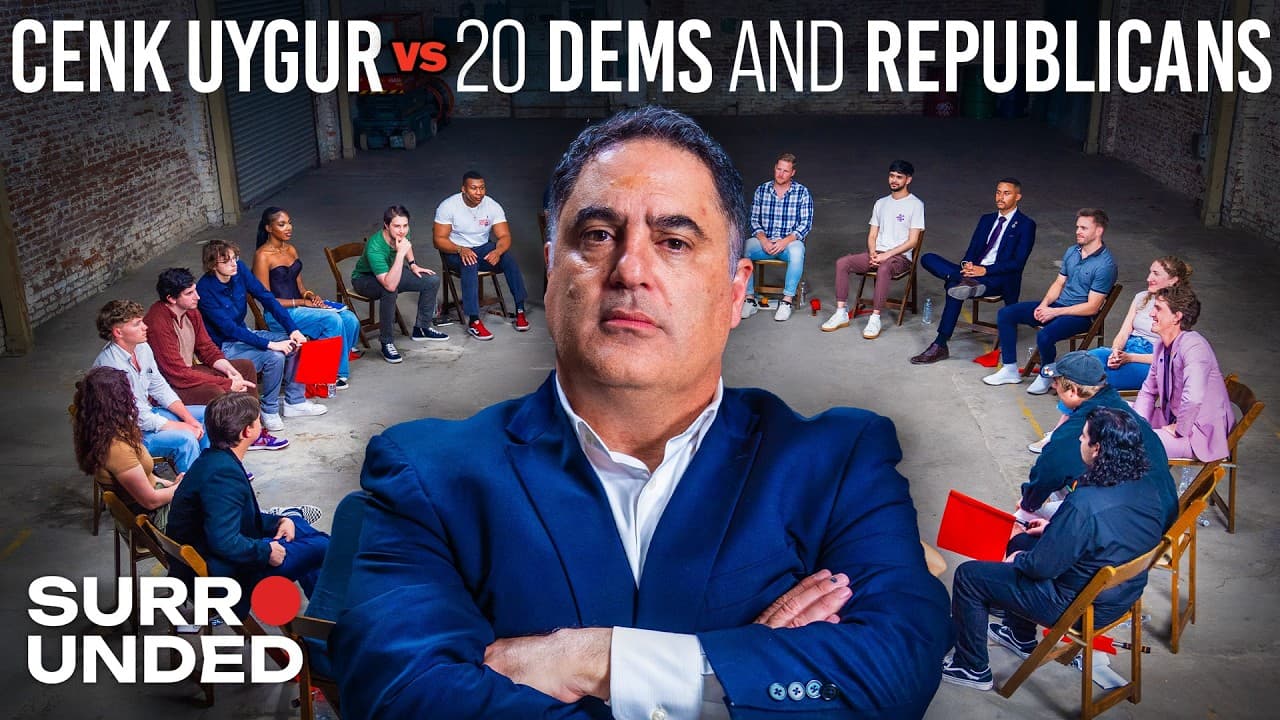
Cenk Uygur argues that Democrats and Republicans largely protect wealthy donors while offering voters limited benefits as political release valves. He still sees a meaningful difference between the parties and votes Democratic, but says left-wing populism is the untried alternative that would pursue widely supported policies such as paid family leave, a public health insurance option, and a higher minimum wage.
Transcript
We've tried establishment Democrats, complete failures. We've tried establishment Republicans, complete failures. We tried fake populism under Donald Trump, complete failures. I disagree. The only thing we haven't tried is left-wing populism. And you say, "Don't try it. Go back to the establishment Democrats." Are you crazy? You can't vote Democrat... Read More
Key Insights
- Uygur's central position is that Democrats and Republicans largely agree on economic policy because both parties protect wealthy donors. He does not claim complete agreement, acknowledging a limited difference between them and explaining that this difference is why he continues to vote for Democratic candidates.
- Limited policy concessions are described by Uygur as release valves that reduce public pressure without changing the underlying system. He applies this interpretation to Democratic health reforms and Republican tax provisions, arguing that each party offers modest benefits while preserving arrangements that principally favor corporations or wealthy individuals.
- Oliver's main objection is that health policy reveals a consequential difference between the parties. He cites more than 8 million people becoming eligible for Medicaid under Biden-era expansions, then contrasts that outcome with a Republican budget proposal he says could make 15 to 16 million people ineligible over 10 years.
- Drug-price negotiation is presented as an example of inadequate Democratic action. Uygur says negotiations covered insulin and perhaps 10 other drugs, producing at most $6 billion in savings, while he claims comprehensive negotiation could save several hundred billion dollars and demonstrate a stronger challenge to pharmaceutical interests.
- The Affordable Care Act is characterized by Uygur as a limited corporate-friendly reform rather than a fundamental restructuring of health care. He emphasizes its connection to Romney's state-level plan and the Heritage Foundation to support his argument that Democratic reforms can originate within conservative policy frameworks.
- Unfulfilled popular proposals are treated as evidence of donor influence rather than unavoidable congressional difficulty. Uygur cites paid family leave with 84 percent support, a public option with support above 70 percent, and a $15 minimum wage as policies Democrats promised but failed to enact or fully pursue.
- Democratic leaders are described by Uygur as corporatists rather than socialists or communists. He argues that Joe Biden and Kamala Harris did not seek to end corporations or capital, but instead accommodated corporate donors, making accusations of communism inconsistent with the behavior he attributes to them.
- The Republican budget bill is portrayed by Uygur as redistributing resources upward. He says it cuts Medicaid and SNAP by $1.1 trillion while providing $1.1 trillion in tax cuts to people earning above $500,000, with smaller provisions for tips and overtime functioning as limited concessions.
Install to Summarize YouTube Videos and Get Transcripts
Explore YouTube Video Summarizer or Get YouTube Transcript Extractor
Questions & Answers
Q: Why does Cenk Uygur say Democrats and Republicans agree economically?
Cenk Uygur argues that both parties largely protect wealthy donors and corporations, even though their policies are not identical. He says Democrats offer limited social benefits while Republicans offer limited tax benefits to ordinary voters, but neither party fundamentally changes the donor-centered system. He describes these smaller concessions as release valves that reduce public pressure while keeping the larger economic structure intact.
Q: Does Cenk Uygur believe Democrats and Republicans are exactly the same?
No. Uygur explicitly acknowledges a difference between the parties and says that difference is why he votes Democratic. His argument is that the contrast is closer to 5 to 10 percent than the stark divide presented to voters. He believes Democratic policies can produce positive results, but contends that Democratic leaders repeatedly stop far short of the larger reforms they promise.
Q: What health care differences between the parties does Oliver identify?
Oliver argues that health coverage demonstrates a meaningful difference between Democratic and Republican governance. He says expansions of the Affordable Care Act and Medicaid under the Biden administration made more than 8 million people eligible for Medicaid. He contrasts that with provisions in Trump's budget bill that he says could make between 15 and 16 million people ineligible over a 10-year period.
Q: Why does Cenk Uygur criticize Democratic drug-price negotiations?
Uygur says Democrats promised to negotiate drug prices but delivered negotiations covering only insulin and perhaps 10 other drugs among tens of thousands. He places the resulting savings at no more than $6 billion, while claiming comprehensive negotiation could save several hundred billion dollars. For him, the narrow scope indicates a limited concession that avoids fully confronting pharmaceutical companies and their influence.
Q: Why does Cenk Uygur call the Affordable Care Act a release valve?
Uygur characterizes the Affordable Care Act as a small adjustment designed to relieve political pressure without transforming the health care system. He notes that the approach had previously been associated with Mitt Romney's state plan and says the Heritage Foundation developed it. From his perspective, that origin supports the view that the law was compatible with corporate interests rather than a major left-wing restructuring.
Q: What policies does Cenk Uygur say Democrats failed to pursue?
Uygur points to paid family leave, a public health insurance option, and a $15 minimum wage. He says paid family leave has 84 percent support and the public option has support above 70 percent, yet Democrats did not enact them. He particularly emphasizes that Joe Biden did not introduce the public option, treating the absence of an attempt as evidence of intent rather than congressional difficulty.
Q: Why does Cenk Uygur reject calling Democratic leaders communists?
Uygur says Democratic politicians, including Joe Biden and Kamala Harris, do not advocate ending corporations, private capital, or the broader capitalist system. He argues that their defining problem is corporate alignment, not communism or socialism. Even Bernie Sanders, who calls himself a democratic socialist, is described as not pursuing what the Republican participant groups together under conventional socialism and communism.
Q: How does Cenk Uygur describe the Republican budget bill?
Uygur says the bill provides some benefits involving taxes on tips and overtime, but treats those measures as small concessions. He claims the bill cuts Medicaid and SNAP by $1.1 trillion while directing $1.1 trillion in tax cuts to people earning more than $500,000 annually. He uses that comparison to argue that its principal economic effect favors wealthy people.
Summary & Key Takeaways
-
Cenk Uygur argues that establishment Democrats, establishment Republicans, and Donald Trump's version of populism have failed. He presents left-wing populism as the remaining untried option, contending that both major parties largely serve wealthy donors while using cultural conflict and limited economic concessions to preserve the existing political and economic system.
-
Oliver challenges the claim that both parties agree economically by contrasting Democratic health coverage expansions with proposed Republican Medicaid reductions. Uygur acknowledges a difference and explains that he votes Democratic, but characterizes Democratic accomplishments as small release valves that fall far short of promised reforms such as broader drug-price negotiation and a public option.
-
A Republican participant describes the left as socialist or communist and the right as favoring lower taxes. Uygur rejects those labels for Democratic leaders, calling them corporatists instead. He argues that Republican tax provisions similarly offer limited middle-class benefits while directing most advantages toward wealthy people and cutting Medicaid and SNAP programs.
-
The discussion centers on whether legislative failures result from political constraints, incompetence, or deliberate alignment with donors. Uygur treats the failure even to introduce certain promised measures as evidence of intent. His opponents warn that portraying the parties as nearly identical may discourage voting and obscure policy differences that materially affect people's lives.
Read in Other Languages (beta)
Share This Summary 📚
Summarize YouTube Videos and Get Video Transcripts with 1-Click
Try YouTube Summary with ChatGPT & Claude or YouTube Transcript Generator
Explore More Summaries from Jubilee 📚




Summarize YouTube Videos and Get Video Transcripts with 1-Click
Try YouTube Summary with ChatGPT & Claude or YouTube Transcript Generator