How to use AI in your business to scale profits
TL;DR
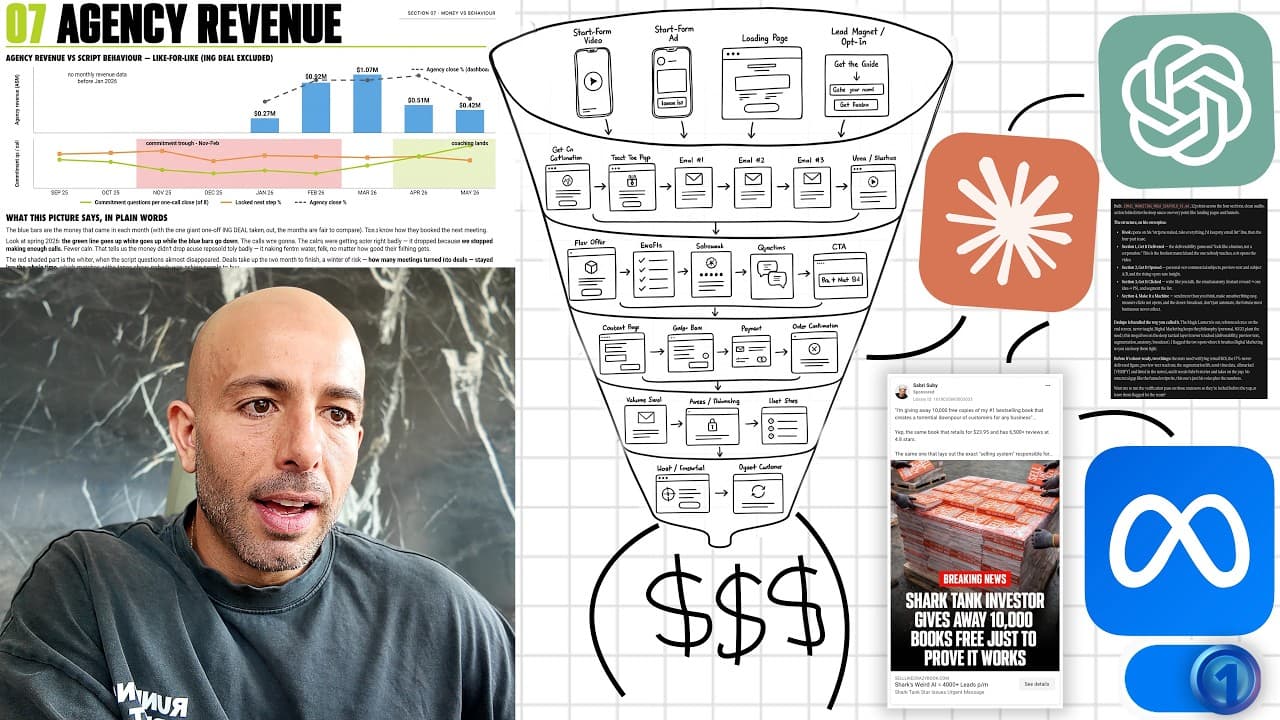
AI should be used with full context and data to unlock high value. Start by analyzing existing data like sales calls and feedback, then use AI to extract insights, rank performance, and build targeted actions. This approach scales operations beyond ad copy and creates measurable improvements across the business.
Transcript
This is exactly how I'm implementing AI to be in every single inch [music] of my business. AI is obviously all the rave right now. Everyone's talking about implementing it, using it in their business, and how they're getting more output. What I will say is that nine out of 10 people [music] that you see online, talking about AI and how it's revolut... Read More
Key Insights
- AI is most effective when given extensive context and data rather than starting from zero
- Analyzing large volumes of sales calls can reveal actionable insights like script adherence and close rates
- AI can rank reps and generate a team scorecard from call data to identify improvement areas
- A data-driven workflow can be set up to run weekly, maintaining a pulse on performance
- Using AI to mine customer support tickets and reviews can uncover recurring themes for ads
- Contextualized prompts produce better ad creative than generic AI outputs
- Top performers camp out on problems to remove constraints and improve throughput
- Real-world use of AI in a business context can save time and money compared to traditional consulting
Install to Summarize YouTube Videos and Get Transcripts
Explore YouTube Video Summarizer or Get YouTube Transcript Extractor
Questions & Answers
Q: How to use AI to audit sales calls for performance insights?
To audit sales calls with AI, collect transcripts from a long period and input them with a prompt that asks the AI to rank reps on dials, talk time, and script adherence. The AI then creates a team scorecard and month by month trend analysis, highlighting where reps excel or struggle and how close they are to closing a sale.
Q: What is the first step to apply AI in a business according to the video?
The first step is gathering the relevant data, such as years of sales calls, transcripts, and customer feedback. The speaker emphasizes providing a broad context window to the AI so it can derive meaningful patterns, rather than starting with generic tasks like writing an ad alone.
Q: How can AI help with ad creation beyond generic writing?
AI helps by using a rich context window from customer feedback, competitor reviews, and existing winning ads to craft multiple unique ads. It should follow your established ad formats and include insights from the data, ensuring the output aligns with the specific framework teams already use.
Q: What kind of data does the speaker analyze besides sales calls?
Besides sales calls, the speaker also mentions analyzing customer support tickets and reviews from sources like Trust Pilot and Google My Business. This broader data set reveals recurring themes and pain points that can inform ads and product improvements.
Q: How often does the speaker suggest running the AI-backed analysis?
The speaker suggests setting up a recurring task to run the analysis weekly, after initially building the data workflow. This cadence provides a continuous pulse on market signals, objections, and competitor mentions on calls, which can guide ongoing strategy.
Q: What does AI help identify about objections in sales calls?
AI helps identify the frequency and type of objections raised during sales calls, as well as how reps address them. It surfaces patterns such as which objections are most common, how effective the response scripts are, and where follow-up calls or commitments are placed in the process.
Q: What is the role of management and humans when using AI in this approach?
Humans still play a crucial role in data curation and interpretation. The approach highlights that while AI can process vast data, the business owner or leader must guide the context, define the framework for analysis, and make decisions based on the AI-generated insights.
Q: Why does the speaker criticize typical AI claims from other experts?
The speaker argues that many people online are selling courses and offering superficial AI fixes, resulting in mediocre outputs. He contrasts this with his data-driven approach that uses AI to deeply analyze real business processes like sales and customer feedback to drive substantial improvements.
Summary & Key Takeaways
-
A detailed data-driven approach shows AI can transform sales analysis and decision making by auditing calls and outcomes.
-
The method emphasizes deep context and ongoing setup so AI becomes a repeatable, weekly business process.
-
The speaker contrasts common hype with hands-on use, demonstrating how to leverage AI for measurable scale across teams.
Read in Other Languages (beta)
Share This Summary 📚
Summarize YouTube Videos and Get Video Transcripts with 1-Click
Try YouTube Summary with ChatGPT & Claude or YouTube Transcript Generator
Explore More Summaries from Sabri Suby 📚






Summarize YouTube Videos and Get Video Transcripts with 1-Click
Try YouTube Summary with ChatGPT & Claude or YouTube Transcript Generator