How to rewrite a homepage to convert more clients
TL;DR
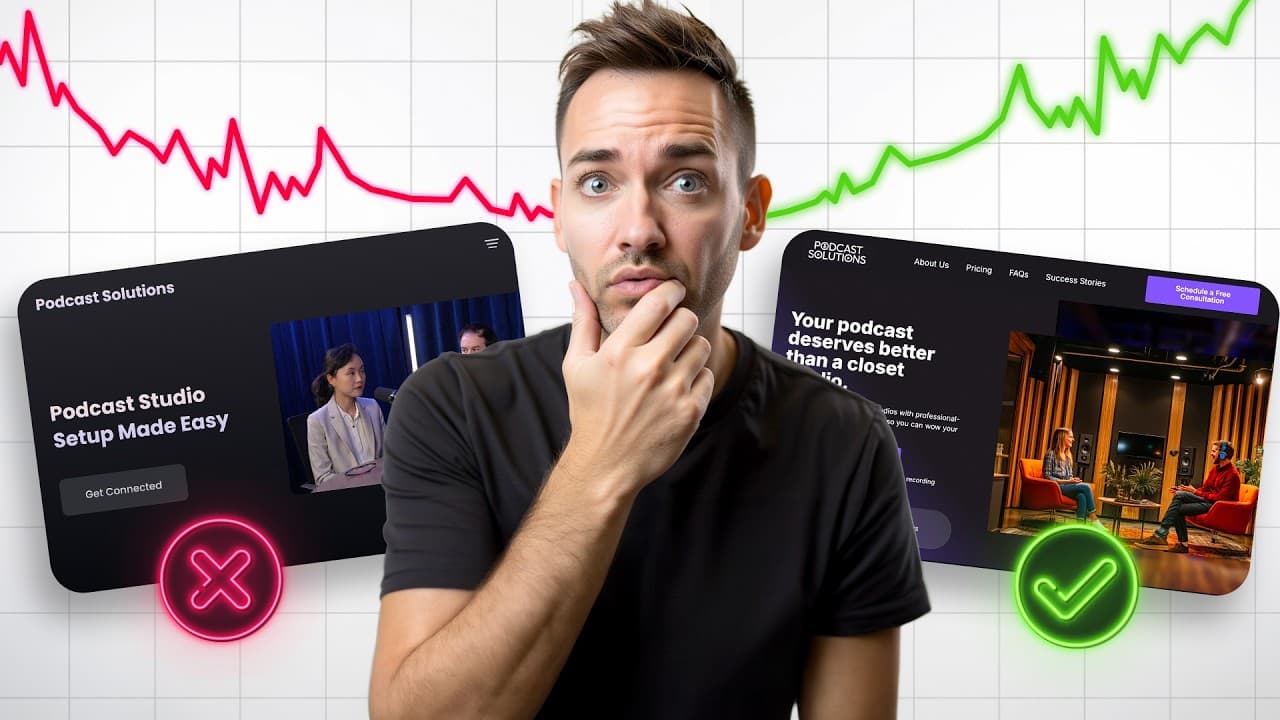
The video shows fixing five real websites by shifting the client to the hero position, clarifying offers, and simplifying calls to action. A simple framework is revealed to diagnose problems, replace risky visuals with end results, and clearly outline what clients get in four weeks or less.
Transcript
studies show that service businesses lose 61% of potential clients in the first 5 Seconds of visiting their website but nobody's showing you how to fix it until now I've been creating Leen websites for over 15 years and in this video I'm going to fix five of my viewers websites to show you how your website is losing you clients and the simple tweak... Read More
Key Insights
- The hero section should feature the client as the hero, not the business owner, to connect with visitor goals.
- Clear, outcome-focused promises outperform feature-heavy copy when it comes to conversions.
- Replace work-in-progress imagery with end-result visuals to evoke the lifestyle clients seek.
- A prominent primary CTA should guide the main conversion path, with secondary options offered later.
- Use a concise problem section to frame the transformation before introducing the mentor or service.
- Socio-psychological cues, like relatable client images and believable testimonials, boost trust faster than long reviews.
- Video backgrounds or dynamic media can enhance credibility if they reinforce the transformation being sold.
- A simple four-week coaching or program outline helps visitors understand scope and commitment upfront.
- More videos from this channel:
- More from this channel: Wes McDowell
Install to Summarize YouTube Videos and Get Transcripts
Explore YouTube Video Summarizer or Get YouTube Transcript Extractor
Questions & Answers
Q: What is the main reason a homepage fails to convert visitors quickly?
The main reason is that the hero section centers on the business rather than the client, making it harder for visitors to see how the service will change their life. By shifting focus to the client as the hero and outlining a clear outcome, visitors quickly understand what they will gain and why it matters.
Q: How can headlines improve clarity on a service site?
Headlines should clearly state the transformation or outcome for the client, not describe the business. A direct, benefit-driven line helps visitors immediately grasp what they will achieve, reducing confusion and increasing the likelihood they stay on the page to learn more.
Q: Why are end-result images more effective than work-in-progress photos?
End-result images visually communicate the final lifestyle or outcome the client desires, making it easier for visitors to imagine themselves achieving the result. Work-in-progress photos can feel abstract and unconvincing, while polished end-state visuals boost confidence and motivation to engage.
Q: What role does a primary call to action play in conversion?
The primary call to action serves as the main path for conversion. It should be highly visible, specific, and aligned with the promised outcome. A secondary option should exist but not obscure the main path, ensuring visitors understand exactly what action to take first.
Q: How should testimonials be used to support a transformation story?
Testimonials should focus on the outcomes and the client journey, not just the process. Short, result-oriented statements build credibility and help visitors relate to real-life improvements, which reduces skepticism and reinforces trust in the service or program.
Q: What is the benefit of a dedicated problem section on a homepage?
A dedicated problem section clarifies what the client is losing or struggling with, creating emotional resonance and relevance. This paves the way for presenting the solution and the expected transformation, making the offer feel timely and necessary.
Q: How can video be used effectively on a hero section?
Video can establish credibility by showing the mentor in action or a successful outcome, but it should be contextually relevant to the offer. A concise, high-quality clip can reinforce trust and demonstrate tangible benefits without distracting from the main message.
Q: What is the value of outlining a four-week program upfront?
Outlining a four-week program upfront provides a concrete scope, timeline, and expectations, reducing uncertainty for potential clients. It helps visitors decide quickly if the program fits their needs and increases the likelihood of enrolling by presenting a clear path to the desired result.
Summary & Key Takeaways
-
The host explains that many service sites fail in the first seconds and demonstrates a fix by making the client the hero in the homepage rather than the founder, which helps visitors picture their own transformation.
-
Several sites are critiqued for unclear promises, poor imagery, and overwhelming copy. The fixes include clear headlines, lifestyle-focused benefits, credible social proof, and a primary call to action that guides potential clients.
-
A consistent framework is shared to diagnose problems, emphasize outcomes, and present a straightforward offer. The emphasis is on visual hierarchy, end-state results, and a concrete next step for visitors to take.
Read in Other Languages (beta)
Share This Summary 📚
Summarize YouTube Videos and Get Video Transcripts with 1-Click
Try YouTube Summary with ChatGPT & Claude or YouTube Transcript Generator
Explore More Summaries from Wes McDowell 📚
Summarize YouTube Videos and Get Video Transcripts with 1-Click
Try YouTube Summary with ChatGPT & Claude or YouTube Transcript Generator