Lecture 1 | The Fourier Transforms and its Applications

Transcript
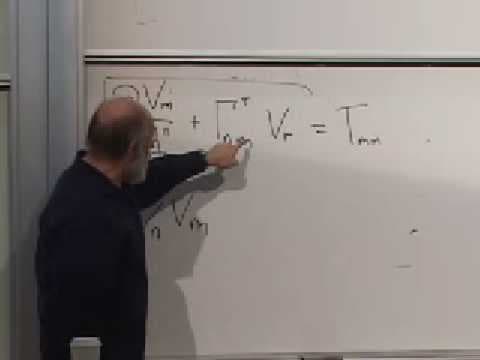
this presentation is delivered by the Stanford center for professional development we are on the air okay welcome one and all and as I said on the TV when you were walking in but just to make sure everybody knows this is e261 the fora transform and its applications forier transforms at all forier and my name is Brad Osgood circulating around are tw... Read More
Install to Summarize YouTube Videos and Get Transcripts
Explore YouTube Video Summarizer or Get YouTube Transcript Extractor
Summary
This is a presentation delivered by the Stanford Center for Professional Development about the Fourier transform and its applications. The speaker introduces the course and its partners, provides information about the syllabus and schedule, and mentions the availability of the course reader and taped lectures. He discusses the importance of Fourier series and the Fourier transform in the analysis of periodic phenomena, as well as the mathematical descriptors of periodicity in time and space. He also mentions the relationship between frequency and wavelength in wave motion.
Questions & Answers
Q: What documents are being circulated in the class?
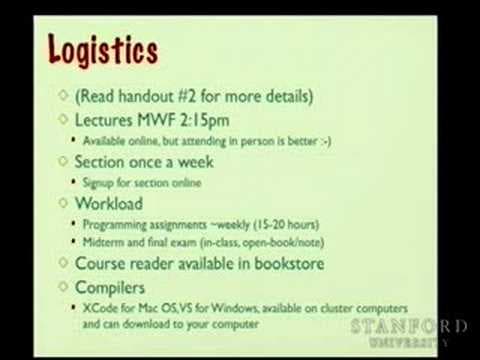
There are two documents being circulated that provide information about the class: a general description and course information, and a syllabus and schedule.
Q: How can students access course handouts and announcements?
Students can access course handouts and announcements through the course website. They must register on the website to receive emails and access materials.
Q: What is the purpose of the syllabus and schedule?
The syllabus and schedule outline what will be covered in the course and provide a plan for reading. It is important for students to read the material thoroughly before each class to get the most out of the lectures.
Q: Are there any exams in the course?
Yes, there are two exams scheduled: a midterm exam and a final exam. The midterm exam will be outside of class and will be longer than the usual 15 minutes to allow for more comprehensive coverage. The final exam will be scheduled by the registrar's office.
Q: What assignments will students have?
Students will have regular problem sets to complete. The first problem set will be handed out on the first day of class and will be due the following Wednesday. The problem sets may include one or two MATLAB problems, so students should have some experience with using MATLAB.
Q: What is the course reader?
The course reader is a compilation of lecture notes used in the class. It is available at the bookstore and on the course website. While the organization may be a bit odd, it serves as a helpful companion for the class material. Students are encouraged to provide feedback and suggestions for improvement.
Q: Will the lecture be available to the public?
Yes, the lectures will be available to the public on the course website. This is an experimental initiative by Stanford to make some class materials accessible to the world. However, the instructor and TAs will only answer emails from registered students.
Q: What are the benefits of taking this class for electrical engineering students?
Taking this class allows electrical engineering students to see the material of Fourier analysis in one piece, enhancing their understanding of the core ideas and methods. It provides an opportunity to synthesize their previous knowledge and gain new perspectives on the subject.
Q: How is Fourier series related to the study of periodic phenomena?
Fourier series is closely associated with the analysis of periodic phenomena, whether they are periodic in time or space. It provides a mathematical framework for breaking down a signal into simpler constituent parts and synthesizing it back together. The subject also involves linear operations, making it linked to the study of linear systems.
Q: How are frequency and wavelength used to describe periodicity in wave motion?
In wave motion, frequency is used to describe the number of times a pattern repeats in one second, while wavelength is used to describe the distance the wave travels in one cycle. There is a reciprocal relationship between frequency and wavelength, with the velocity of the wave acting as the constant of proportionality. This relationship is governed by the formula distance equals rate times time.
Read in Other Languages (beta)
Share This Summary 📚
Summarize YouTube Videos and Get Video Transcripts with 1-Click
Try YouTube Summary with ChatGPT & Claude or YouTube Transcript Generator
Explore More Summaries from Stanford 📚
Summarize YouTube Videos and Get Video Transcripts with 1-Click
Try YouTube Summary with ChatGPT & Claude or YouTube Transcript Generator