How to Rank a Local Business on Google With Claude Code
TL;DR
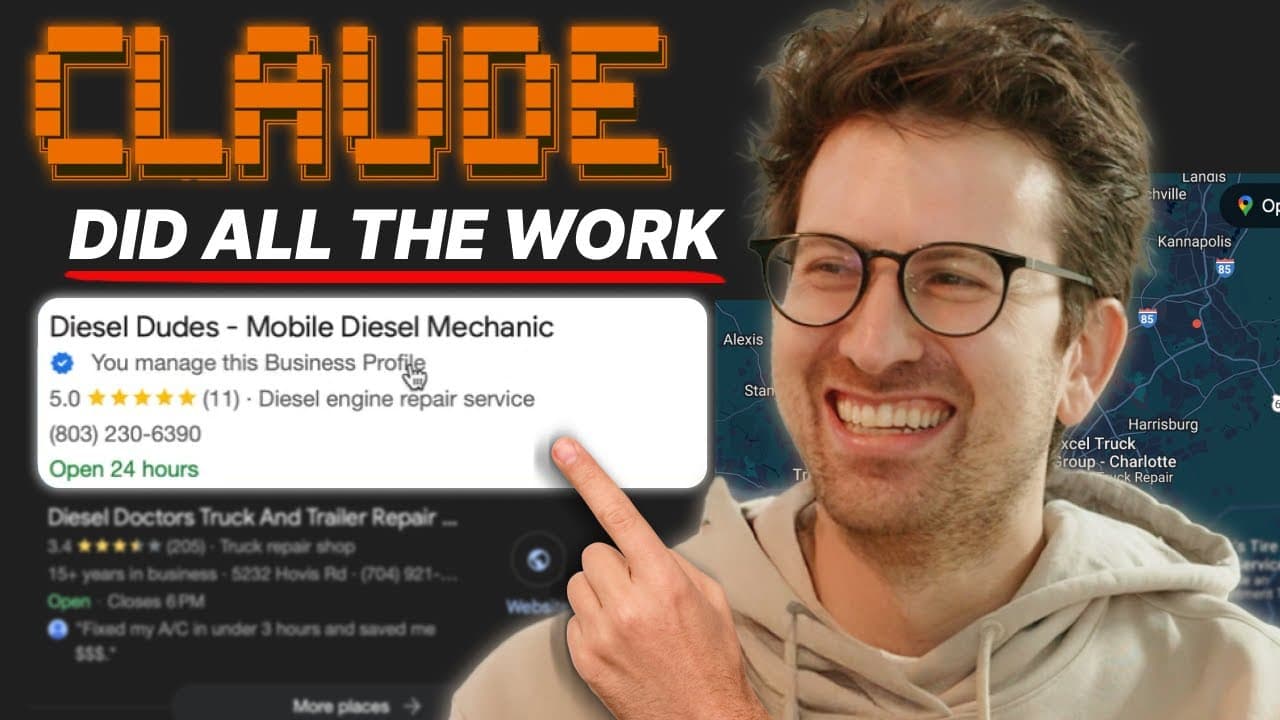
Using Claude Code, a local mobile diesel truck repair website with 50+ optimized pages was built in about four hours and ranked in Google's top three spots for multiple target keywords. The playbook asks AI for 25 to 50 keywords, sorts them by search intent and buying stage, then fixes technical SEO and writes locally relevant content. The site brought in thousands of dollars within 24 hours.
Transcript
Everyone wants to build GPT rappers, micro SAS. I get it. It's super super sexy. But there's a huge opportunity right now to be using AI for boring businesses. I brought on the boring marketer and he shares the story of how in less than 24 hours, he ranked one of his boring businesses on Google in the top three spots for multiple target keywords an... Read More
Key Insights
- Local service businesses are a large opportunity for AI-savvy builders because competitors often have not updated their websites in 10 or 15 years and still run on notepads and spreadsheets, so basic SEO can outrank them quickly.
- Claude Code handled all of the work on the diesel repair website. The site went live in about four hours over a weekend, covering what James described as months of SEO work, including more than 50 pages.
- Local SEO is far from dead because people with urgent problems, like a trucker broken down on the highway, open Google, check reviews and tap the call button. They do not ask ChatGPT to research mechanics for them.
- Keyword research for a local market can skip complex tools and metrics. Give ChatGPT o3 or Claude your website and goal, and ask for 25 to 50 keywords to optimize the site around.
- The key to choosing keywords is sorting them by search intent and buying stage, which separates people ready to call for a repair right now from people who are only researching.
- Location pages that carry unique details, such as landmarks and specific information about each service area, plus internal links between pages, are a core part of the site's local SEO structure.
- A barbell strategy pairs online businesses like SaaS, services and communities with partner stakes in boring local businesses. Physical services such as repairing heavy-duty tractor trailers are hard for AI to disrupt in the next five years.
- Partnering works when the roles complement each other: the trucking company owner knew operations and had a mechanic relationship, while James supplied the website and marketing skills the business lacked.
Install to Summarize YouTube Videos and Get Transcripts
Explore YouTube Video Summarizer or Get YouTube Transcript Extractor
Questions & Answers
Q: How can Claude Code be used to rank a local business on Google?
Claude Code was used to build and optimize a website for a local mobile diesel truck repair business. It created more than 50 pages, including detailed location pages with landmarks and unique local information, plus internal links and technical SEO fixes. The site went live in about four hours and ranked in Google's top three spots for multiple target keywords.
Q: How do you do keyword research for a local business with AI?
Open ChatGPT o3, Claude or a similar tool, give it your website, explain what you are trying to do, and ask for a list of 25 to 50 keywords to optimize the site around. For a local market, James says you do not need to obsess over search volume, competition level or other metrics, because that often causes analysis paralysis.
Q: Why are boring local businesses a good opportunity for AI-savvy entrepreneurs?
Competition in local niches is often unsophisticated. Many competitors have not updated their websites in 10 or 15 years and still run on notepads and spreadsheets. Someone who knows AI tools can partner with operators and build marketing that makes real money quickly, as the diesel repair site showed by bringing in thousands of dollars within 24 hours of its updates.
Q: Is SEO still worth doing for local service businesses?
Yes. James says SEO is not dead at the local level and is actually a big opportunity right now. When someone has an urgent need, like a broken-down truck, a broken air conditioner or a broken window, they open Google, look for good reviews and call. He estimates this is how 99.9 percent of local service searches work, rather than asking an AI chatbot to do research.
Q: What does it mean to sort keywords by search intent and buying stage?
Sorting by search intent and buying stage means separating keywords used by people who need repairs or service right now, and will pick up the phone to call a company, from keywords used by people who are only gathering information. For a local service business, the first group matters most because those searches turn directly into calls and revenue.
Q: What is the barbell strategy for hedging against AI disruption?
The barbell strategy puts digital assets on one side, such as online service businesses, SaaS tools and a community. On the other side are partner stakes in boring local businesses that are hard for AI to disrupt. James reasons that if AGI arrives by around 2030 and disrupts digital services, physical work like fixing heavy-duty tractor trailers will still be needed for years.
Q: How long did it take to build the diesel repair website and see results?
James built the site over a weekend in about four hours, using Claude Code to complete what he called months of SEO work and push it live. Within 24 hours of the updates going live, the business made thousands of dollars in revenue. The phone kept ringing, and the mechanic was fully booked for the next few days.
Q: What should local service website location pages include for SEO?
Each location page on the diesel repair site contained a lot of detail about the area it served, including landmarks and unique information about that location. The pages linked to each other through internal links and connected to individual service pages. James notes that an SEO or digital marketing agency would charge a lot to build and optimize 50+ pages like these.
Summary & Key Takeaways
-
James, known as The Boring Marketer, teamed up with a friend who runs a small trucking company and knows a local mechanic. Together they launched a mobile diesel repair service. James built the website with Claude Code in about four hours, and within 24 hours the phone was ringing and the mechanic was booked for days.
-
James argues that boring local businesses are a big, overlooked opportunity while everyone else builds GPT wrappers and micro SaaS. Local competition is unsophisticated, and physical services offer a hedge against heavy AI disruption of digital businesses, possibly with AGI arriving by 2030, as part of a barbell strategy.
-
The SEO process starts with asking an AI model for 25 to 50 keywords, then sorting them by search intent and buying stage. Next come technical SEO fixes, content focused on local relevance, and detailed location pages. The episode also covers matching Figma designs with Anima and setting up a Claude Code development environment.
Read in Other Languages (beta)
Share This Summary 📚
Summarize YouTube Videos and Get Video Transcripts with 1-Click
Try YouTube Summary with ChatGPT & Claude or YouTube Transcript Generator
Explore More Summaries from Greg Isenberg 📚




Summarize YouTube Videos and Get Video Transcripts with 1-Click
Try YouTube Summary with ChatGPT & Claude or YouTube Transcript Generator