How to Implement SARSA in Python Using Numpy
TL;DR
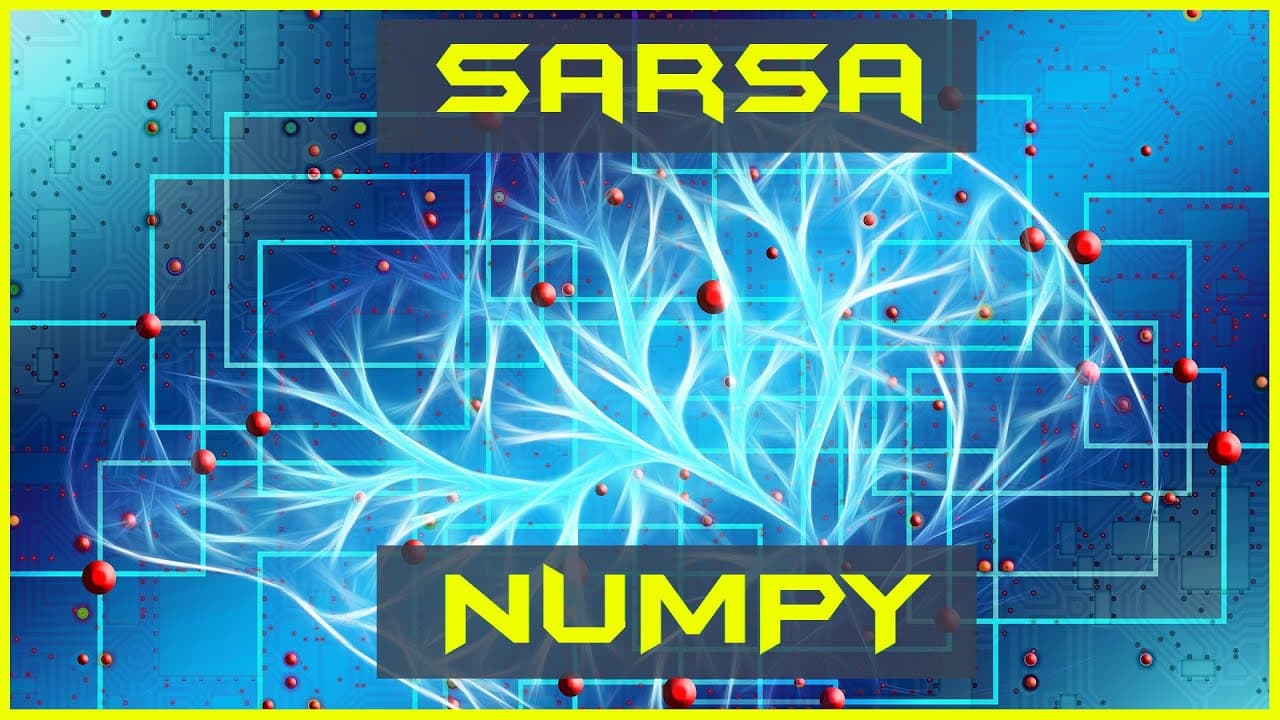
To implement the SARSA algorithm in Python using Numpy, start by setting up the OpenAI Gym environment and understanding its state and action spaces. Then, discretize continuous observations and initialize a Q-table for state-action pairs. Finally, run episodes to learn through exploration and exploitation, updating the Q-values based on rewards received.
Transcript
what is up everybody welcome back to another reinforcement learning tutorial in the open AI gym in this episode you're gonna learn how to go from nothing to a fully implemented source and algorithm using only numpy matplotlib and jim if you've ever struggled with reinforcement learning if you've ever wanted to get started with reinforcement learnin... Read More
Key Insights
- ℹ️ The tutorial focuses on implementing a source algorithm for reinforcement learning using numpy, matplotlib, and OpenAI Gym.
- 👾 The content highlights the importance of understanding the environment documentation and how to deal with continuous state spaces.
- 😆 The SARSA algorithm is explained as a method to learn and update the Q-value estimates for state-action pairs.
- 💾 The tutorial also covers saving and loading the model using the pickle module.
- 💁 The author provides practical coding examples and tips throughout the tutorial.
- 👾 The importance of exploring the state and action spaces is emphasized, as well as the need to discretize observations in order to work with tabular methods.
- ♻️ The tutorial showcases how reinforcement learning can be applied to solve the acrobat environment problem from OpenAI Gym.
Install to Summarize YouTube Videos and Get Transcripts
Explore YouTube Video Summarizer or Get YouTube Transcript Extractor
Questions & Answers
Q: What are the main libraries used in the reinforcement learning tutorial?
The tutorial primarily uses numpy, matplotlib, and OpenAI Gym libraries for implementing the source algorithm.
Q: How is the continuous state space converted into a discrete state space?
The tutorial suggests dividing the continuous state space into a set of discrete chunks or buckets. In this case, the author uses linspace to create 10 buckets to represent the state space.
Q: How does the SARSA algorithm work?
The SARSA algorithm starts by initializing the Q(si, a) estimates to zero for all state-action pairs. It then iteratively selects an action based on the current state and updates the Q estimates based on the reward, learning rate (alpha), and discount factor (gamma).
Q: How is the model of the environment saved?
The tutorial utilizes the pickle module to save and load the model. The model is saved as a byte file using pickle.dump() and loaded using pickle.load().
Summary & Key Takeaways
-
The tutorial teaches how to implement a source algorithm for reinforcement learning using numpy, matplotlib, and OpenAI Gym.
-
The content discusses the process of solving reinforcement learning problems, exploring the documentation, and understanding the environment.
-
The author explains how to deal with continuous state spaces, discretize observations, and implement the SARSA algorithm for learning.
Read in Other Languages (beta)
Share This Summary 📚
Summarize YouTube Videos and Get Video Transcripts with 1-Click
Try YouTube Summary with ChatGPT & Claude or YouTube Transcript Generator
Explore More Summaries from Machine Learning with Phil 📚


Summarize YouTube Videos and Get Video Transcripts with 1-Click
Try YouTube Summary with ChatGPT & Claude or YouTube Transcript Generator