What Is Q-Learning and How Does It Work?
TL;DR
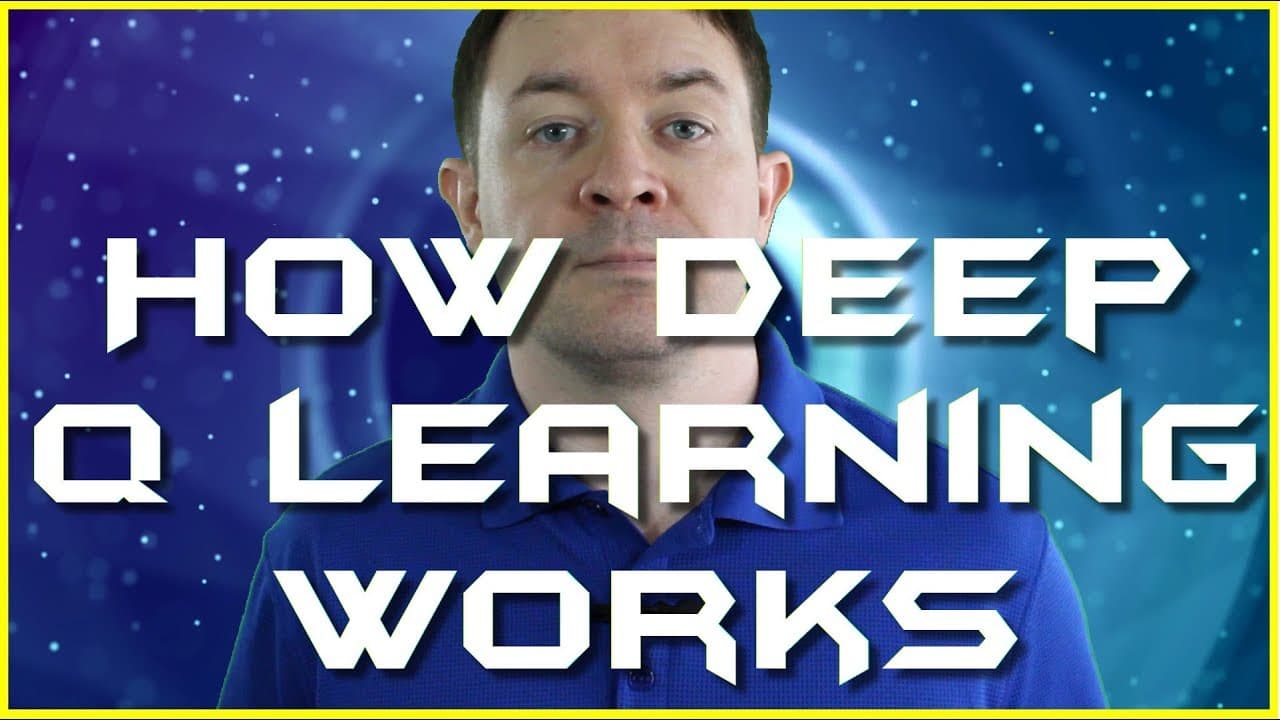
Q-learning is a reinforcement learning algorithm that enables agents to learn optimal strategies in uncertain environments by maximizing long-term rewards. It maps pairs of states and actions to expected future rewards using an epsilon-greedy strategy for action selection. In deep Q-learning, deep neural networks approximate these relationships, allowing for effective learning in complex environments.
Transcript
in this video you're gonna learn everything you need to know to implement cue learning from scratch you don't need any prior exposure to key learning you don't even really need much familiarity with reinforcement learning you get everything you need in this video if you're new here I'm Phil and I'm here to help you get started with machine learning... Read More
Key Insights
- ♻️ Q-Learning is an effective approach to maximizine rewards in uncertain environments by learning from the environment in real-time.
- 🇶🇦 Traditional Q-Learning uses a table to store state and action pairs, while deep Q-Learning utilizes deep neural networks for environments with a large number of states or continuous state space.
- ⚖️ Epsilon-greedy action selection is a strategy used by Q-Learning agents to balance exploration and exploitation of the environment.
- 🍵 Convolutional neural networks are used in deep Q-Learning to handle environments with pixel images.
- 🎯 Two networks, an evaluation network, and a target network are used in deep Q-Learning to eliminate bias during the learning process.
- 👾 Non-sequential random sampling of the agent's memory is important to avoid getting trapped in one corner of the parameter space.
- 🇶🇦 Popular frameworks for implementing deep Q-Learning include PyTorch and TensorFlow, both of which support model checkpointing.
Install to Summarize YouTube Videos and Get Transcripts
Explore YouTube Video Summarizer or Get YouTube Transcript Extractor
Questions & Answers
Q: What is the purpose of Q-Learning in reinforcement learning?
Q-Learning allows agents to maximize long-term rewards in uncertain environments by learning from the environment in real-time and making optimal decisions based on expected future rewards.
Q: How does epsilon-greedy action selection work in Q-Learning?
Epsilon-greedy action selection is a strategy used by Q-Learning agents. It involves the agent spending some time taking random actions to explore the environment and the remaining time selecting actions with the highest known expected future rewards.
Q: What is the difference between traditional Q-Learning and deep Q-Learning?
Traditional Q-Learning uses a table to store state and action pairs, while deep Q-Learning utilizes deep neural networks to approximate the relationship between states, actions, and rewards in environments with a large number of states or continuous state space.
Q: How does deep Q-Learning handle environments with pixel images?
In environments with pixel images, a convolutional neural network is used to perform feature extraction on the images. The output is then fed into a dense neural network to approximate the values of each action for the agent.
Summary & Key Takeaways
-
Q-Learning is a powerful solution in reinforcement learning that enables agents to learn from the environment in real-time and make optimal decisions based on expected future rewards.
-
It works by mapping pairs of states and actions to future rewards, using a strategy called epsilon-greedy action selection.
-
Traditional Q-Learning uses a table to store state and action pairs, while deep Q-Learning utilizes deep neural networks to approximate the relationship between states, actions, and rewards in environments with a large number of states or continuous state space.
-
(Content reviewed on 2026-08-27.)
Read in Other Languages (beta)
Share This Summary 📚
Summarize YouTube Videos and Get Video Transcripts with 1-Click
Try YouTube Summary with ChatGPT & Claude or YouTube Transcript Generator
Explore More Summaries from Machine Learning with Phil 📚


Summarize YouTube Videos and Get Video Transcripts with 1-Click
Try YouTube Summary with ChatGPT & Claude or YouTube Transcript Generator