How to Make Your Design Portfolio Pass a Fast Review
TL;DR
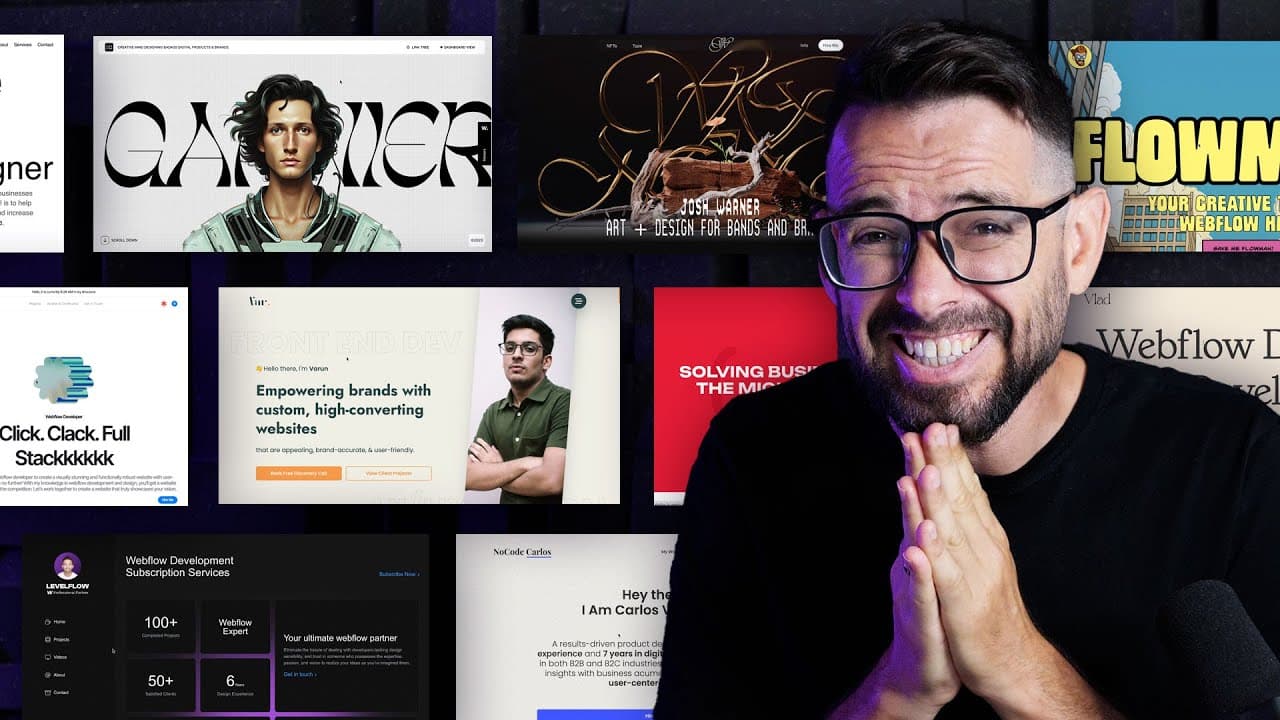
Hiring managers review portfolios in seconds, not minutes, so lead with strong work immediately. Show client projects fast, use professional typography and a professional headshot, keep layouts consistent, and avoid gimmicky concepts or interactions that hide your work. Trust is built in the first few seconds through clean design, social proof, and clear personality.
Transcript
in this video I'm going to try to review 50 portfolios super super fast and you're asking yourself why do it so fast that's not fair give the person enough time diving to their portfolio but the truth is I recently had to hire a designer and I got 550 portfolio applications if I would spend one minute reviewing a portfolio that would be over 10 hou... Read More
Key Insights
- Hiring managers review portfolios extremely fast because volume is huge. The reviewer received 550 portfolio applications for one designer role, and spending one minute each would take over 10 hours, which no hiring manager or client can afford to do.
- Strong portfolios build trust in the first few seconds through good typography, clean layout, good colors, and visible client work. When a designer's typography, interactions, and logos of real clients appear immediately, the reviewer can tell they are a good designer almost instantly.
- A creative concept can hurt more than help if it distorts how the work is presented. A comics-themed portfolio had appropriate typography for the concept, but the styling made the actual client work look unflattering and delayed showing what the person can design.
- Font pairing matters a lot for signaling design skill. Combining a serif with a slightly rounded sans-serif read as a weak combination and immediately made the reviewer doubt the designer's typography skills before even judging the work.
- A professional headshot builds trust while casual photos undermine it. Photos taken on a bridge or as selfies show personality but not professionalism, and the reviewer recommended AI photo tools when a photographer is unavailable.
- Interactions that make text unreadable damage a portfolio. One site changed paragraph size on scroll and only became legible at an exact scroll position, and another had a circle overlay making the scroll hard to read, both hurting usability.
- Consistency across project mock-ups signals a real portfolio. When each project used a completely different mock-up and visual style, it looked like four separate things rather than one cohesive body of work, and three identical iPhone mock-ups made distinct projects look duplicated.
- Too much text and premature calls to action overwhelm reviewers. A 'hire me' button appearing before any work is shown feels too early, and dense text blocks at the top make the reviewer feel overwhelmed instead of drawn in.
Install to Summarize YouTube Videos and Get Transcripts
Explore YouTube Video Summarizer or Get YouTube Transcript Extractor
Questions & Answers
Q: How fast do hiring managers actually review a design portfolio?
Hiring managers review portfolios extremely fast, often in seconds rather than minutes. The reviewer explains he received 550 portfolio applications for a single designer role, and spending just one minute on each would total over 10 hours, which he says no hiring manager or client can realistically do. Because of this volume, first impressions in the opening seconds determine whether your portfolio makes the shortlist.
Q: What makes a design portfolio build trust immediately?
Trust is built in the first few seconds through clean typography, good layout, good colors, smooth interactions, and immediately visible client work. In the strongest examples the reviewer could tell the person was a good designer right away because the work, logos of real clients, and overall presentation looked polished. Social proof such as recognizable clients, partner badges, and project counts also reinforces trustworthiness fast.
Q: Why can a creative concept hurt a design portfolio?
A creative concept can hurt when it distorts how the actual work is presented. The reviewer liked one designer's comics concept and found the typography appropriate to that theme, but felt it did not look like great typography for a designer and made the client work look unflattering. He concluded that while it was a cool creative idea, it may not be a good creative concept for a portfolio because it delays and undercuts showing real capability.
Q: What kind of photo should a freelance designer use in their portfolio?
A freelance designer should use a professional photo in a professional setting rather than a casual snapshot. The reviewer repeatedly criticized photos taken on a bridge, selfies, or pixelated images where the person was not even looking at the camera, saying they show personality but do not help build hiring trust. He noted that even without a photographer, AI tools can now generate a professional-looking photo.
Q: How should you present project mock-ups in a portfolio?
Project mock-ups should look consistent and clearly distinct from one another. The reviewer criticized one portfolio where three iPhone mock-ups looked identical, forcing him to study details to tell the projects apart, and advised making them look like three different things. He also faulted a portfolio where each project used a completely different mock-up style, making it feel like four unrelated things instead of one cohesive body of work.
Q: Why do certain scroll interactions hurt a portfolio?
Scroll interactions hurt when they make content hard to read. The reviewer flagged one site where a text effect changed the paragraph size and moved everything as he scrolled, and another where the design reacted to scroll so text was only legible at one exact scroll position. A circle overlay on another site also made the scroll hard to read. Interactions should enhance, not block, readability.
Q: What is wrong with putting too much text or an early hire-me button on your homepage?
Leading with dense text or a premature call to action overwhelms reviewers and asks for commitment too soon. The reviewer felt overwhelmed by portfolios with lots of front-page text and said a 'hire me' button appearing before he had seen any work was too early, since he knew nothing about the designer yet. He also disliked confusion between agency and personal branding when both a company name and a person appeared without clarity.
Q: When does typography and graphic design skill let a portfolio down?
Typography and graphic design let a portfolio down when the fundamentals are weak, even if the work is okay. The reviewer told several designers they could step up their graphic design skills in typography, layout, hierarchies, and iconography. He also criticized a portfolio shown entirely in black and white that looked like an error until hovered, saying the work looked fine but was not presented in a way that helped, which weakened the overall impression.
Summary & Key Takeaways
-
The reviewer explains he had to hire a designer and received 550 portfolio applications, making one-minute-each reviews impossible at over 10 hours. He recreates the real, rapid first-impression review process on portfolios submitted overnight via Twitter, seeing each for the first time on camera.
-
Top portfolios like Mathis and Yar win immediately with strong typography, trendy interactions, good colors, visible client work, and social proof that builds trust fast. Others like Corey and Vladimir show decent work but are undercut by concept-heavy framing or weak, generic font pairings.
-
Common failures include unprofessional or selfie-style photos, layouts that are overwhelming or all over the place, inconsistent mock-ups across projects, black-and-white presentation that looks like an error, and interactions that block readability. Several portfolios show fine work but present it in ways that fail to build trust.
Read in Other Languages (beta)
Share This Summary 📚
Summarize YouTube Videos and Get Video Transcripts with 1-Click
Try YouTube Summary with ChatGPT & Claude or YouTube Transcript Generator
Explore More Summaries from Flux Academy 📚

Summarize YouTube Videos and Get Video Transcripts with 1-Click
Try YouTube Summary with ChatGPT & Claude or YouTube Transcript Generator