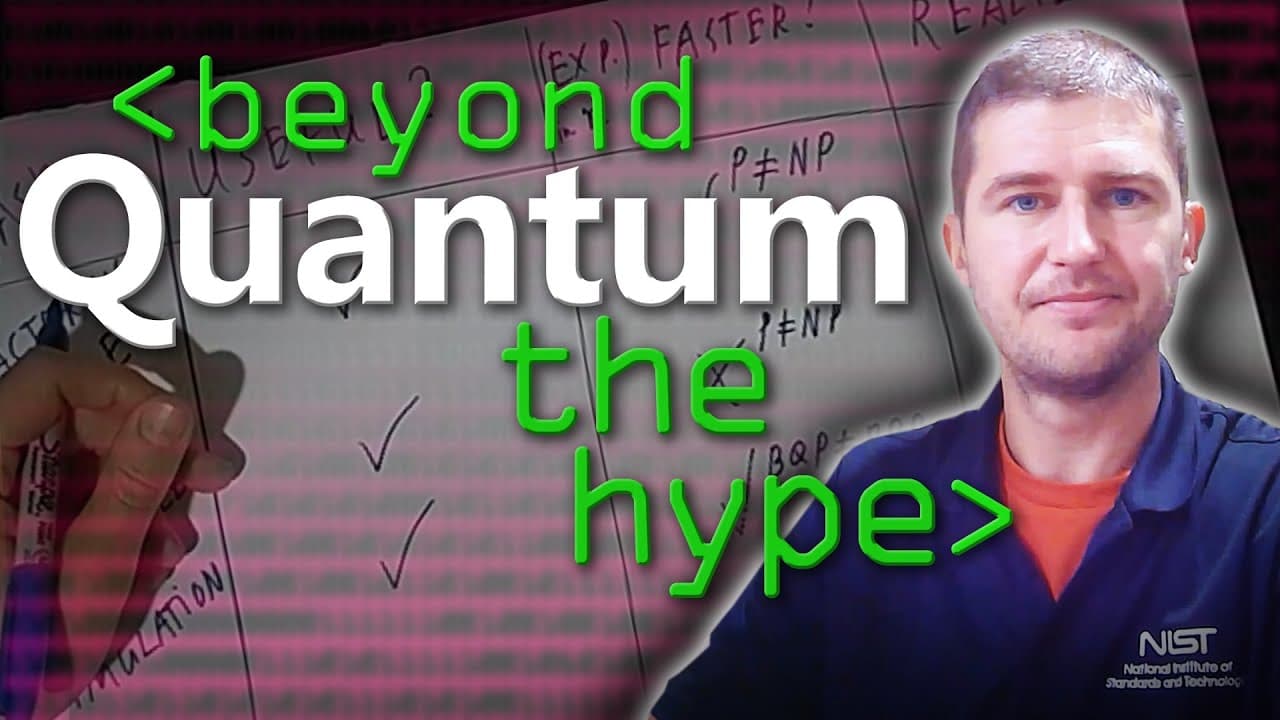
Quantum Computing in Reality (Pt3: Beyond the Hype) - Computerphile
TL;DR
Quantum computers have the potential to solve certain problems faster than classical computers, but there are still challenges in scaling up and maintaining the fragile quantum properties necessary for precise computations.
Transcript
we have this many body Quantum system and uh we can only view sort of bits and pieces of it at a time that's the bad news the good news is that we can utilize superposition and interference between uh the states of these systems but in order to be able to solve things faster than uh than classical computers this type of structure is only amenable t... Read More
Key Insights
- 💻 Quantum computers can leverage superposition and interference to solve certain problems faster than classical computers.
- ⚾ Different tasks can be categorized based on their usefulness, exponential scalability, and realization in the lab.
- 🧑🏭 Factoring large numbers, simulating quantum systems, and some quantum algorithms show promise but still require advancements in technology.
- 💻 Noise and fragility of quantum properties pose challenges in scaling up quantum computers.
- 💢 The era of scaling up to noisy intermediate scale quantum devices (NISQ era) is characterized by the need for error correction and fault tolerance.
- 👶 Quantum computers have the potential to yield new physics insights but have not yet made significant breakthroughs for practical problem-solving.
- 🏑 The development of quantum algorithms is an active and exciting area in the field of quantum computing.
Install to Summarize YouTube Videos and Get Transcripts
Explore YouTube Video Summarizer or Get YouTube Transcript Extractor
Questions & Answers
Q: What are the potential benefits of quantum computers over classical computers?
Quantum computers have the potential to solve certain problems faster due to superposition and interference between states. They can potentially factor large numbers and simulate quantum systems more efficiently.
Q: What are some tasks that quantum computers are believed to be able to perform better?
Factoring large numbers, simulating quantum systems, and certain quantum algorithms, such as ones related to optimization or search, are believed to be well-suited for quantum computers.
Q: Are there any limitations to quantum computing?
Quantum computers are still in the early stages of development and face challenges in scaling up and maintaining the fragile quantum properties needed for precise computations. They are also limited by noise, which affects the accuracy of calculations.
Q: Have quantum computers been able to solve real-world problems yet?
While quantum computers have shown promise in certain areas, such as simulating quantum systems, they have not yet significantly impacted real-world problem-solving. Further advancements and larger system sizes are needed for practical applications.
Summary & Key Takeaways
-
Quantum computers can utilize superposition and interference between states to solve certain problems faster than classical computers.
-
Tasks can be organized based on whether they are useful in the real world, exponentially faster with the number of qubits, or have been realized in the lab.
-
Factoring large numbers, simulating quantum systems, and various quantum algorithms show promise for quantum computers, but there are still limitations and challenges to overcome.
Read in Other Languages (beta)
Share This Summary 📚
Summarize YouTube Videos and Get Video Transcripts with 1-Click
Try YouTube Summary with ChatGPT & Claude or YouTube Transcript Generator
Explore More Summaries from Computerphile 📚






Summarize YouTube Videos and Get Video Transcripts with 1-Click
Try YouTube Summary with ChatGPT & Claude or YouTube Transcript Generator