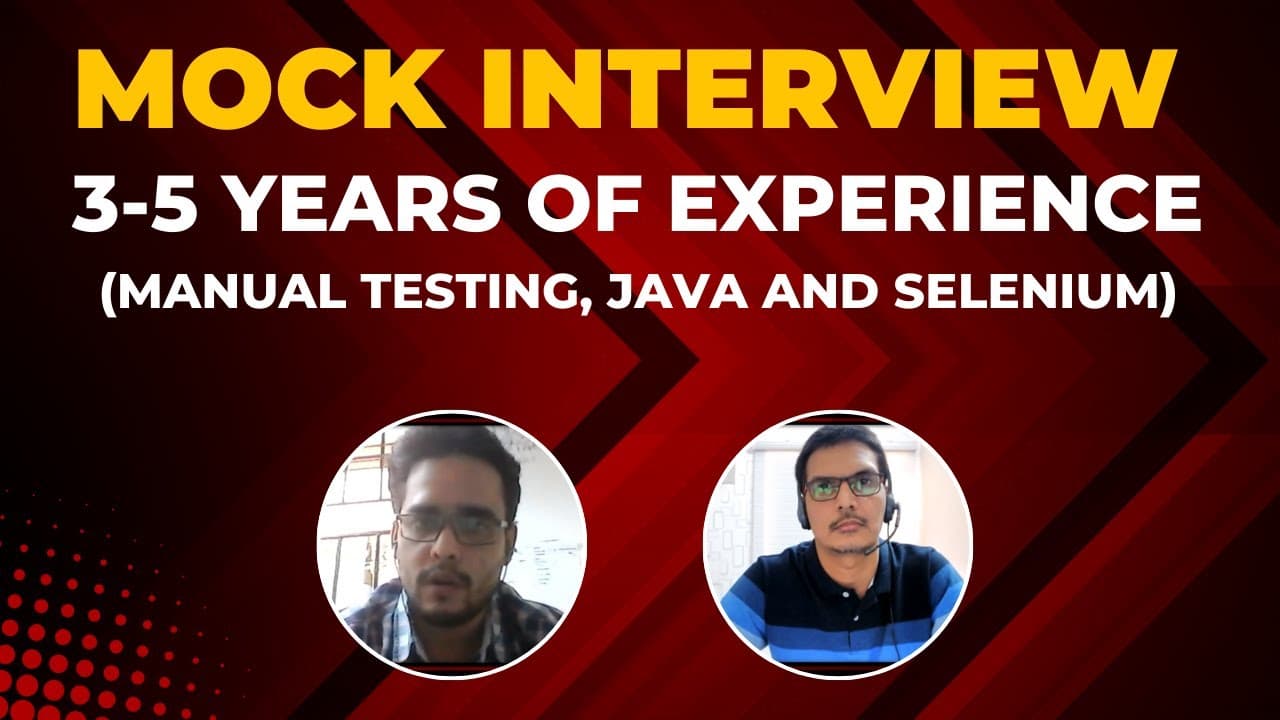
Automation Testing Mock Interview for 3–5 YOE: Manual Testing, Java, Selenium, TestNG, and Framework Questions
TL;DR
This automation testing mock interview shows how a QA candidate with 4.5 years of experience answers questions on manual testing, Java, Selenium, TestNG, and frameworks. Rahul explains test coverage, Agile challenges, integration testing, production-bug handling, test design techniques, and why regression automation begins after roughly four or five builds. Read on for direct answers to common interview questions and practical testing scenarios.
Transcript
okay so hi rahul welcome to mock interview so i have a four point of five years of experience so in manual testing as well as an automation testing so before starting so let me do some instructions okay so this video will be recorded and later it will be uploaded in youtube uh are you yeah no issue sir so i can see your profile which is in fr... Read More
Key Insights
- Test coverage is confirmed by checking the acceptance criteria set by the product owner, verifying end-to-end functionality works, and ensuring all basic and critical features function without any critical or blocker defects before declaring testing sufficient.
- Agile's main challenges are frequent requirement changes and communication gaps; frameworks must be designed to accept future changes, and poor documentation means testers must understand requirements very clearly since detail is discussed mainly in sprint planning.
- Integration testing verifies data flow between modules, confirming that data created in one module reflects correctly in another, especially when the second module requires that data to proceed with further testing.
- Regression testing is started only after four or five builds when the application's main and basic functionality becomes stable, because automating early is wasteful when features are still changing.
- Regression scope prioritizes frequently used functionality, critical scenarios, and smoke test scenarios first, while newly developed and unstable features are excluded from automation because they may still change.
- When a bug reaches production, the immediate steps are conducting a meeting to assess business impact, performing root cause analysis to locate whether the error is in coding or testing, fixing, retesting, then redeploying.
- Test case design techniques used before writing cases include boundary value analysis, error guessing, and equivalence partitioning, which help create standard cases covering the maximum number of scenarios.
- Identifying impacted areas from developer bug fixes is essential before regression testing; without knowing which modules the fixes affect, testers cannot select the relevant test cases to execute.
Install to Summarize YouTube Videos and Get Transcripts
Explore YouTube Video Summarizer or Get YouTube Transcript Extractor
Questions & Answers
Q: How do you ensure all application scenarios have been tested?
Review the product owner's acceptance criteria and confirm that the test cases reflect customer expectations. Verify the end-to-end business flow, basic and critical features, and ensure no critical or blocker defects remain. A traceability matrix and documentation for important features help track coverage.
Q: What challenges can testers face in the Agile process?
Frequent requirement changes make it difficult to manage work and consistently meet customer expectations, so the automation framework should accommodate future changes. Communication gaps and limited documentation can also cause unclear requirements, making sprint-planning discussions especially important.
Q: What is integration testing?
Integration testing verifies data flow between connected modules. For example, when data created in one module is required or displayed in another, testers confirm that it transfers correctly and supports the subsequent business flow.
Q: Which test case design techniques are used when writing test cases?
The candidate uses boundary value analysis, error guessing, and equivalence partitioning. These techniques help standardize test cases and cover the maximum number of relevant scenarios.
Q: What steps should a team take when a bug reaches production?
The team first meets to identify the bug and assess how it affects the customer's business flow. It then performs root cause analysis to determine whether the failure came from coding or testing, resolves the cause, retests the fix, and redeploys it to production.
Q: When should regression testing and automation begin?
Regression testing begins after roughly four or five builds, once the application's main and basic functionality is stable. Early features can be tested manually, while stable manual regression scenarios are later automated to avoid repetitive, time-consuming execution.
Q: Which scenarios should be prioritized during regression testing?
Start by running smoke scenarios and confirming that critical, basic, and end-to-end functionality works. Then test submodules and internal functionality, prioritizing frequently used and critical scenarios. Newly developed, unstable functionality should not be automated while it may still change.
Q: Why must testers identify impacted areas before regression testing?
Developer fixes may affect related modules, so testers need to understand the changed and impacted areas before choosing regression cases. Communication with developers and knowledge of the assigned module help identify relevant tests, while smoke and sanity checks confirm that the build is stable first.
Summary & Key Takeaways
-
The mock interview targets a candidate with 4.5 years in software testing, three of which are in automation using Java and Selenium. His project stack includes GitHub for storing test cases, Maven for build management, Jenkins for execution, and Jira for defect logging, following the Agile Scrum process.
-
The candidate explains ensuring full test coverage through acceptance criteria, end-to-end functionality checks, and traceability matrices. He conducted functional, integration, system, and regression testing but no performance testing, and applies boundary value analysis, error guessing, and equivalence partitioning when designing test cases.
-
He recounts missing an integration bug in his first project that required a hotfix, then describes production bug handling: impact meetings, root cause analysis, retesting, and redeployment. Regression begins only after the build stabilizes, requiring smoke and sanity checks plus knowledge of developer-fixed impacted areas first.
Read in Other Languages (beta)
Share This Summary 📚
Summarize YouTube Videos and Get Video Transcripts with 1-Click
Try YouTube Summary with ChatGPT & Claude or YouTube Transcript Generator
Explore More Summaries from SDET- QA 📚





Summarize YouTube Videos and Get Video Transcripts with 1-Click
Try YouTube Summary with ChatGPT & Claude or YouTube Transcript Generator