How Can We Trick AI Image Recognition Systems?
TL;DR
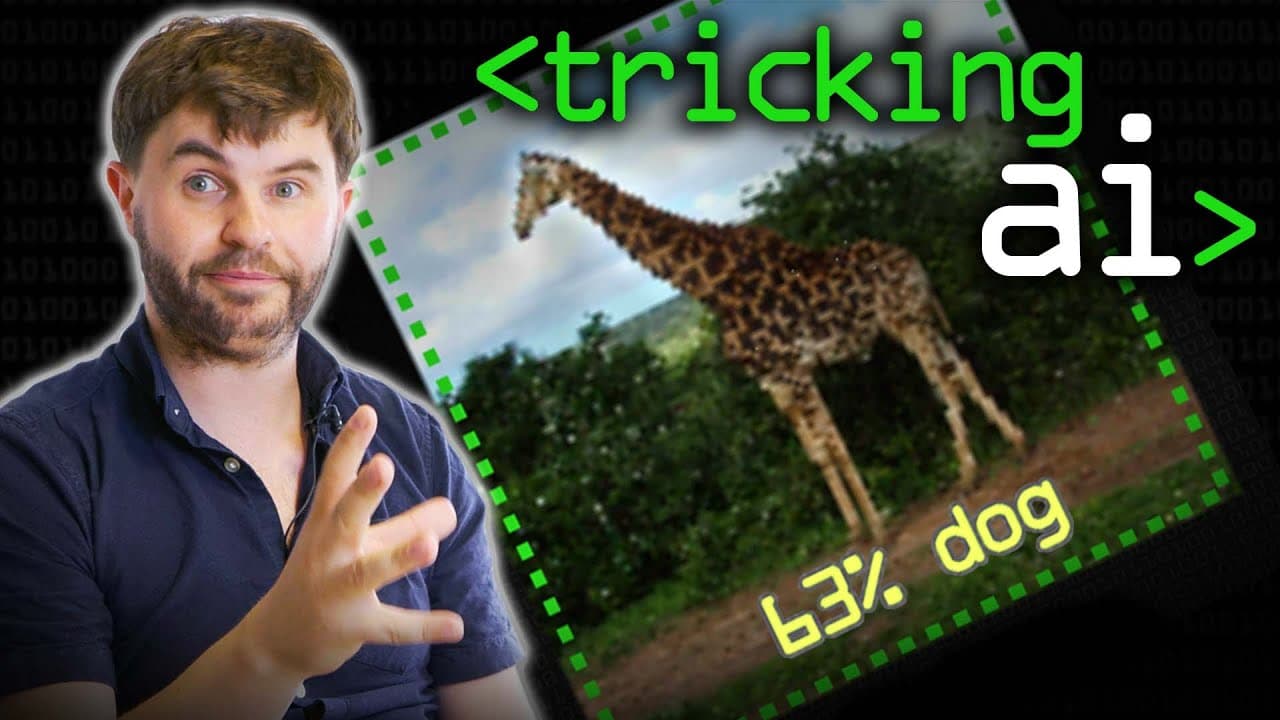
AI image recognition systems can be tricked by making small pixel changes to images, leading to misclassifications. This experiment reveals that while neural networks like ResNet excel at categorisation, their object detection methods differ significantly from human perception.
Transcript
so we are going to look at object object detection with neural networks and we are going to see if us humans detect objects in the same way as neural networks and to do this we are going to trick the neural networks and see if we are tricked in the same way let's do some object detection we're going to take a picture of something so we've got some ... Read More
Key Insights
- ✋ Neural networks like ResNet can achieve high accuracy in object detection tasks, considering the complexity of the ImageNet dataset.
- ❓ The internal workings of neural networks with numerous layers and parameters are difficult for humans to interpret.
- 💱 The experiment demonstrates that neural networks and humans perceive objects differently, as the changes made to trick the network do not align with human intuition.
- 💄 Neural networks can be easily fooled into misclassifying objects by making subtle changes to the image, highlighting vulnerabilities in their decision-making process.
- 🥺 With further refinement and optimization, neural networks could potentially be used for tasks like driving, but certain unexpected inputs may still lead to inaccurate classifications.
- 🛀 The experiment shows that using genetic algorithms and iterative approaches can yield results in changing the neural network's classification with minimal pixel alterations.
Install to Summarize YouTube Videos and Get Transcripts
Explore YouTube Video Summarizer or Get YouTube Transcript Extractor
Questions & Answers
Q: How does the neural network classify objects in an image?
The neural network provides a vector of probabilities for different objects in the image. The highest probability value corresponds to the detected object.
Q: What is the significance of the ImageNet repository in object classification?
ImageNet is a repository of annotated images used to test the classification abilities of neural networks. It contains a wide range of categories, making it a challenging task for neural networks to achieve high accuracy.
Q: Why is ResNet chosen for the experiment?
ResNet is a pre-trained neural network known for its performance in object detection. It has a relatively smaller size compared to other networks and can be run multiple times, making it suitable for the experiment.
Q: How can changing a single pixel in the image affect the neural network's classification?
Changing a single pixel can incrementally change the probability values associated with different objects. By carefully making these changes, it is possible to manipulate the neural network into misclassifying the object.
Summary & Key Takeaways
-
The experiment involves using an image of sunglasses and a pre-trained neural network called ResNet for object detection.
-
The neural network provides a vector of probabilities for different objects in the image, with the highest value indicating the detected object.
-
By incrementally changing pixels in the image, the neural network can be tricked into misclassifying the object as something else, such as a coffee mug, computer keyboard, envelope, golf ball, or photocopier.
Read in Other Languages (beta)
Share This Summary 📚
Summarize YouTube Videos and Get Video Transcripts with 1-Click
Try YouTube Summary with ChatGPT & Claude or YouTube Transcript Generator
Explore More Summaries from Computerphile 📚




Summarize YouTube Videos and Get Video Transcripts with 1-Click
Try YouTube Summary with ChatGPT & Claude or YouTube Transcript Generator