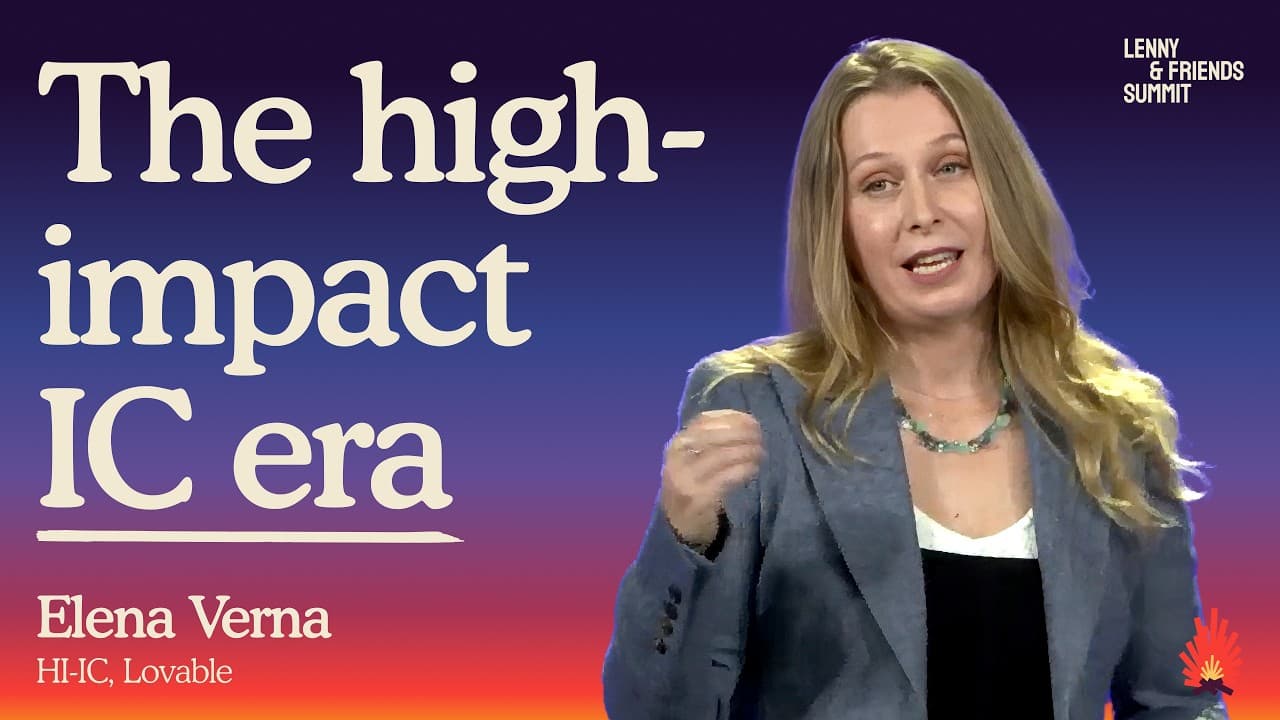
How to become a high impact IC in the AI era
TL;DR
High impact individual contributors can drive company outcomes by owning problems end to end, using AI as a tool to widen execution, and by reorganizing around capability rather than reports. Elena Verna argues that careers should value impactful work and autonomy over traditional ladders, with ongoing adaptability as AI reshapes roles and structures.
Transcript
I'm going to be talking today about something different. Usually I talk about productled growth, productled sales, uh, and how to grow your company. Today, I'd like to talk to you about how to grow your career. You're all incredible leaders already in this place. Uh but my career has taken a turn for something different about uh eight months ago an... Read More
Key Insights
- A high impact IC is defined by the ability to identify problems, decide, execute, and own outcomes across functions.
- AI-enabled average proficiency across many disciplines can be leveraged to achieve deep impact with relatively few specialists.
- The traditional ladder of manager to director to VP is changing as impact increasingly comes from output rather than reports.
- Organizations should design around capability and autonomy, enabling individuals to ship without heavy dependence on multi-month approval cycles.
- Change is constant in the current era, with frequent reorgs and role shifts that require flexible mindsets.
- Personal identity tied to managerial titles can hinder adaptation; embracing a non-traditional path can unlock greater influence and job satisfaction.
- Individuals should own pricing, prototyping, deployment, and user research to accelerate learning and customer feedback loops.
- Effective ICs use AI as a force multiplier to reduce coordination costs and shorten the time from idea to impact.
Install to Summarize YouTube Videos and Get Transcripts
Explore YouTube Video Summarizer or Get YouTube Transcript Extractor
Questions & Answers
Q: How does Elena Verna redefine the measure of career impact?
Elena argues that true career impact is not about how many people you manage, but about your ability to ship, iterate, and own outcomes across functions. The emphasis shifts from the number of reports to the breadth of execution and decision making that delivers tangible business results. This perspective invites experienced builders to pursue roles where they can influence products and customers directly, regardless of traditional titles.
Q: What changes in organizational design does she advocate for AI readiness?
She suggests redesigning organizations to leverage AI by granting experienced builders access to information, authority to decide, and compensation that reflects their impact. The idea is to move away from a default management track toward a framework where high impact ICs can operate with autonomy, reduce cross functional bottlenecks, and align incentives with fast, customer driven outcomes.
Q: What personal transition did she experience at Lovable?
Verna describes shifting from leading a growth function to becoming an individual contributor, an adjustment that challenged her identity but ultimately allowed her to contribute directly to pricing, prototyping, deployment, and user research. The transition demonstrated that impact can be maintained or even increased when a practitioner focuses on execution rather than management responsibilities.
Q: How does AI influence the required skill set for ICs?
AI lowers the barrier to broad execution by providing capabilities across disciplines, enabling an average level of proficiency in multiple areas to combine with a few areas of exceptional craft. This allows ICs to learn quickly from customer feedback, make informed decisions, and execute with speed, enhancing their ability to own end to end outcomes.
Q: Why does she compare the ladder to an industrial revolution?
She uses the analogy to describe rapid, systemic change in work roles driven by AI and automation. Just as industrial revolutions reshape how work is organized and performed, the current AI shift necessitates flexible career paths, ongoing learning, and rethinking leadership to stay relevant and impactful.
Q: What is meant by a high impact IC with broad executional surface?
A high impact IC possesses deep expertise in a core area but applies it across multiple functions to drive outcomes. They can design, build, test, deploy, and iterate with minimal dependency on formal project rituals, using AI tools to augment decision making and execution while owning the final result.
Q: What role does customer feedback play in her approach?
Customer feedback is central to the iteration loop. ICs should rapidly test ideas, observe customer responses, and adjust strategies accordingly. This feedback loop accelerates learning, reduces the need for lengthy approval cycles, and helps ensure that the product and pricing choices align with real user needs.
Q: How should professionals view changing roles in the near term?
Professionals should anticipate role changes and welcome them as opportunities rather than threats. By focusing on impact, autonomy, and continuous learning, workers can maintain influence and satisfaction even as titles and structures evolve. This mindset is essential for thriving in an AI-enabled, rapidly changing workplace.
Summary & Key Takeaways
-
Elena Verna describes leaving management to become an IC and argues that impact should be measured by outcomes and execution rather than headcount. She emphasizes AI as an enabler that broadens an IC’s surface, not just a tool for isolated tasks.
-
The talk highlights frequent reorgs and the need to adapt organizational design so individuals can ship quickly, learn from feedback, and maintain influence without climbing traditional ladders.
-
The speaker shares personal reflection on identity and fulfillment when changing roles, stressing that willingness to change and continuous learning are key in the evolving AI-driven workplace.
Read in Other Languages (beta)
Share This Summary 📚
Summarize YouTube Videos and Get Video Transcripts with 1-Click
Try YouTube Summary with ChatGPT & Claude or YouTube Transcript Generator
Explore More Summaries from Lenny's Podcast 📚

Summarize YouTube Videos and Get Video Transcripts with 1-Click
Try YouTube Summary with ChatGPT & Claude or YouTube Transcript Generator