MDE under the Hood (Model Driven Engineering) - Computerphile
TL;DR
This content discusses the process of building a modeling language for model-driven engineering and its various components.
Transcript
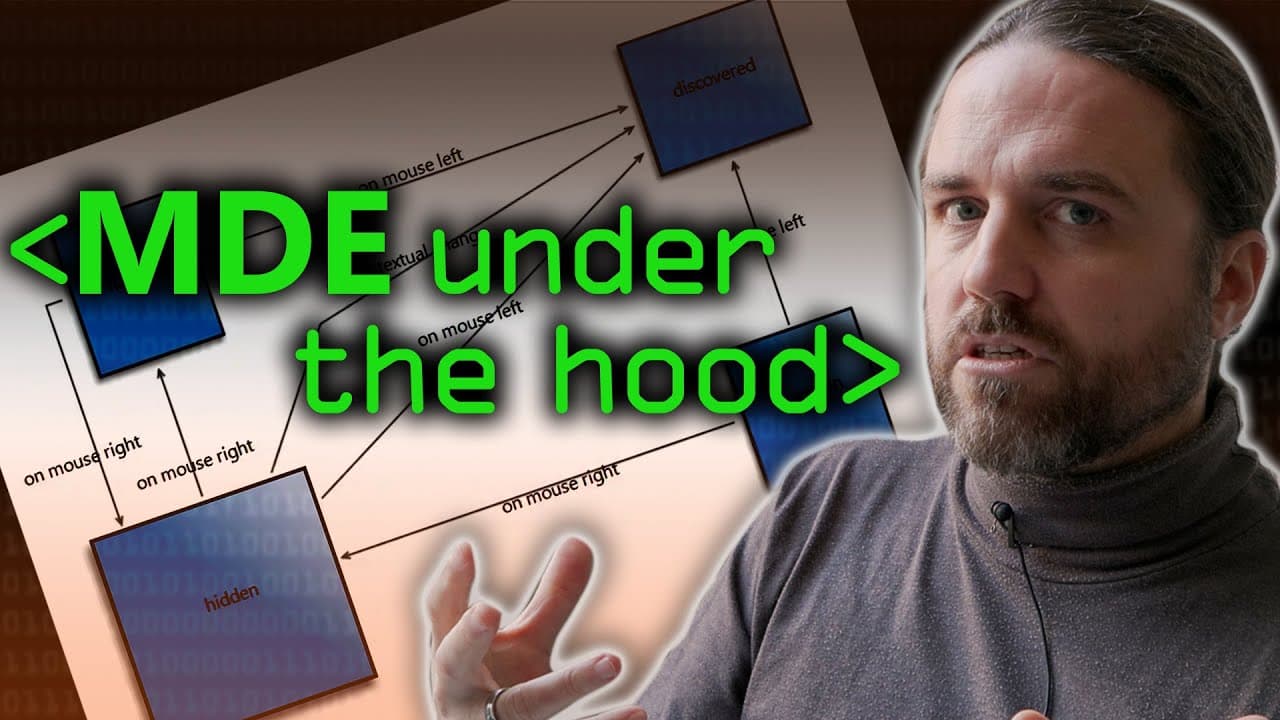
so we started out I think last time talking about this this grid games language as an example of of a modeling language that one might use in the model driven engineering approach to building software and so what I think I wanted to do today is talk a little bit about how that language was built how how I've built that language how built the infras... Read More
Key Insights
- 🧑🏭 The abstract syntax defines the concepts and relationships in a modeling language, acting as the foundation of the language.
- 👻 Concrete syntax, defined through a grammar, allows users to interact with the language through text and enables the editing, storage, and manipulation of models.
- 👨💻 Code generation techniques enable the generation of code infrastructure based on the information stored in the model, providing automation and consistency in the language implementation.
- 🏛️ Building a modeling language is beneficial in complex projects where similar systems will be built repeatedly, as it allows for better control, analysis, and reuse of models.
Install to Summarize YouTube Videos and Get Transcripts
Explore YouTube Video Summarizer or Get YouTube Transcript Extractor
Questions & Answers
Q: What are the three main components of a modeling language in model-driven engineering?
The three main components are abstract syntax, concrete syntax, and semantics. Abstract syntax defines the concepts and their relationships, concrete syntax defines how to interact with the language through text, and semantics provides meaning to the concepts.
Q: How is the concrete syntax of a language defined?
The concrete syntax is defined through a grammar, which sets rules for patterns that can be instantiated in the text. These rules define the structure of the language and allow for text editing, storage, and other interactions.
Q: How is code infrastructure generated for a language?
Code infrastructure can be generated through code generation techniques. The information from the model is navigated to find the necessary data, which is then used to generate code. This allows for automation and consistency in the language implementation.
Q: Why is building a modeling language necessary instead of using a library?
Building a modeling language provides flexibility and additional capabilities. It allows for multiple concrete syntaxes, graphical representations, and the ability to capture expertise from different stakeholders. Libraries, on the other hand, may be limited by the capabilities of the host programming language.
Summary & Key Takeaways
-
The content discusses the three main components of a modeling language in model-driven engineering: abstract syntax, concrete syntax, and semantics.
-
The author explains how the concrete syntax of the language is defined through a grammar, and how it can be used to interact with the model.
-
The content also explores the use of code generation to generate code infrastructure and demonstrates the process of generating classes for individual cells in the language.
Read in Other Languages (beta)
Share This Summary 📚
Summarize YouTube Videos and Get Video Transcripts with 1-Click
Try YouTube Summary with ChatGPT & Claude or YouTube Transcript Generator
Explore More Summaries from Computerphile 📚





Summarize YouTube Videos and Get Video Transcripts with 1-Click
Try YouTube Summary with ChatGPT & Claude or YouTube Transcript Generator