How Do Algorithms Work at Five Levels of Difficulty?
TL;DR
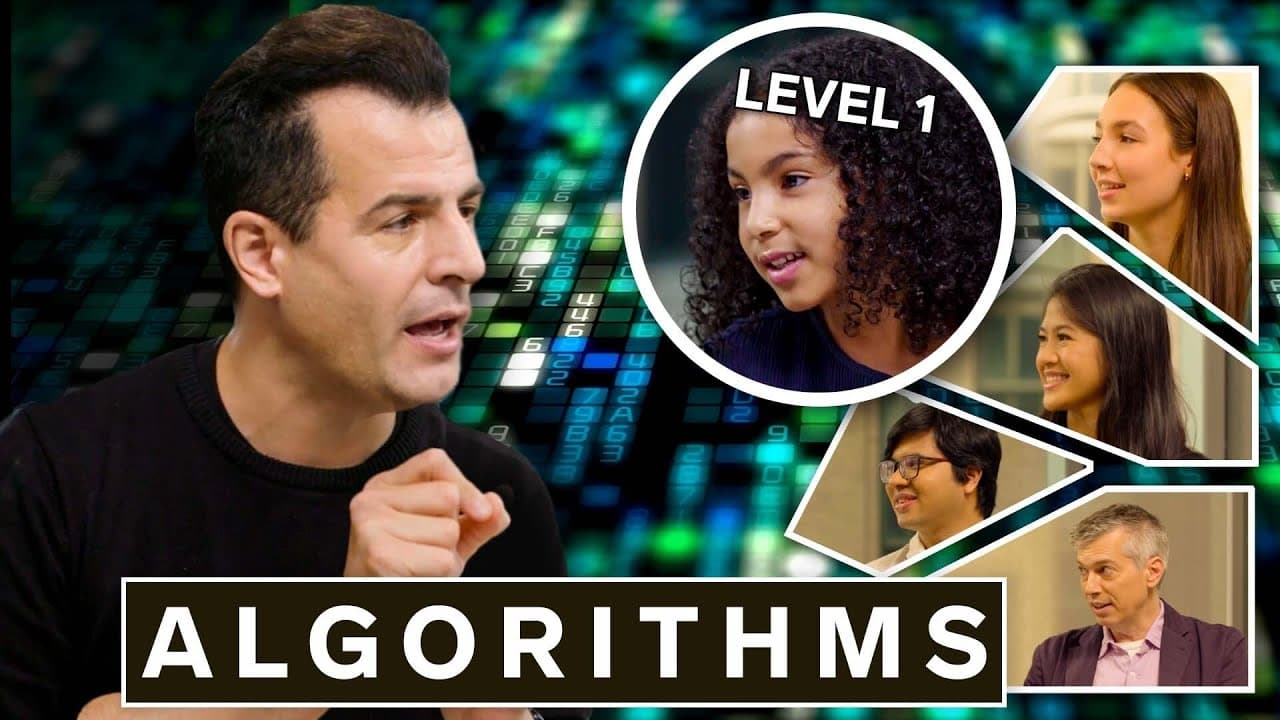
Algorithms are step by step instructions that solve problems and can be optimized with techniques like looping and binary search. The video shows five levels of explanation from a child to an expert to illustrate how algorithms appear in everyday tasks and in computers, highlighting the need for precision and clear instructions.
Transcript
- Hello world. My name is David J. Malan and I'm a professor of computer science at Harvard University. Today, I've been asked to explain algorithms in five levels of increasing difficulty. Algorithms are important because they really are everywhere, not only in the physical world, but certainly in the virtual world as well. And in fact, what excit... Read More
Key Insights
- Algorithms are step by step instructions to solve problems.
- Precision in instructions is critical for correct execution.
- Computers follow algorithms exactly as written, making clarity essential.
- Loops enable repeated actions to solve problems efficiently.
- Divide and conquer techniques reduce search space dramatically.
- Different audiences require different levels of explanation for the same concept.
- Real world tasks can be broken into algorithmic steps, like routines or recipes.
- Understanding algorithms helps explain everyday technologies like search and data organization.
Install to Summarize YouTube Videos and Get Transcripts
Explore YouTube Video Summarizer or Get YouTube Transcript Extractor
Questions & Answers
Q: A real search query question about the video How do algorithms work at five levels of difficulty
What is an algorithm and why is it important across different levels of understanding? An algorithm is a list of precise instructions designed to perform a task or solve a problem. It matters because clear steps prevent mistakes, especially when instructions are translated into computer programs. From a child to an expert, the foundational idea remains the same, but the depth of explanation increases, illustrating how complex problems can be approached methodically.
Q: What makes precision so important in algorithm design
Precision matters because vague instructions lead to incorrect outcomes. In the video, an imprecise peanut butter sandwich procedure shows how small mistakes in steps can cause failures or unintended results. In computing, exact instructions determine how a program behaves, how data is processed, and whether results are correct, reliable, and reproducible across runs.
Q: How do loops help in solving problems
Loops allow repeated execution of a set of instructions, which is essential for handling tasks where the number of iterations is not fixed. The video demonstrates looping in the context of searching a list or phone book, where repeating actions efficiently narrows down possibilities. Without loops, many tasks would require manual repetition and would be far less scalable.
Q: What is the divide and conquer approach shown in the video
Divide and conquer is shown as repeatedly halving the problem space to locate a target faster. By discarding half of the search area, the method dramatically reduces the number of steps needed. This concept underpins many efficient algorithms and explains why certain strategies outperform naive linear search.
Q: How does the five level format help explain algorithms
The five level format facilitates learning by progressively increasing complexity. It starts with a child’s perspective, moves through a teen and college student, and ends with a grad student and expert. This structure demonstrates how the same core concepts scale with depth of understanding, illustrating intuition before formalism.
Q: Why is alphabetizing contacts useful in the context of algorithms
Alphabetizing contacts makes retrieval faster by imposing a structured order rather than a random one. Efficient data access is a fundamental algorithmic problem; sorting, indexing, and searching are core techniques that improve performance. The video uses this example to bridge everyday experience and computational thinking, showing how good data organization reduces effort and time.
Q: What do these five levels reveal about problem solving in real life
They reveal that most daily tasks involve algorithmic thinking, even if we do not name it. From getting ready in the morning to deciding how to search information, humans naturally follow step by step plans. The five levels show how formal algorithmic thinking underpins both simple routines and complex computing tasks.
Q: How can someone start applying these ideas to learning programming
Begin with simple, concrete tasks and describe them as step by step instructions. Then practice turning those steps into pseudocode, focusing on precision. Gradually introduce loops and conditionals, and practice on real problems like sorting a list or searching a directory. This builds intuition for how algorithms structure solutions and prepares you for actual code implementation.
Summary & Key Takeaways
-
Algorithms are everywhere and consist of precise steps that tell a computer or a person how to solve a problem. The five levels demonstrate how understanding grows with audience sophistication, from basic ideas to formal techniques. Precision and structure are essential for correct outcomes in real world tasks and programming.
-
The demonstration uses everyday examples like making a sandwich and finding a name in a phone book to show how simple problems become more complex when scaled. It also explains how looping and dividing the search space improve efficiency. The goal is to convey core ideas without assuming advanced prior knowledge.
-
The talk emphasizes that computers execute instructions exactly as written, which is why clear, unambiguous algorithms matter. It connects these ideas to search engines and internet use, where precise queries and well designed algorithms yield correct results quickly.
Read in Other Languages (beta)
Share This Summary 📚
Summarize YouTube Videos and Get Video Transcripts with 1-Click
Try YouTube Summary with ChatGPT & Claude or YouTube Transcript Generator
Explore More Summaries from WIRED 📚






Summarize YouTube Videos and Get Video Transcripts with 1-Click
Try YouTube Summary with ChatGPT & Claude or YouTube Transcript Generator