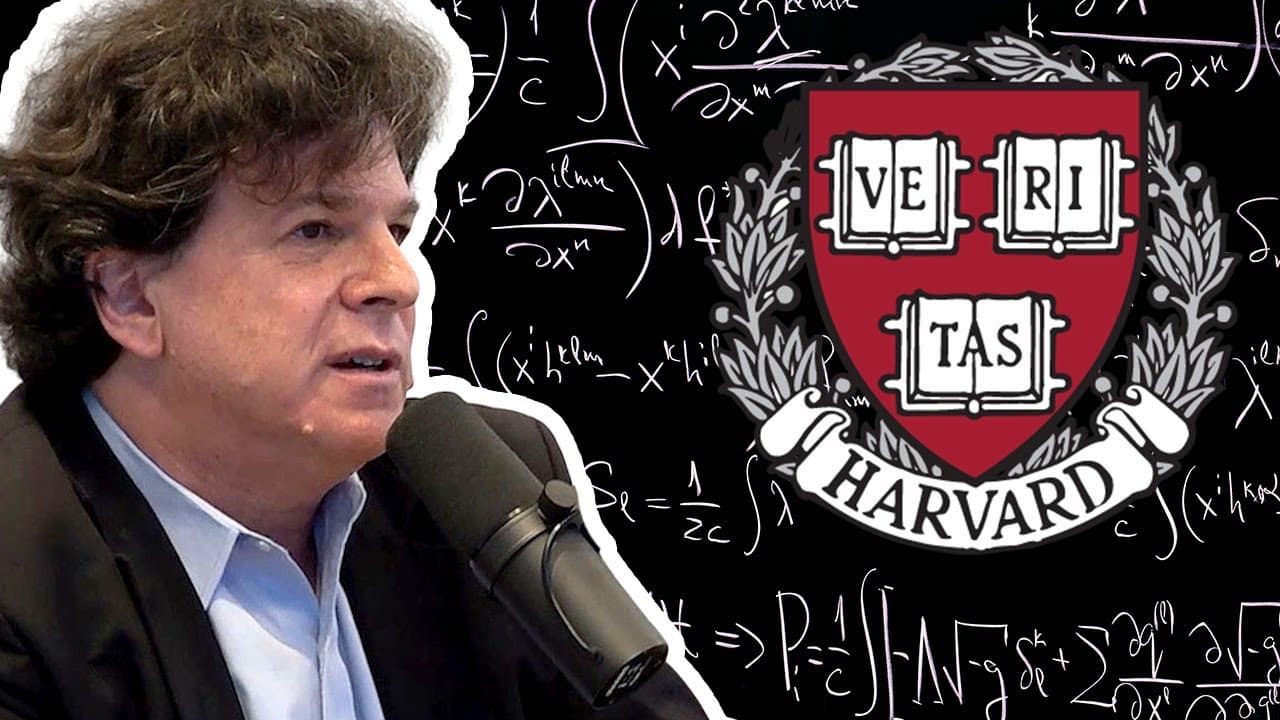
Eric Weinstein's Harvard Story - The System Breaks Down in Novel Situations | AI Podcast Clips
TL;DR
Harvard's academic environment harbors a hidden parallel system that excludes many bright minds from crucial opportunities. The speaker's experience with a secret seminar exposes how closed meetings and private communications dictate success, revealing the often-deceptive nature of academic institutions. This systemic issue underscores the need for significant reform to ensure equitable access and support for all aspiring scholars.
Transcript
without naming names can you tell the story of your struggle during your time at Harvard maybe in a way that tells the bigger story of the struggle of young bright minds that are trying to come up with big bold ideas within the institutions that we're talking about you can start I mean in part it starts with coffee with a couple of Croatians in the... Read More
Key Insights
- 🔒 Academic institutions have a parallel system that operates differently from the mainstream, with hidden meetings, private communications, and exclusive opportunities.
- 🤯 The parallel system perpetuates unfairness, hinders the growth of bright minds, and restricts equal access to knowledge and resources.
- 👨🔬 Academia needs drastic changes, including shutting down the majority of PhD programs and focusing on teaching and research departments.
Install to Summarize YouTube Videos and Get Transcripts
Explore YouTube Video Summarizer or Get YouTube Transcript Extractor
Questions & Answers
Q: What was the speaker's experience at Harvard that revealed the existence of a parallel system?
The speaker received an invitation to a secret seminar on a topic of their interest, which their advisor had not mentioned. This exposed the parallel system and the exclusion of certain individuals from academic opportunities.
Q: Why does the speaker believe the parallel system in academia is problematic?
The speaker believes that the parallel system perpetuates unfairness, with only a select few benefiting from secret information and opportunities. It restricts the growth and success of bright minds, resulting in their potential being squandered.
Q: Can individuals navigate and succeed within the parallel system of academia?
Some individuals may excel in navigating the system, but the speaker argues that it is not their responsibility to exist within a fundamentally flawed system. Their focus is on survival and thriving in the public eye, revolutionizing the field from outside the established structures.
Q: What can be done to address the issues within the academic system?
The speaker suggests exposing the nonsensical and flawed aspects of the system, such as focusing on proxies like the H index and the false importance given to advisors and publishing. They aim to revolutionize academia by promoting a new relationship between institutions and individuals.
Key Insights:
- Academic institutions have a parallel system that operates differently from the mainstream, with hidden meetings, private communications, and exclusive opportunities.
- The parallel system perpetuates unfairness, hinders the growth of bright minds, and restricts equal access to knowledge and resources.
- Academia needs drastic changes, including shutting down the majority of PhD programs and focusing on teaching and research departments.
- Individuals who have escaped the system have a responsibility to challenge and expose it, revolutionizing the field and reinforcing the importance of engaging outside institutional frameworks.
Summary
In this video, the speaker shares their personal struggle at Harvard, shedding light on the challenges faced by bright young minds navigating institutions. Their experience includes discovering secret seminars and a parallel structure within academia, which contradicts the ideals of openness and transparency. They discuss the broken aspects of the system and the need for survival and thriving, as well as their desire to revolutionize a field and challenge existing norms.
Questions & Answers
Q: Can you share the story of your struggle during your time at Harvard?
Sure, it all started with coffee conversations with some Croatians in the math department at MIT. We would discuss various subjects like music, dance, math, physics, and love. One day, my friend Gordana mentioned a secret seminar that my advisor was running and invited me to attend. I thought it was a joke until I entered an empty room and realized it was true. This experience led me to uncover a parallel structure within academia that operates differently from the public perception of openness and scientific transmission of information. It made me question the game of publication, blind refereeing, and citation that I was sold. This revelation marked the beginning of my journey to understand and challenge this hidden system.
Q: Do you believe this parallel structure is just a part of the system?
It is not an entire system, but it is certainly a significant part of it. There are individuals within this structure who may not necessarily aspire to be a part of it. However, the existence of secret seminars and closed communication channels raises ethical questions and impacts those who are not aware of or invited to these events. The system thrives on interference competition, where certain individuals try to ensure their survival and success at the expense of others. The lack of funding and the need to pick favorites contribute to this parallel structure.
Q: What should have these people done instead of conducting secret seminars?
It is hard to say precisely what the dynamics of these secret seminars were, but the right thing to do would have been to consider how it could potentially harm brilliant minds like myself. It appears that their intention was to maintain a competitive advantage and ensure their own survival, using strategies similar to interference competition. The problem lies in the fact that most people outside this parallel structure don't survive, and this truth cannot be openly acknowledged. It's a systemic issue that reflects the underfunding and dishonesty within academia.
Q: As an individual, should you exit the system or acknowledge it as a game and win it?
My primary goal is to survive and thrive in the public eye. As an escapee of the system, I feel compelled to reveal the flaws and share my insights. It's not about me winning the game but about revolutionizing the field and challenging the existing norms. I aim to bridge the gap between the institutional framework and the outside world, highlighting the flaws within the system and working towards making positive changes.
Q: Can't you play the game enough to win while acknowledging its broken aspects?
I do engage with the system to a certain extent, but I also challenge its assumptions and proxies. Concepts like the H index, publication records, and adherence to certain rules may not capture one's true contribution accurately. My aim is to show the fallacy of these metrics and embrace a more holistic approach. I want to revolutionize a field with an H index of zero, rejecting the notion that success is solely defined by these traditional metrics. It's about bringing about positive change and redefining the way we evaluate and recognize achievements.
Q: How do you handle a flood of emails from individuals claiming to have groundbreaking theories?
I receive numerous emails from people claiming to have theories of everything or innovative ideas. I use my own radar to determine whether they are genuine or not. While it can be challenging to assess their credibility accurately, I try to evaluate the content and intentions behind their messages. There are common patterns and characteristics that can help differentiate between genuine insights and baseless claims. However, it's an ongoing process, and I'm always looking to systemize this evaluation.
Q: Why do you sound different despite being part of the system?
I believe I sound different because I approach conversations with sincerity and transparency. I openly acknowledge that I am not a physicist and try to explain complex concepts in a way that can be understood by a broader audience. I don't try to hide my limitations, but rather focus on finding areas of engagement and exploration. Additionally, my unconventional path and unique attributes set me apart from the traditional academic trajectory. The authenticity and novelty in my approach contribute to why I might sound different.
Q: How do you handle criticism and skepticism about your theories?
Criticism is essential and welcomed, but it needs to be constructive and based on the actual content and ideas presented. I hold myself accountable and remain open to feedback and challenges. However, I expect criticism to address the substance of my theories rather than making assumptions or attacking me personally. It's crucial to differentiate between criticism that adds value and criticism motivated by bias or a reluctance to accept new perspectives. Constructive skepticism helps drive progress, but unfair judgment or lack of genuine engagement hinder meaningful dialogue.
Q: Can you elaborate on the burden of existing outside the system?
Despite not conforming to the typical academic trajectory, I have managed to build a fulfilling life outside the system. I have a podcast that allows me to engage with brilliant individuals, interesting friends, and a community of like-minded people. While there are challenges and pressures, I have found ways to navigate and make a positive impact. It is possible to exist outside the system, challenge its flaws, and contribute meaningfully to the world.
Takeaways
The speaker's struggle at Harvard exposes a hidden parallel structure within academia, which contradicts ideals of openness and transparency. This parallel system operates differently, favoring certain individuals and perpetuating personal gains at the expense of others. The system's ruthlessness and aggressive nature become evident when its rules are broken. However, the speaker's aim is to survive, thrive, revolutionize fields, and challenge existing norms. They aspire to bridge the institutional framework with the outside world, bringing positive change and redefining how achievements are recognized. Constructive criticism is welcomed, but assumptions, personal attacks, and lack of genuine engagement hinder meaningful progress. Despite existing outside the system, there are ways to navigate, make an impact, and find fulfillment.
Summary & Key Takeaways
-
The speaker shares a personal story of a secret seminar at Harvard, revealing the existence of a parallel system within academia.
-
This parallel system operates differently from the mainstream, with closed meetings and hidden communications dictating success and recognition.
-
The speaker comes to understand the deception in the academic world and vows to challenge and expose this hidden system.
Read in Other Languages (beta)
Share This Summary 📚
Summarize YouTube Videos and Get Video Transcripts with 1-Click
Try YouTube Summary with ChatGPT & Claude or YouTube Transcript Generator
Explore More Summaries from Lex Fridman 📚





Summarize YouTube Videos and Get Video Transcripts with 1-Click
Try YouTube Summary with ChatGPT & Claude or YouTube Transcript Generator