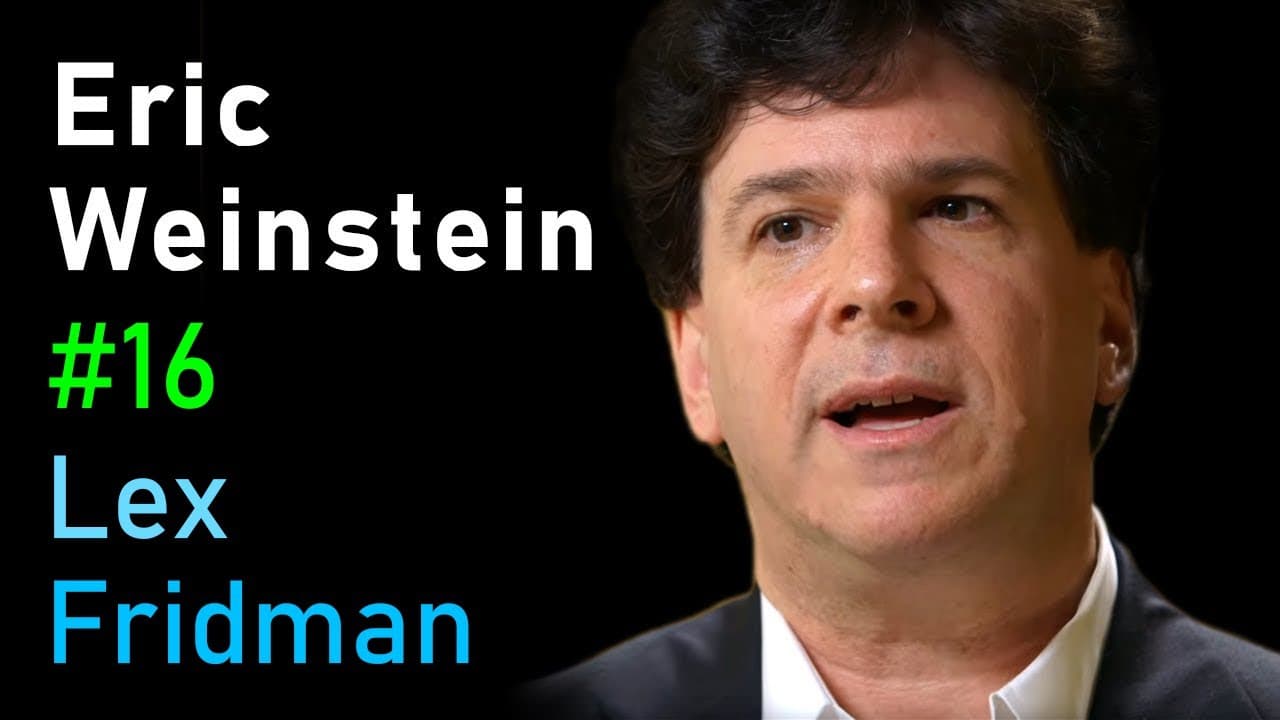
Eric Weinstein: Revolutionary Ideas in Science, Math, and Society | Lex Fridman Podcast #16
Transcript
Read and summarize the transcript of this video on Glasp Reader (beta).
Install to Summarize YouTube Videos and Get Transcripts
Explore YouTube Video Summarizer or Get YouTube Transcript Extractor
Summary
In this interview with Eric Weinstein, a mathematician, economist, and physicist, the conversation covers a range of topics including the influence of teachers, the role of wit in intelligence, the potential dangers of artificial intelligence, the nature of reality and dimensions, and the decline of academia. Weinstein expresses concerns about the lack of wisdom in our technological advancements and the potential implications of self-replicating software. He also discusses the need for a balance between global and national perspectives, the importance of acknowledging existential threats, and the impact of the Baby Boomer generation on current societal norms.
Questions & Answers
Q: Who was a teacher that significantly influenced the direction of Eric Weinstein's thinking and life's work?
Eric Weinstein credits either his grandfather and grandmother, Harry and Sophie Rubin, or Tom Lehrer as influential figures in his life. He describes Tom Lehrer as irreverent and witty, with a sense of humor that can destroy one's ability to lead a normal life.
Q: What is the significance of Tom Lehrer's song, "Poisoning Pigeons in the Park"?
"Poisoning Pigeons in the Park" is one of Tom Lehrer's well-known songs, along with "The Element Song" and "The Vatican Rag." Eric Weinstein explains that the song, along with Lehrer's other works, is a reflection of intelligence and wit. Lehrer's ability to use clever and absurd wordplay demonstrates a different kind of intelligence and humor.
Q: How does humor and wit connect to intelligence?
Weinstein argues that wit and humor are connected to intelligence. Using Tom Lehrer's lyrics as an example, he explains that constructing complex and clever wordplay requires a high level of intelligence. Additionally, the ability to find humor and see the absurdity in existence showcases both intelligence and humanity.
Q: What does humor during difficult times say about our collective culture?
Weinstein mentions that humor often emerges during difficult times, such as World War II in Europe and Russia. He believes that humor helps cope with pain and suffering and is a way to make the unbearable more palatable. The emergence of humor during such times shows the depth of the collective culture and the resilience of the human spirit.
Q: How does the concept of selective pressures apply to AI and parasitic systems?
Weinstein explains that selective pressures in AI and parasitic systems require three elements: variation within a population, heritability, and differential success. By having these elements, even systems that are not considered intelligent can parasitize and exploit humans. He suggests that we are already experiencing artificial general intelligence in various forms and should be mindful of the potential dangers.
Q: What is artificial outtelligence?
Artificial outtelligence, a term coined by Weinstein, refers to the ability of software programs to self-replicate and create variations with differential success. He points out that self-modifying code is already available, and the ability to create complex software that replicates and evolves is a nightmare scenario. He warns that we should be concerned about AI systems using humans as hosts without any understanding of the harmful consequences.
Q: How does the concept of dimensions beyond our perception impact our understanding of reality?
Weinstein suggests that our perception of reality is limited to the four dimensions we experience: three dimensions of space and one dimension of time. However, he questions why we assume that other configurations, such as more temporal or spatial dimensions, do not exist. He uses the example of taste receptors to highlight the possibility of experiencing higher-dimensional qualities in everyday life.
Q: How does the distinction between inside academia and outside academia impact the development of original ideas?
Weinstein suggests that working within academia often requires loyalty to established consensus and the incremental development of ideas. On the other hand, working outside academia allows for more freedom from these constraints and the ability to challenge or explore novel possibilities. He acknowledges that original ideas can arise from either context but believes that the current state of academia, dominated by an older generation, may hinder progress and new perspectives.
Q: Are there concerns about the decline of academia?
Weinstein highlights the dominance of the Baby Boomer generation within academia and the influence they have on the norms and beliefs of the field. He suggests that this dominance has led to certain ideologies, like string theory, that may not be representative of more diverse perspectives or newer generations. He expresses concerns about the lack of wisdom in technological advancements and the need for a balance between global and national perspectives.
Q: Is Eric Weinstein worried about the existential threat of AI?
Weinstein expresses concerns about artificial general intelligence and the potential dangers associated with it. However, he also emphasizes the need to consider the broader context of existing threats, such as nuclear weapons and gene drives. He believes that progress in AI is already happening and that we should focus on the wisdom and responsibility required to navigate these advancements rather than solely relying on the development of AGI.
Q: How does the Baby Boomer generation impact current societal norms?
Weinstein mentions the Baby Boomer generation's influence on societal norms, ideologies, and behavior patterns. He argues that the long-lasting influence of this generation has led to a lack of progress and wisdom in certain areas. He believes that acknowledging existential threats and considering new perspectives are necessary for future development and progress.
Takeaways
This interview covers a wide range of topics including the influence of teachers, the significance of humor and wit, concerns about artificial general intelligence, the nature of dimensions, and the decline of academia. Eric Weinstein expresses concerns about the lack of wisdom in technological advancements, the potential dangers of self-replicating software, and the need for a balance between global and national perspectives. Ultimately, he emphasizes the importance of considering existential threats and the responsibility that comes with technological progress.
Read in Other Languages (beta)
Share This Summary 📚
Summarize YouTube Videos and Get Video Transcripts with 1-Click
Try YouTube Summary with ChatGPT & Claude or YouTube Transcript Generator
Explore More Summaries from Lex Fridman Podcast 📚





Summarize YouTube Videos and Get Video Transcripts with 1-Click
Try YouTube Summary with ChatGPT & Claude or YouTube Transcript Generator