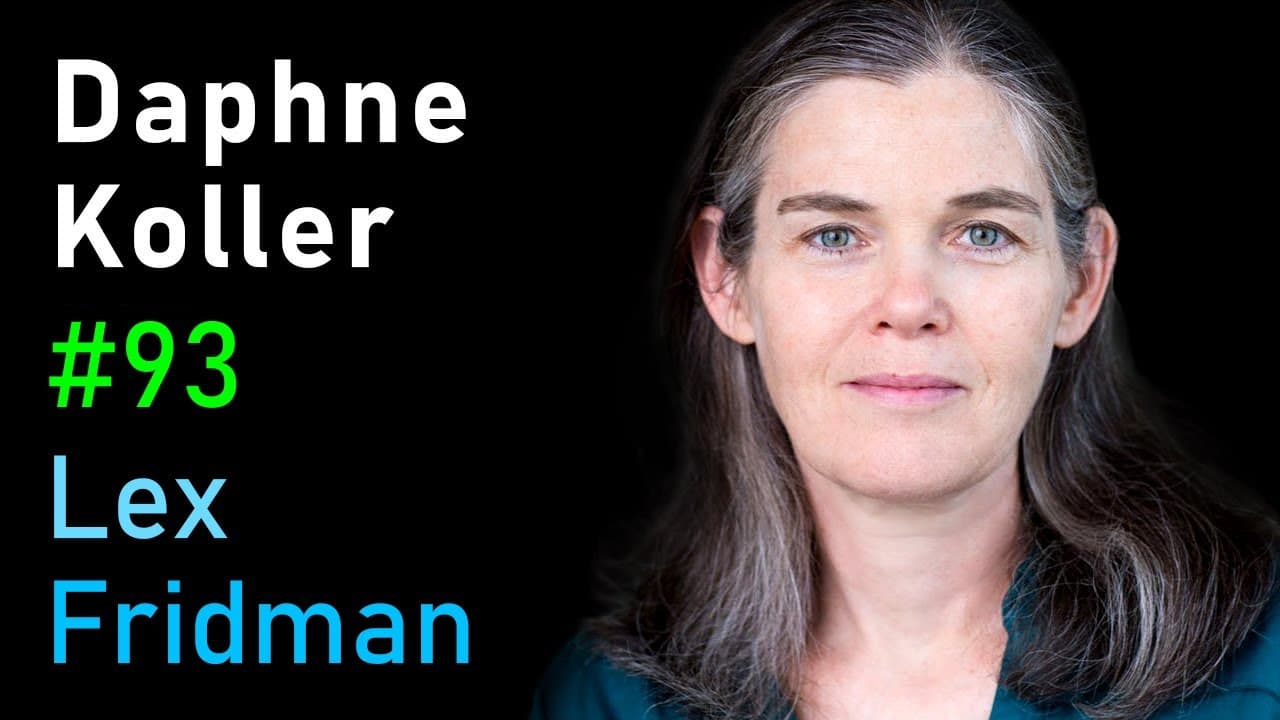
Daphne Koller: Biomedicine and Machine Learning | Lex Fridman Podcast #93
TL;DR
Machine learning is revolutionizing biomedicine by developing new methods for drug discovery and creating 'disease in a dish' models. These advances enable deeper insights into disease mechanisms and potential treatments, although finding cures for all major diseases remains a complex challenge.
Transcript
the following is a conversation with Daphne Koller a professor of computer science at Stanford University a co-founder of Coursera with Andrew Eng and founder and CEO of in seat row a company at the intersection of machine learning and biomedicine we're now in the exciting early days of using the data-driven methods of machine learning to help disc... Read More
Key Insights
- 🏑 Machine learning methods are being used to accelerate drug discovery and development in the field of biomedicine.
- 🏆 Disease in a dish models provide a platform for studying diseases at the cellular level and testing potential interventions.
- 💅 The complexity of diseases and the limitations of current treatments make finding cures for all major diseases challenging.
- 🤕 The study of longevity and age-related diseases overlaps with disease research and can benefit from data-driven methods and machine learning.
- 🎰 Ensuring the robustness, interpretability, and generalizability of machine learning models is crucial for their successful implementation in healthcare and other critical domains.
- 😒 Social norms and ethical considerations are essential in guiding the responsible use of AI and preventing potential abuses or negative consequences.
Install to Summarize YouTube Videos and Get Transcripts
Explore YouTube Video Summarizer or Get YouTube Transcript Extractor
Questions & Answers
Q: Can machine learning algorithms cure all major diseases?
Machine learning can play a role in curing diseases, but the complexity of diseases and the limitations of treatments make it challenging to find cures for all major diseases. Regenerating entire parts of the human body is a difficult problem to solve.
Q: How far along are we in understanding the fundamental mechanisms of major diseases?
The understanding of disease mechanisms varies based on the disease. Some diseases have been extensively studied, while others are still poorly understood. Diseases like Alzheimer's, schizophrenia, and type 2 diabetes fall closer to zero in terms of understanding their mechanisms.
Q: How do diseases in a dish models work?
Disease in a dish models involve deriving stem cells from individuals and differentiating them into specific cell types related to the disease. By studying these cells, researchers can gain insights into disease mechanisms and test potential interventions.
Q: How does the study of longevity overlap with disease research?
The risk of contracting diseases increases exponentially with age, which suggests an overlap between disease and aging. Understanding aging processes and developing interventions for age-related diseases is an important aspect of longevity research.
Summary
This conversation is with Daphne Koller, a professor of computer science at Stanford University and a co-founder of Coursera. She discusses the intersection of machine learning and biomedicine, particularly in the discovery and development of new drugs and treatments. The potential breakthroughs in this field could have a significant impact on medical research and the current coronavirus pandemic.
Questions & Answers
Q: Do you think we will one day find cures for all major diseases known today?
Daphne believes that making definitive predictions about curing diseases is not feasible. Curing diseases is challenging because it often requires regenerating entire parts of the human body. While we have made progress in treating diseases, the number of actual cures is relatively small. More work and advancements are needed before we can claim to have cured a significant number, let alone all, diseases.
Q: How far along are we in understanding the mechanisms of major diseases?
It depends on the disease. Some diseases may be at around 70-80% understanding, while others, like Alzheimer's, schizophrenia, and type 2 diabetes, are closer to zero. Diseases like Alzheimer's and schizophrenia are likely not one disease but a collection of mechanisms that result in similar clinical outcomes. This complexity makes it difficult to fully understand the specific mechanisms behind each disease.
Q: Is there a relationship between disease and longevity?
Disease and longevity are overlapping to some extent. Many diseases have an increased risk as a person ages. However, aging is not solely the cause of disease, and there are diseases and mechanisms that are not specifically related to aging. While there is a correlation between getting older and the occurrence of diseases, the relationship is complex and not fully understood.
Q: Are there any benefits to our mortality in the context of fighting disease and aging?
Daphne believes that aspiring to immortality is not desirable, as it is a very long time. However, an increased health span, where individuals can live to an old age while maintaining good health and quality of life, is a worthy goal. Aging comes with physical and mental deterioration, which is a sad phenomenon. Striving to live longer in good health is an achievable and desirable objective.
Q: How do data and machine learning play a role in understanding and eradicating diseases?
Data and machine learning have not played a significant role in disease understanding until recently. The lack of large, high-quality datasets has been a limitation. However, advancements in technology have enabled the generation of large-scale datasets. In-seat row is focused on creating datasets using biotechnology that can be effectively utilized by machine learning models. By applying machine learning to these datasets, researchers can uncover patterns and potentially identify new interventions for various diseases.
Q: What are disease in a dish models, and how do they differ from animal models?
Animal models for diseases involve introducing external perturbations in animals to mimic the diseases found in humans. While these models may have clinical outcomes similar to those seen in humans, the underlying mechanisms can be different. Disease in a dish models, on the other hand, involve using stem cells and differentiating them into specific cell types related to a disease. These models provide a more accurate representation of human biology and allow for the understanding and exploration of disease mechanisms.
Q: How do you create data sets for disease in a dish models?
Creating data sets for disease in a dish models involves using stem cells and differentiating them into specific cell types related to a disease. This process is becoming more accessible and scalable, but it is not yet possible to create data sets at the scale of tens or hundreds of thousands of samples. However, advancements in biotechnology are continually improving, and it is expected that larger and more diverse data sets will be achievable in the future.
Q: What kind of data is useful in disease in a dish models?
Disease in a dish models benefit from various types of data. Single-cell RNA sequencing allows for the measurement of gene activity in individual cells. Microscopy techniques, such as super resolution microscopy, provide detailed information about subcellular structures. There are also ongoing developments in obtaining more types of data from single cells. By combining and analyzing these data, researchers can gain a deeper understanding of diseases and potentially identify new interventions.
Q: What diseases can benefit from disease in a dish models?
Disease in a dish models are particularly useful for diseases with a strong genetic basis, reproducible and robust cellular models, and diseases that are contained within specific cell types. Diseases that meet these criteria have a higher likelihood of success in disease in a dish models. However, advancements in biotechnology may expand the range of diseases that can be studied using this approach in the future.
Q: What have you learned about effective education from your experience with Coursera?
Coursera has found that shorter video modules and courses work better, as people have limited time and attention spans. Breaking content into shorter units with natural completion points helps learners feel a sense of accomplishment. Engaging learners during the content, providing quick feedback through assessments, and incorporating female role models have also been found to enhance engagement and learning outcomes. The ability to experiment and gather data has provided valuable insights into effective teaching methods.
Takeaways
Disease in a dish models, enabled by advancements in biotechnology and machine learning, hold great promise for understanding and treating diseases. Shorter and more engaging online courses, such as those offered by Coursera, have provided an accessible and flexible way for individuals to learn new skills. The hunger for learning and the rapidly changing employment landscape have created a need for lifelong and global education. Effective education requires brevity, engagement, and personalized feedback to enhance learning outcomes.
Summary & Key Takeaways
-
Daphne Koller is using data-driven methods of machine learning to help discover and develop new drugs and treatments at scale in the field of biomedicine.
-
Machine learning models can be applied to create disease in a dish models, which provide a deeper understanding of diseases, their mechanisms, and potential interventions.
-
The possibility of finding cures for all major diseases and extending human lifespan is challenging due to the complexity of diseases and the limitations of current treatments.
Read in Other Languages (beta)
Share This Summary 📚
Summarize YouTube Videos and Get Video Transcripts with 1-Click
Try YouTube Summary with ChatGPT & Claude or YouTube Transcript Generator
Explore More Summaries from Lex Fridman Podcast 📚






Summarize YouTube Videos and Get Video Transcripts with 1-Click
Try YouTube Summary with ChatGPT & Claude or YouTube Transcript Generator