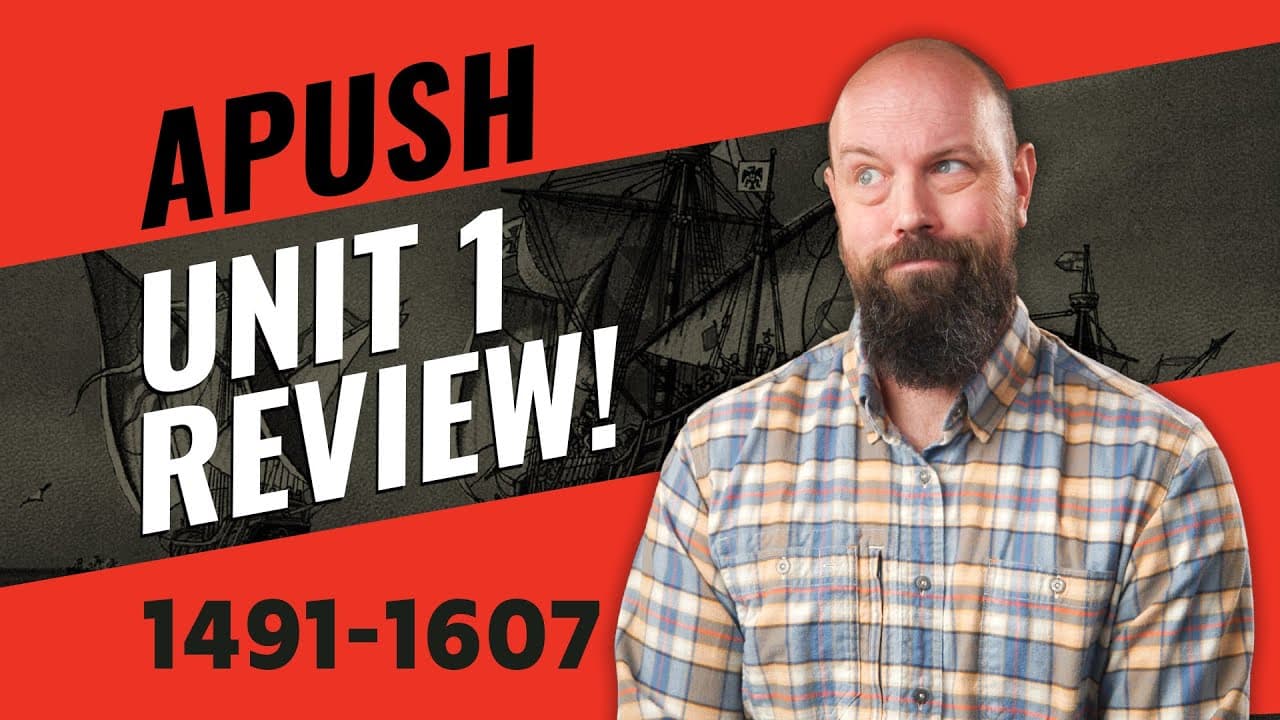
APUSH Unit 1 Review: Indigenous Americas to European Contact
TL;DR
Indigenous societies across the Americas were as diverse as those on any other continent, shaped largely by geography rather than being uniform. Maize cultivation, spreading from southern Mexico, enabled larger, more complex, and often sedentary societies. Europeans later arrived driven by intertwined economic, religious, and reputation-seeking motives summarized as gold, God, and glory.
Transcript
Do my eyes deceive me or do you have the anxiety sweats about learning everything you need to know about a push unit one? Well, this video is about to dry up all that flop sweat. So, if you're ready to get them brain cows milked, let's get to it. First of all, let me give you the big picture of this unit so you know where everything is headed. The ... Read More
Key Insights
- Indigenous societies in the Americas were as varied and diverse as societies on any other continent, and geography played a significant role in shaping the differences among them, making the idea of a single uniform Native American culture inaccurate.
- Maize cultivation began in what is today southern Mexico and spread throughout the Americas through trade networks and migration routes, becoming the staple crop that made larger and more complex societies possible, including the Aztec capital of Tenochtitlan.
- The adoption of maize produced four common effects: economic development through surplus and trade, permanent sedentary settlements, advanced irrigation techniques for diverting water to crops, and social diversification with specialized labor and social hierarchies.
- Many indigenous cultures were matrilineal, meaning power and possessions were passed down through the mother's side rather than the father's, which gave women far more social capital than their more patriarchal European counterparts had.
- Geography drove distinct lifeways: the Iroquois of the Northeast built longhouses from the region's abundant timber, while the hot, dry Great Basin and Great Plains produced nomadic groups like the Ute who lived in mobile animal-skin teepees.
- Not all non-farming societies were nomadic; Northwest and California groups such as the Chinook and Chumash built permanent settlements because the ocean and surrounding environment supplied abundant food, making sedentary life possible without agriculture.
- European exploration was driven by gold, God, and glory, meaning economic, religious, and reputational motives that intensified after the Renaissance and after the Ottoman Empire gained control of the land routes linking Europe to Asian trade.
- Sea-based exploration became possible through new maritime technology, including the Portuguese caravel with its lateen sail, the magnetic compass, and the astrolabe, alongside joint stock companies that pooled many investors' wealth to fund risky expeditions.
Install to Summarize YouTube Videos and Get Transcripts
Explore YouTube Video Summarizer or Get YouTube Transcript Extractor
Questions & Answers
Q: What time period does APUSH Unit 1 cover?
APUSH Unit 1, Period 1, covers the era from the year before Columbus arrived in the New World up to the establishment of Jamestown, the first British colony in North America. The unit explores the social and political landscape of indigenous peoples in the Americas, why Europeans came, and the effects of European intrusion in the Americas, setting the stage for the contact between the Old and New Worlds.
Q: Why is it wrong to think all Native Americans were the same?
Indigenous societies in the Americas were every bit as varied and diverse as societies on any other continent, just as Italians and Germans are not the same or Chinese and Japanese are not the same. Geography played a significant role in shaping these differences, so groups ranged from farming societies with permanent towns to nomadic peoples living in mobile shelters. The stereotype that all lived in teepees ignores this diversity.
Q: How did maize cultivation change indigenous societies?
Maize, first cultivated in what is today southern Mexico, spread through the Americas via trade networks and migration routes and became a staple crop that supported larger, more complex societies. Its adoption typically produced four effects: economic development from surplus food and trade, permanent sedentary settlements where people stayed to tend crops, advanced irrigation techniques, and social diversification with specialized labor and social hierarchies. Without it, massive urban centers likely would have been impossible.
Q: What is a matrilineal society and how did it differ from Europe?
A matrilineal society is one in which power and possessions are passed down through generations on the mother's side rather than the father's. Many indigenous groups, such as the Cherokee, were matrilineal, and their women held far more social capital than their European counterparts. This contrasted sharply with Europe, which was highly patriarchal and focused on men, showing how differently gender and inheritance functioned across the two regions.
Q: How did geography shape the way different indigenous groups lived?
Geography strongly influenced lifeways across the Americas. In the timber-rich Northeast, the Iroquois built longhouses for extended families. Along the fertile Mississippi and Ohio river valleys, Mississippian peoples formed large towns with extensive trade and social hierarchies. In the hot, dry Great Basin and Great Plains, groups like the Ute lived nomadically in animal-skin teepees, moving seasonally to hunt and gather. Environment determined infrastructure, settlement patterns, and economy.
Q: Why did some non-farming societies still build permanent settlements?
In the Northwest and present-day California, groups such as the Chinook and Chumash did not practice agriculture yet still built permanent settlements. This was possible because they found abundant food in the ocean and surrounding environment, which supported sedentary life without farming. Their example shows that agriculture was not the only path to permanent settlements, since a rich natural food supply could sustain a stationary population just as effectively.
Q: Why did Europeans begin exploring and coming to the Americas?
European motives are often summarized as gold, God, and glory, meaning economic, religious, and reputational drivers. After the Renaissance sparked innovation and ambition, Europeans wanted greater power and wealth. When the Ottoman Empire gained control over the land routes connecting Europe to Asian trade, Europeans sought sea routes to reach Asian and Southeast Asian markets directly, cutting out the middleman and gaining access to valuable goods on their own terms.
Q: What technologies and financial tools made European sea exploration possible?
Two developments enabled European sea exploration. First were advances in shipbuilding and maritime technology, including the Portuguese caravel, which was fast and navigable thanks to its lateen sail that could take wind from both directions, plus older Arab and Chinese tools like the magnetic compass for direction and the astrolabe for latitude. Second were joint stock companies, which pooled many investors' wealth so that a failed expedition cost each only a portion while success proved highly profitable.
Summary & Key Takeaways
-
APUSH Unit 1 covers the period from just before Columbus reached the New World to the founding of Jamestown, the first British colony in North America. The unit begins with the diverse indigenous peoples of the Americas, whose societies varied widely because geography shaped their development.
-
Maize, first cultivated in southern Mexico, spread across the Americas and enabled larger, more complex societies. Its adoption typically led to economic development, permanent sedentary settlements, advanced irrigation, and social diversification, with regional groups from the Iroquois to the Ute reflecting their local environments.
-
Europeans arrived seeking gold, God, and glory. After the Renaissance and the Ottoman blockade of overland Asian trade routes, powers like Portugal pursued sea routes using new ship designs and navigation tools, funded increasingly by joint stock companies that spread financial risk across many investors.
Read in Other Languages (beta)
Share This Summary 📚
Summarize YouTube Videos and Get Video Transcripts with 1-Click
Try YouTube Summary with ChatGPT & Claude or YouTube Transcript Generator
Explore More Summaries from Heimler's History 📚




Summarize YouTube Videos and Get Video Transcripts with 1-Click
Try YouTube Summary with ChatGPT & Claude or YouTube Transcript Generator