How Does Runway Build General World Models?
TL;DR
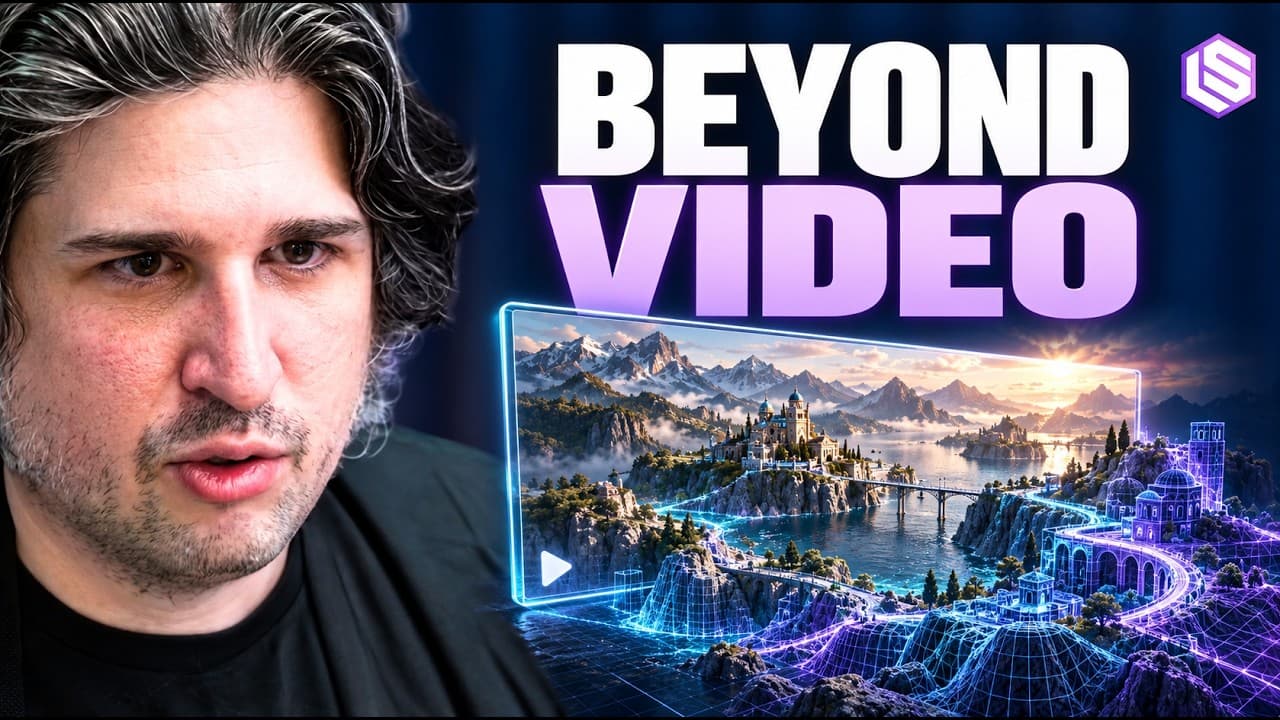
Runway treats video generation as a route to models that simulate environments, physical behavior, robots, and software interfaces. Its strategy combines scaled video training, creative tools, real-world data, and learnable pixel rendering, with the long-term possibility of interactive worlds and a fully neural operating system.
Transcript
effectively the the the [music] end game of something like interface world models is you have a fully neural operating system. So I think uh uh Andre Karopathic has written about that quite quite quite a while [music] back but it's uh you know I think to me it's it's a bit um it's a bit odd that you know we have for example with an [music] interact... Read More
Key Insights
- Runway’s original thesis was that improving generative models would eventually produce much of the world’s content, forcing creative tools to be reconsidered. The company therefore focused on making machine learning models accessible to artists rather than limiting them to machine learning engineers.
- Runway’s early experiments showed that artists could repurpose narrowly trained models in unexpected ways. A model trained on self-driving data, including pedestrians, traffic signs, bicycles, and stoplights, became a tool for creating surreal scenes that departed sharply from its original training purpose.
- Runway’s Green Screen product automated image and video segmentation, a central task in visual effects that otherwise involves manual subject separation and rotoscoping. This post-production tool became Runway’s primary product for a substantial period and was used in visible film and television projects.
- Runway built an internal research organization because existing image and video generation models were not sufficiently capable of supporting production creative workflows. For roughly the company’s first four years, much of this research developed in the background while practical editing tools supported users.
- Latent diffusion and DALL-E 2 produced a major capability shift around 2022, demonstrating that high-quality generation could become practical, including on consumer hardware. This change helped move Runway from post-production assistance toward developing its Gen-1, Gen-2, Gen-3, and Gen-4.5 video models.
- Runway’s thousand-A100 cluster represented a major bet that scaling laws would benefit image and video generation as they had benefited language generation. The company committed to the cluster while it was a Series B startup because it expected large-scale training to produce a substantially stronger video model.
- World models are presented as an extension of generative video because learning to predict visual change may also teach models about environments and physical behavior. Runway sees this capability supporting simulations, interactive worlds, robotics, and agents that operate through generated video.
- Interface world models could render software directly as pixels instead of relying on HTML, CSS, or React. The longer-term concept is a fully neural operating system in which both the language model and its visual interface are learnable parts of one end-to-end application.
Install to Summarize YouTube Videos and Get Transcripts
Explore YouTube Video Summarizer or Get YouTube Transcript Extractor
Questions & Answers
Q: Why did Runway start building generative creative tools?
Runway began from the belief that continued improvements in resolution and quality would eventually make generated content widespread. Its founders concluded that existing creative software would need to be redesigned around generative models. The first version therefore made open-source models easier for artists to use, removing technical barriers that had previously restricted them largely to machine learning engineers.
Q: How did early art experiments shape Runway’s direction?
Early projects combined generative systems, simulation, and human interaction. One installation generated identities and coordinated simulated small-talk encounters among gallery visitors. Another used an image-to-image model trained on self-driving scenes, then let artists arrange road-related categories freely. The unexpected surreal outputs suggested that creative users could discover valuable applications beyond a model’s original training purpose.
Q: What problem did Runway’s Green Screen tool solve?
Green Screen addressed image and video segmentation, which separates subjects from the rest of a scene. This is important in visual effects because rotoscoping is highly manual and undesirable work. The tool became Runway’s main product for a long period, established the company as a post-production platform, and was used in productions including Everything Everywhere All at Once.
Q: Why did Runway create its own research organization?
Runway found that the available image generation models, and the few existing video generation models, were not yet strong enough to become dependable parts of production creative workflows. Building an internal research organization allowed the company to push model capabilities forward while continuing to develop usable tools. Much of that research progressed in the background during Runway’s first four years.
Q: Why was latent diffusion important to Runway?
Latent diffusion contributed to a step change in generative image capabilities around 2022, alongside DALL-E 2. The shift showed that useful generation was not merely theoretically possible but could also work on consumer hardware. For Runway, this marked a transition from primarily offering post-production functions toward training and releasing its own video generation systems, including successive Gen model families.
Q: Why did Runway invest in a thousand A100 GPUs?
Runway believed scaling laws could apply to image and video generation in much the same way they applied to language generation. In mid-2022, the company committed to building a cluster of a thousand A100 GPUs. This was described as a slightly irrational decision for a Series B startup, but it reflected confidence that larger-scale training would yield a strong video model.
Q: How can video models become world models?
Runway sees generative video as a path toward general-purpose world simulation because generating coherent visual change requires models to represent environments, motion, interactions, and physical behavior. The company is extending its work beyond creative media into real-world scenarios, including robotics and interactive environments. The description also identifies third-person video as a possible source for scaling robotic learning.
Q: What is a fully neural operating system?
A fully neural operating system is the proposed endpoint of interface world models, where software interfaces are generated directly as pixels by neural networks rather than constructed with fixed technologies such as HTML, CSS, or React. The interface would become learnable and join the language model inside one end-to-end system, allowing both behavior and visual presentation to adapt instead of remaining rigid.
Summary & Key Takeaways
-
Runway began with the belief that generative models would eventually produce much of the world’s content, requiring creative software to be redesigned. Its founders initially made experimental tools that exposed early models to artists, who frequently used limited training categories in unexpected ways to create compelling imagery outside the models’ intended applications.
-
The company evolved from making open-source models accessible to building an internal research organization. Early commercial work focused on automated image and video segmentation through a Green Screen tool used in professional productions. Advances in latent diffusion around 2022 then enabled Runway to shift toward developing and releasing its own generative video models.
-
Runway now views video generation as a foundation for broader world simulation. Its models may support robotics, interactive environments, video agents, and neural software interfaces rendered directly as pixels. The proposed endpoint is a learnable interface integrated with the underlying model, potentially replacing rigid application layers with a fully neural operating system.
Read in Other Languages (beta)
Share This Summary 📚
Summarize YouTube Videos and Get Video Transcripts with 1-Click
Try YouTube Summary with ChatGPT & Claude or YouTube Transcript Generator
Explore More Summaries from Latent Space 📚




Summarize YouTube Videos and Get Video Transcripts with 1-Click
Try YouTube Summary with ChatGPT & Claude or YouTube Transcript Generator