How to avoid common product management regrets
TL;DR
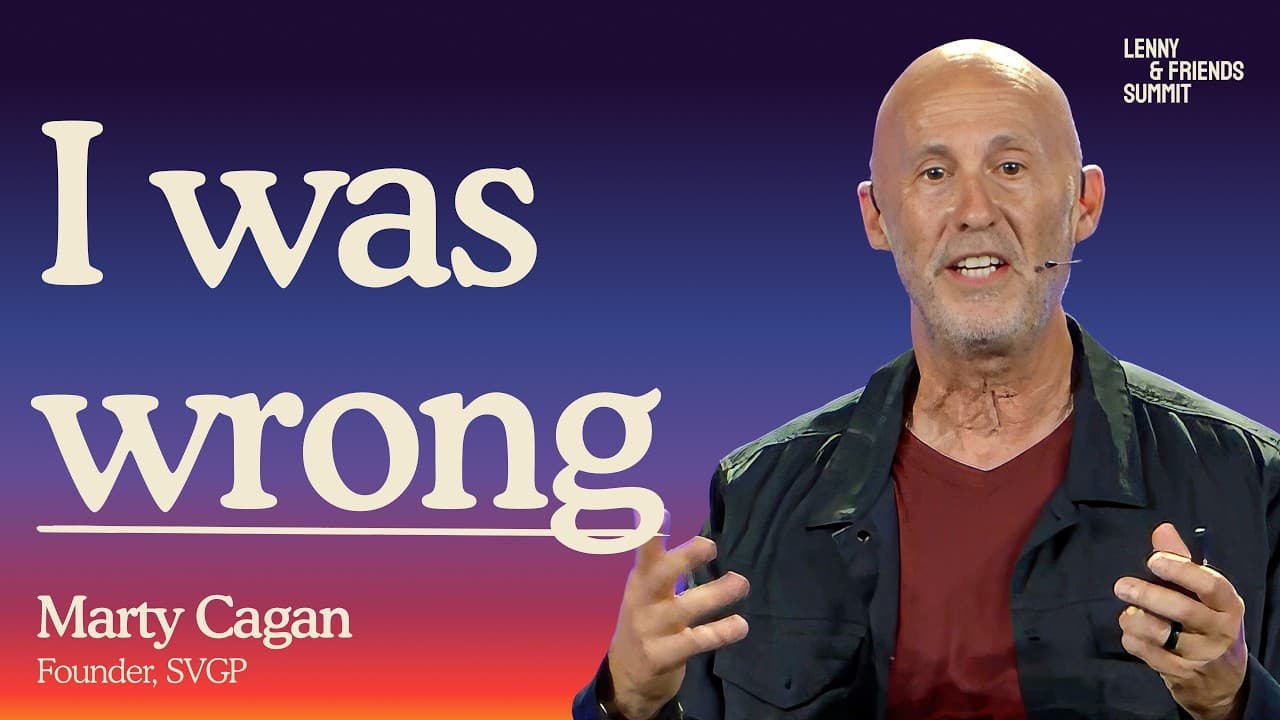
Business viability must be considered from the start, including customer value, legal and ethical constraints. Focus on problem discovery and solution discovery, not just problem definition. Seek reasons why people use or do not use your product, and cultivate humility to stay open to learning rather than forcing predictability.
Transcript
Thank you. Um, also thank you to Lenny for running this and for inviting me actually to be a speaker. Um, I don't actually go to a lot of conferences. Uh, but when I do, um, I really enjoy them and I will tell you I can't I lost track of the people that came up to me and thanked me for content for books. People ask me to they have tattered copies o... Read More
Key Insights
- Business viability is a core product concern that must cover market, legal, privacy, and operational aspects.
- Problem discovery alone is insufficient; teams must balance problem understanding with bold solution exploration to drive true innovation.
- Why users are not using a product is as important as why they would use it, and this insight drives meaningful iteration.
- Humility means admitting what you cannot know and learning continuously from customers and data.
- Predictability can blind teams to new information, particularly with evolving technology waves like AI.
- Product leadership requires clear, durable principles that survive new technological shifts.
- A product manager must treat content as a product themselves, continuously learning through discovery.
- This talk blends practical experience from decades in product management with observations on current AI trends.
Install to Summarize YouTube Videos and Get Transcripts
Explore YouTube Video Summarizer or Get YouTube Transcript Extractor
Questions & Answers
Q: What is the core job of product management according to the speaker?
The core job of product management is to solve problems for customers and achieve outcomes for the business. This means ensuring solutions are viable, usable, and feasible, while focusing on principles that endure across technology waves. It emphasizes outcomes and customer value over just implementing new tooling or processes.
Q: Why is business viability emphasized as essential?
Business viability is essential because it ensures that a product can be bought by customers and can be financially and legally sustained by the business. It includes privacy, safety, ethics, compliance, and the ability to market, sell, and service the product. The speaker reveals this was a major blind spot in earlier work and stresses its importance, especially for AI products.
Q: What is problem discovery and why is it important?
Problem discovery involves understanding and defining the real problem to solve and identifying who has that problem and what success looks like. It is important because misjudging the problem leads to ineffective solutions and missed opportunities. The speaker argues that solution discovery is where real innovation happens and should not be neglected.
Q: What does the talk say about why people stop using a product?
The talk highlights that understanding why people stop using a product is crucial for uncovering insights and driving improvement. It argues that asking users why they churn is often neglected, yet this question is key to unlocking innovation and better solutions, guiding teams to adjust their approach and deliver more valuable outcomes.
Q: How should teams view the role of humility in product management?
Humility in product management means recognizing what you cannot know and being willing to revise beliefs in light of new evidence. It counters the idea that the product manager is the CEO of the product and promotes an open mindset, collaboration, and learning from customers and data to avoid biased decisions.
Q: What is the speaker’s view on predictability in product work?
The speaker identifies a deep desire for predictability as a major regret, arguing that the focus on predictable roadmaps and processes can hinder learning and responsiveness to real customer needs. This mindset can stifle exploration, experimentation, and the ability to adapt to new technological changes like AI.
Q: How does the talk relate AI to product thinking?
The talk connects AI to product thinking by noting that AI makes building products easier, which increases the need for clear thinking and outcomes over processes. It stresses that as capabilities expand, teams must stay grounded in business viability, customer problems, and solution discovery to deliver meaningful impact.
Q: What is the suggested approach to product content discovery?
The speaker treats his content as a product and engages in ongoing product discovery with teams. This involves exploring diverse perspectives, collecting feedback, and identifying the top ten regrets to improve how products are defined and built. The approach emphasizes continual learning and iteration rather than static, one off guidance.
Summary & Key Takeaways
-
A product manager should ensure business viability encompasses customer value, compliance, and operations, not just feasibility. The talk argues this was underemphasized in earlier work and is critical for AI products where viability is harder.
-
Problem discovery is as important as solution discovery; without understanding why problems exist or why users would adopt a solution, teams miss real opportunities for innovation.
-
Humility and openness to new evidence are essential for product leaders, as overconfidence can lead to biased decisions and failed products, especially when new technologies like AI change the landscape.
Read in Other Languages (beta)
Share This Summary 📚
Summarize YouTube Videos and Get Video Transcripts with 1-Click
Try YouTube Summary with ChatGPT & Claude or YouTube Transcript Generator
Explore More Summaries from Lenny's Podcast 📚






Summarize YouTube Videos and Get Video Transcripts with 1-Click
Try YouTube Summary with ChatGPT & Claude or YouTube Transcript Generator