How Do Reed-Solomon Codes Enhance Error Correction?
TL;DR
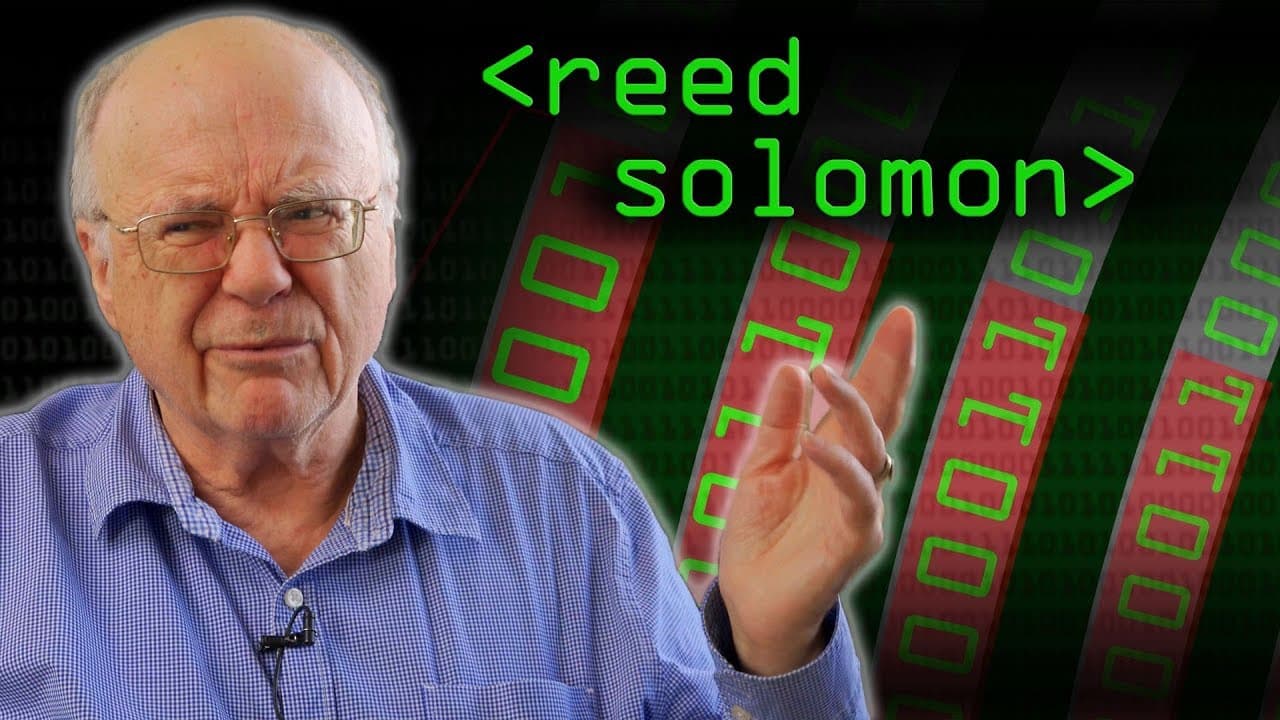
Reed-Solomon codes provide advanced error correction by utilising Galois fields and a two-dimensional approach, making them effective against burst errors. This complex method requires intricate mathematical operations, enabling precise identification and correction of errors, especially in media like CDs.
Transcript
we're going to talk about going from galwa fields to read solomon codes we must be mad sure really i mean so many of you have said just do read solomon you know you've done hamming codes they can't be that much more complex oh yes they can the stuff we have done earlier and done a fair bit on hamming codes which if you remember are basically going ... Read More
Key Insights
- 👨💻 Hamming codes provided basic error correction for single errors, while Reed Solomon codes offer more powerful error correction capabilities for burst errors.
- 👨💻 Reed Solomon codes utilize Galwa fields and two-dimensional coding to enhance error correction.
- 😒 The use of syndromes helps identify errors in Reed Solomon codes, leading to precise error correction.
- 👨💻 Reed Solomon coding requires complex mathematical operations, such as long divisions and additions, but can be implemented more efficiently using custom hardware.
- 😒 Galwa fields allow for the use of powers of primes, such as 2, instead of prime numbers, expanding the possibilities for error correction.
Install to Summarize YouTube Videos and Get Transcripts
Explore YouTube Video Summarizer or Get YouTube Transcript Extractor
Questions & Answers
Q: What is the main difference between Hamming codes and Reed Solomon codes?
Hamming codes were used for single-error correction, while Reed Solomon codes were developed to handle burst errors and localized scratches more effectively.
Q: What are Galwa fields and how are they used in Reed Solomon codes?
Galwa fields are mathematical concepts used in finite field arithmetic to find multiplicative and additive inverses. In Reed Solomon codes, Galwa fields enable more powerful error correction capabilities.
Q: How does Reed Solomon coding differ from linear coding?
Reed Solomon coding moves from a linear approach to a two-dimensional approach, treating each position in the code word as a symbol position instead of a bit position. This allows for more sophisticated error detection and correction techniques.
Q: How does the use of Galwa fields and Reed Solomon codes benefit error correction?
The use of Galwa fields and Reed Solomon codes allows for the detection and correction of errors in burst form, such as localized scratches on CDs, by analyzing syndromes and performing complex mathematical operations.
Summary & Key Takeaways
-
Hamming codes were used in the 1960s to correct single errors, but Reed Solomon codes, developed in the late 60s and early 70s, introduced more powerful error correction techniques.
-
Reed Solomon codes utilize Galwa fields and two-dimensional coding to handle burst errors and localized scratches, unlike the linear nature of Hamming codes.
-
The use of Galwa fields requires complex mathematical operations, such as long divisions and additions, to analyze and correct errors.
Read in Other Languages (beta)
Share This Summary 📚
Summarize YouTube Videos and Get Video Transcripts with 1-Click
Try YouTube Summary with ChatGPT & Claude or YouTube Transcript Generator
Explore More Summaries from Computerphile 📚






Summarize YouTube Videos and Get Video Transcripts with 1-Click
Try YouTube Summary with ChatGPT & Claude or YouTube Transcript Generator