What Is Unsupervised Representation Learning?
TL;DR
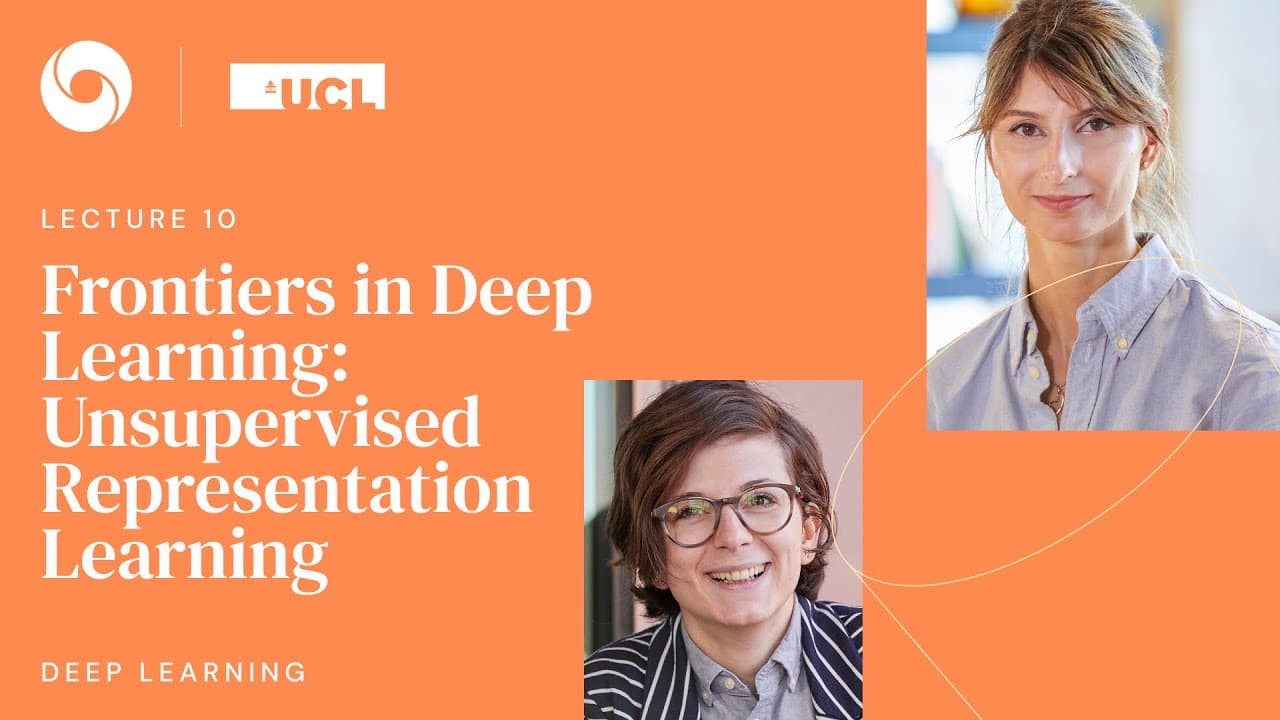
Unsupervised representation learning addresses deep learning limitations by enabling models to identify patterns in unlabelled data. This lecture highlights its historical significance, the importance of evaluating representation quality, and explores techniques like clustering and dimensionality reduction. By employing insights from neuroscience, the discussion reveals pathways for advancing machine learning capabilities.
Transcript
hi my name is Irina and I'm a research scientist at deep mind we're together with mihaela I work in the frontiers team staying true to our team name today mihaela and I will talk about the frontiers in deep learning and in particular about the role of unsupervised representation learning in expanding these frontiers if you listen to any of the prev... Read More
Key Insights
- 🤩 Unsupervised representation learning enhances model performance by enabling learning without labeled data, addressing key limitations of existing algorithms.
- 🎰 The historical significance of representations underscores their foundational role in the evolution and success of machine learning techniques.
- 🏷️ Challenges in evaluating unsupervised learning necessitate innovative approaches to assess representation quality without predefined labels.
- 🦮 Insights from neuroscience highlight desirable properties in representations, guiding the design of more effective machine learning models.
- 🤳 Various techniques such as generative modeling and self-supervised learning showcase different pathways to achieve effective representations that improve generalization.
- 👶 Future advancements in representation learning hinge on exploring new methodologies and deepening the understanding of data distributions and relationships.
- ❓ Integrating causal reasoning into representation learning could significantly improve performance across complex tasks, mimicking human-like adaptability.
Install to Summarize YouTube Videos and Get Transcripts
Explore YouTube Video Summarizer or Get YouTube Transcript Extractor
Questions & Answers
Q: What is the primary focus of unsupervised representation learning?
The primary focus of unsupervised representation learning is to extract meaningful information from data without labeled examples. This learning process allows algorithms to identify patterns, structures, and relationships within the data, improving their capacity to generalize and solve tasks more effectively.
Q: How does clustering contribute to unsupervised learning?
Clustering identifies similarities and groups similar data points together, which helps in solving classification tasks with less supervised data. By recognizing these clusters, algorithms can apply learned characteristics from one data point in the cluster to others, thus generalizing more effectively across similar instances.
Q: What challenges arise in evaluating unsupervised learning algorithms?
Evaluating unsupervised learning algorithms is challenging due to the lack of labeled ground truth data. Without predefined classifications, determining the effectiveness of the learned representation requires alternative methods, such as clustering validity or performance in downstream tasks, which may not straightforwardly measure quality.
Q: Why is there a need for unsupervised learning in the context of deep learning?
Unsupervised learning addresses crucial limitations in current deep learning models, such as data efficiency, robustness, and generalization. These algorithms often require extensive supervision, making them inefficient; unsupervised learning aims to build models that can learn from fewer examples, reflecting how humans learn.
Q: What historical context is given regarding the development of machine learning?
The history of machine learning indicates that for decades, representation played a crucial role in the field. From early feature engineering to the rise of deep learning, the focus shifted, yet recent challenges highlight the renewed importance of effective representations for future advancements.
Q: How do the properties of good representations relate to neuroscience?
Insights from neuroscience suggest that good representations in machine learning should be compositional, support efficient attention mechanisms, possess untangled manifolds, and facilitate adaptive responses to novel inputs. These properties can enhance the algorithm's ability to generalize across tasks and scenarios.
Q: What are some notable techniques discussed in the lecture for unsupervised representation learning?
Techniques include generative modeling, contrastive losses, self-supervision, and attention mechanisms. Each method contributes to learning efficient representations that capture underlying data distributions and relationships, allowing improved performance on a variety of downstream tasks.
Q: What future directions are suggested for the field of representation learning?
Future directions include refining generative models for representation learning, exploring the interplay between priors and posteriors, emphasizing self-supervised learning, and investigating causal relationships in data to enhance the relevance and applicability of learned representations across various tasks.
Summary & Key Takeaways
-
This content explores unsupervised representation learning, emphasizing its historical significance and potential solutions for current deep learning challenges.
-
Key discussions include the importance of clustering, dimensionality reduction, and evaluation of representation quality without ground truth labels.
-
The presentation outlines various techniques and the impact of different approaches on machine learning applications, highlighting ongoing research and future directions.
Read in Other Languages (beta)
Share This Summary 📚
Summarize YouTube Videos and Get Video Transcripts with 1-Click
Try YouTube Summary with ChatGPT & Claude or YouTube Transcript Generator
Explore More Summaries from Google DeepMind 📚

Summarize YouTube Videos and Get Video Transcripts with 1-Click
Try YouTube Summary with ChatGPT & Claude or YouTube Transcript Generator