How to slice strings in Python with negative steps?
TL;DR
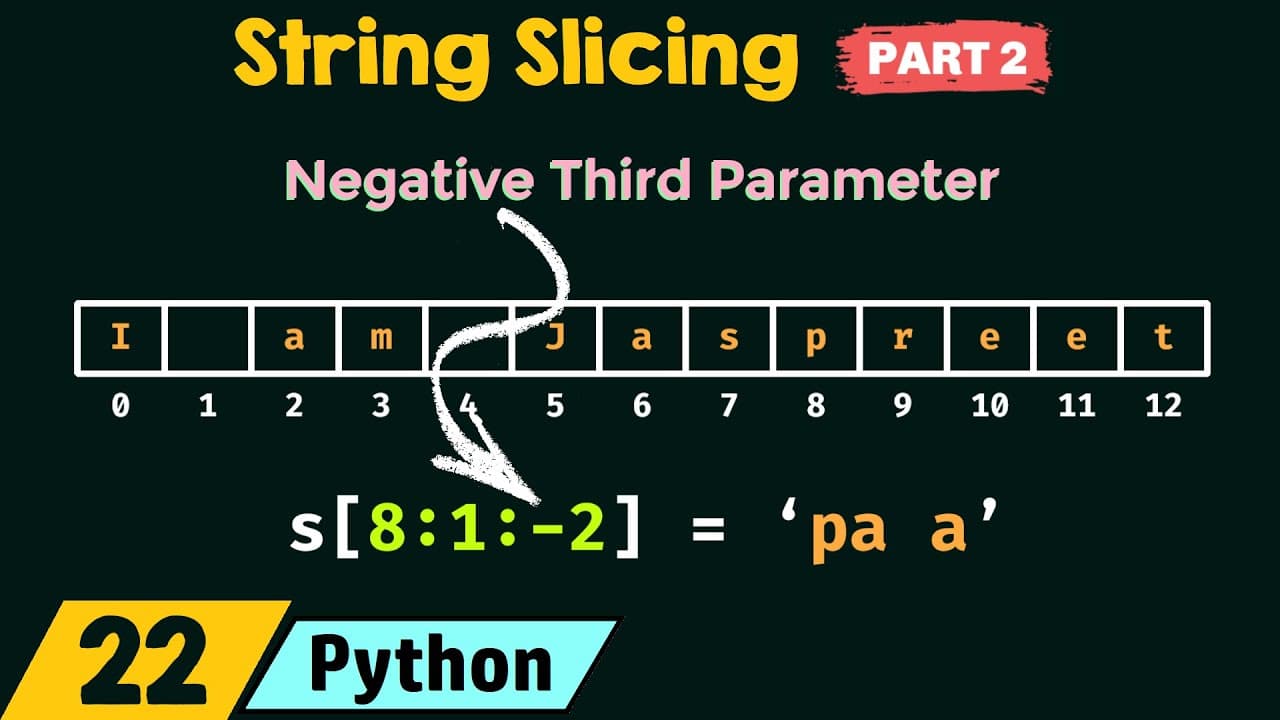
Negative step values determine direction and how many characters to skip when slicing strings in Python. You can reverse a string with colon colon minus one, and to select a left to right or right to left substring you adjust the start end and step parameters accordingly. Understanding these rules makes complex slices predictable.
Transcript
foreign we will continue our discussion on string slicing with python so without any further delay let's get started the first topic is negative third parameter and the second topic is reversing a string we will first understand what is negative third parameter we have already learned what is third parameter in the last lecture now let's recall wha... Read More
Key Insights
- Negative step values control direction and skipping in Python slicing, with minus one indicating a reverse read over the selected range.
- The step value is the third parameter in a slice, and a negative value reverses the read direction while affecting how many elements are skipped.
- To reverse an entire string, use colon colon minus one, which reads from the last character to the first.
- The start and end indices in a slice define the range to read, and the end index is treated as end plus one when reading left to right.
- When slicing from right to left, the start index should be greater than the end index, reflecting the reverse direction.
- The number of skipped elements is derived from the step value minus one in a typical positive step case, and becomes the step magnitude when negative.
- Understanding the interaction between start, end, and step allows precise substring construction in both directions.
- The concept is reinforced with concrete examples showing how different parameter choices yield distinct substrings.
Install to Summarize YouTube Videos and Get Transcripts
Explore YouTube Video Summarizer or Get YouTube Transcript Extractor
Questions & Answers
Q: A real search query question about the video (e.g. 'How to...', 'What is...', 'Why does...'). Question 1
How do you reverse a string using Python slicing and what is the effect of using a negative step value on the output. Using [:: -1] reads characters from the end to the beginning, effectively reversing the string. This works without altering the original string and demonstrates how the step value determines read direction and skip pattern.
Q: Question 2
What happens if you specify a positive start and a negative step in a Python slice. In such cases the slice reads from left to right until it cannot proceed because the direction implies a reverse traversal. The net effect is that the slice may be empty if the indices do not align with the traversal direction.
Q: Question 3
How is the end index treated when slicing with a positive step. The ending position is end plus one in a left to right slice, meaning the slice includes elements up to end index inclusive in that direction. This ensures the substring boundaries are precise and predictable.
Q: Question 4
What role does the start index play when using a negative step. The start index should be greater than the end index to traverse from right to left. The slice begins at the start position and moves backwards, skipping elements according to the magnitude of the negative step.
Q: Question 5
How can you control how many characters are skipped in a slice. The magnitude of the step value determines the skip pattern, with larger absolute values skipping more characters between reads. Negative steps reverse the traversal direction while maintaining the same skip logic.
Q: Question 6
Why is colon colon -1 sufficient to reverse a string. The first colon allows omission of the start index, the second colon omits the end index, and -1 as the step reverses the traversal, resulting in a full reversal of the string without specifying bounds.
Q: Question 7
Can you construct substrings that read mixed directions. Yes, by choosing a positive start and end with a negative step, you can create slices that begin reading forward and then traverse backward within a specified range, yielding complex substrings that demonstrate the interaction of all three parameters.
Q: Question 8
What are practical cues for remembering Python slice rules. Remember that the step value governs direction and skipping, the end point is inclusive in left to right slices, and the reversal technique relies on a negative step value to flip order, which helps build correct substrings with confidence.
Summary & Key Takeaways
-
In Python, the third parameter in slicing is the step value, which defaults to 1 and can be negative to reverse direction. Negative steps require careful handling of start and end indices, as they define the portion of the string read in reverse order and determine how many characters to skip.
-
Reversing a string is a simple slice operation using colon colon minus one, which reads the entire string from end to start without changing the string content. This technique is demonstrated with several example strings to illustrate the effect of the step value on the slice.
-
Understanding negative steps helps in constructing precise substrings by combining start, end, and step values and by recognizing how direction and index bounds influence the resulting output.
Read in Other Languages (beta)
Share This Summary 📚
Summarize YouTube Videos and Get Video Transcripts with 1-Click
Try YouTube Summary with ChatGPT & Claude or YouTube Transcript Generator
Explore More Summaries from Neso Academy 📚




Summarize YouTube Videos and Get Video Transcripts with 1-Click
Try YouTube Summary with ChatGPT & Claude or YouTube Transcript Generator