How Do Large Reasoning Models Think and Learn?
TL;DR
Large reasoning models improve complex problem solving by planning, evaluating options, checking intermediate work, and revising unsuccessful approaches before answering. They are built on pretrained language models, then tuned with reasoning examples and reinforcement learning. Their deeper deliberation can increase accuracy on demanding tasks, but it also consumes more compute, costs more, and produces slower responses.
Transcript
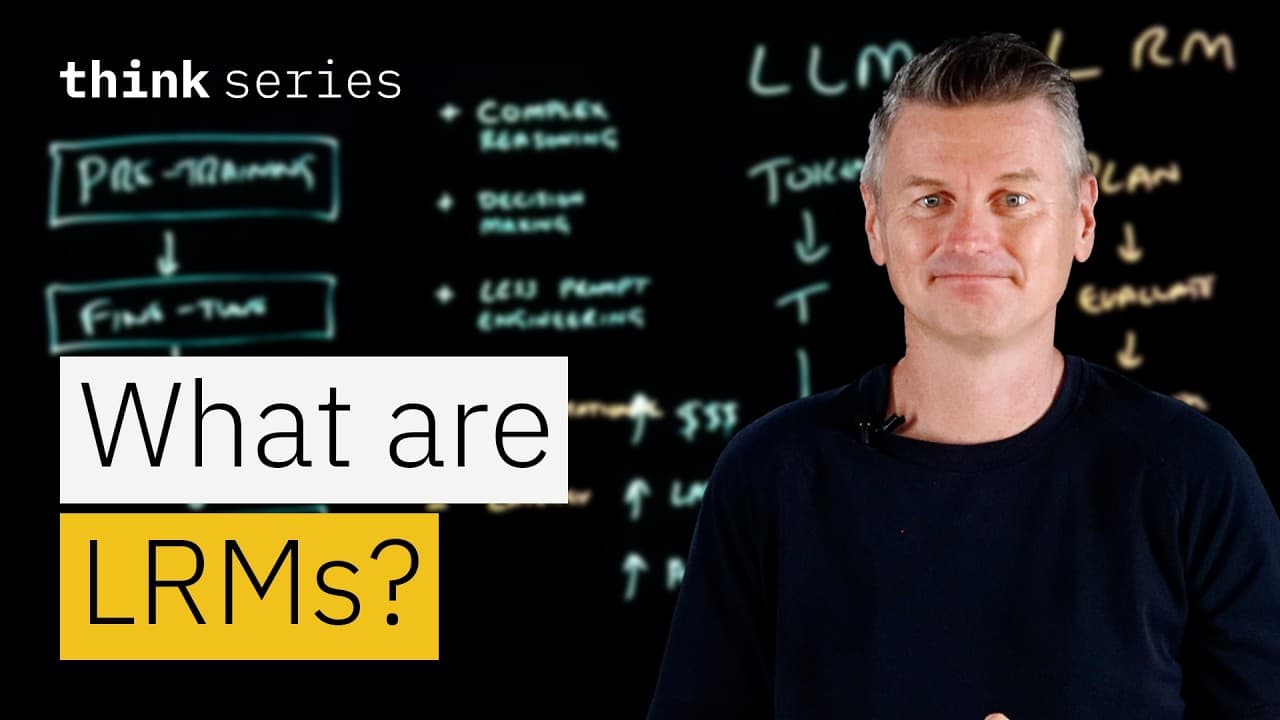
You already know large language models or LLMs. They predict the next token in a sequence, using a statistical pattern matching technique to crank out human like text. There's also LRMs, large reasoning models, and they go a bit further. They think before they talk. Now, give LLM a prompt and it will projectile predict whatever word statistically f... Read More
Key Insights
- Large reasoning models are language models that plan, evaluate, and verify their work before settling on an answer. They still generate tokens, but their additional deliberation helps them move beyond an immediate statistically likely response.
- The main advantage of an LRM is deeper reasoning on tasks involving multistep logic, planning, abstract reasoning, difficult debugging, or complicated financial tracing. It can test hypotheses, abandon unsuccessful paths, and pursue a more coherent solution.
- An LRM is usually built on an existing LLM that has completed massive pretraining on sources such as web pages, books, code, and repositories. This foundation provides language ability and a broad knowledge base before reasoning specialization begins.
- Reasoning-focused tuning teaches a model to move from a problem to a plan, execute multiple steps, and reach a solution. Curated examples can include logic puzzles, multistep mathematics problems, and challenging coding tasks with complete reasoning answer keys.
- Reinforcement learning improves reasoning by rewarding useful sequences of steps. Humans can rate steps through reinforcement learning from human feedback, while process reward models can judge whether each individual step in a reasoning chain is good or bad.
- Distillation trains a smaller or newer model using reasoning traces produced by a larger teacher model. When the teacher solves a problem through a useful sequence of steps, that solution path can become training data for the other model.
- Inference-time compute determines how much deliberation a model receives for a particular request. Extended processing may involve multiple reasoning chains, voting on alternatives, backtracking through tree search, or consulting calculators, databases, and code sandboxes.
- Deeper reasoning has practical tradeoffs because every additional pass, check, and search branch consumes processing resources. LRMs can provide more nuanced and accurate answers with less prompt engineering, but they also require more compute, energy, memory, money, and response time.
Install to Summarize YouTube Videos and Get Transcripts
Explore YouTube Video Summarizer or Get YouTube Transcript Extractor
Questions & Answers
Q: What is a large reasoning model?
A large reasoning model is an AI model designed to plan, evaluate options, check intermediate work, and revise its approach before producing a final answer. It still generates text by predicting tokens, as an LLM does, but adds deliberate reasoning steps. These capabilities help it solve problems that require multistep logic, planning, verification, abstract reasoning, or careful analysis.
Q: How is a large reasoning model different from an LLM?
A standard LLM primarily predicts the next statistically suitable token and continues generating a response. An LRM also predicts tokens, but first performs additional work such as sketching a plan, weighing options, testing hypotheses, checking calculations, and discarding dead ends. This makes an LRM more appropriate for complex reasoning, although it responds more slowly and uses more computational resources.
Q: How are large reasoning models trained?
Large reasoning models usually begin with an LLM that has undergone massive pretraining on web pages, books, code, repositories, and similar material. The pretrained model then receives specialized reasoning-focused tuning with logic puzzles, multistep mathematics, and difficult coding tasks. Complete reasoning examples teach it to create a plan, execute several steps, and arrive at a coherent solution.
Q: How does reinforcement learning improve an LRM?
Reinforcement learning improves an LRM by rewarding reasoning sequences that contain useful and coherent steps. Human reviewers can provide positive or negative feedback through reinforcement learning from human feedback. Alternatively, process reward models can assess each step in a reasoning chain. The LRM then learns to generate thought sequences that receive stronger rewards and improve logical coherence.
Q: What is model distillation for reasoning models?
Model distillation uses a larger teacher model to generate reasoning traces that can train a smaller or newer model. The teacher works through a problem and produces a solution path containing the reasoning steps it used. That path is added to the training material, allowing the other model to learn patterns of planning, execution, verification, and problem solving from the teacher.
Q: What is inference-time compute in large reasoning models?
Inference-time compute, also called test-time compute, is the processing allowance given to a model when it answers a request. A difficult debugging problem may receive substantial thinking time, while a simple caption may require only one quick pass. With more compute, the model can explore several reasoning chains, compare them, backtrack, and perform external spot checks before answering.
Q: When should you use an LRM instead of a regular LLM?
An LRM is most useful when a task requires multistep logic, planning, abstract reasoning, internal verification, or careful decision making. Examples from the source include debugging a difficult stack trace and tracing cash flow through several shell companies. A regular LLM or smaller model may be more suitable for straightforward requests, such as writing a fun social media caption.
Q: What are the costs and limitations of large reasoning models?
Large reasoning models require extra passes through the network for planning, self-checking, searching, and evaluating alternatives. These operations increase inference time, GPU use, energy consumption, memory requirements, latency, and cloud-provider costs. The added expense may be worthwhile when accuracy and complex reasoning matter, but it can be unnecessary for simple tasks that need only a quick response.
Summary & Key Takeaways
-
Large reasoning models extend the capabilities of language models by adding deliberate planning, evaluation, and verification before producing a final response. They can test hypotheses, discard dead ends, perform calculations in sandboxes, and follow multistep solution paths, making them better suited to difficult debugging, financial tracing, logic, mathematics, and coding tasks.
-
An LRM typically begins as a massively pretrained LLM with broad language skills and knowledge. It then receives reasoning-focused tuning using logic puzzles, multistep mathematics, and difficult coding examples with complete solution paths. Reinforcement learning, process reward models, human feedback, and model distillation can further improve the coherence of its reasoning.
-
Runtime thinking is controlled through inference-time compute. Hard problems may receive multiple reasoning attempts, voting, backtracking, tree search, or external tool checks, while simple writing requests may need only a quick pass. More deliberation can improve accuracy and reduce prompt engineering, but it also increases latency, energy use, memory requirements, and cost.
Read in Other Languages (beta)
Share This Summary 📚
Summarize YouTube Videos and Get Video Transcripts with 1-Click
Try YouTube Summary with ChatGPT & Claude or YouTube Transcript Generator
Explore More Summaries from IBM Technology 📚



Summarize YouTube Videos and Get Video Transcripts with 1-Click
Try YouTube Summary with ChatGPT & Claude or YouTube Transcript Generator