How Does a Professional Prompt Engineer Work?
TL;DR
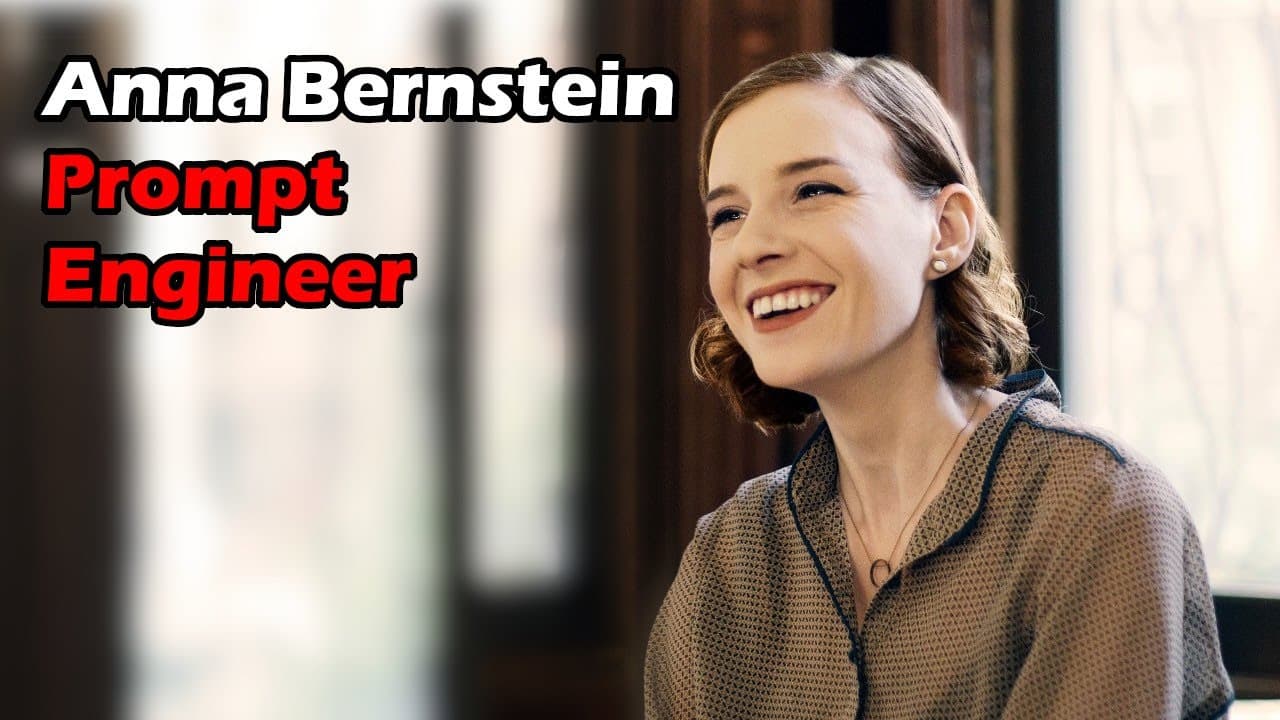
Professional prompt engineering combines precise language analysis, creative experimentation, and careful editing to shape useful AI outputs. Anna Bernstein says her experience with poetry, copywriting, historical research, and Arabic translation prepared her to test both intuitive and unconventional approaches while building prompt infrastructure and exploring what language models might make possible.
Transcript
hey everyone David Shapiro here with another podcast interview today I am super excited to introduce Anna Bernstein one of the world's first uh professional prompt engineers Anna is wonderful to talk to very very bright um and just a wonderful charismatic person and so uh without further Ado um Anna would you like to tell us a little bit ab... Read More
Key Insights
- Professional prompt engineering is both a building role and an experimental role. Bernstein creates prompt infrastructure that Copy.ai needs while also acting as a “mad scientist” who investigates capabilities that might be possible through different uses of language.
- Bernstein’s route into prompt engineering began outside a conventional technical career. She grew up in New York, pursued writing and language, studied at Macalester, worked in copywriting and research, and developed creative practices before becoming a full-time prompt engineer.
- Arabic translation is an example of how precision and creativity can coexist. Bernstein found its grammar compact, efficient, and elaborate, with small features such as a single diacritic capable of changing the meaning of an entire sentence.
- Prompt engineering resembles linguistic puzzle solving because small changes in wording can produce different results. Bernstein connects this process to translating poetry, where careful analysis of grammar and marks unlocks a meaning that is not merely correct but also beautiful.
- Bernstein’s first encounter with GPT-3 occurred through its playground on a phone in the summer of 2021. She immediately suggested reframing a direct question as the beginning of a sentence so the model could autocomplete the requested flavor name.
- Copy.ai initially treated the emerging position as something close to copywriting. The company had tried several people and was unsure whether the role truly existed before inviting Bernstein to work on a freelance contract and later hiring her full time.
- Prompt construction can be understood as inventing a spell whose wording must be precise. Copy.ai co-founder Chris Lu compared it to saying a spell correctly and getting the physical motion right, except that the prompt engineer must also invent the spell.
- Poetry develops habits that transfer to prompt engineering. Bernstein’s writing process involves holding several possible approaches in mind, deciding between intuitive and less obvious choices, preserving rejected paths for possible reuse, and editing language at a granular level.
Install to Summarize YouTube Videos and Get Transcripts
Explore YouTube Video Summarizer or Get YouTube Transcript Extractor
Questions & Answers
Q: What does a professional prompt engineer do?
A professional prompt engineer creates language-based infrastructure that helps an AI system produce useful results. At Copy.ai, Anna Bernstein describes the work as partly building what the company currently needs and partly experimenting with what may be possible. The role requires close attention to wording, repeated exploration, creative judgment, and a willingness to test both obvious and unconventional approaches.
Q: How did Anna Bernstein become a prompt engineer?
Anna Bernstein met an early Copy.ai employee, Wenyuan Zhang, at a jazz club and later saw him use the GPT-3 playground on his phone in the summer of 2021. She proposed changing how a question was phrased so the model could autocomplete it. Copy.ai subsequently offered her contract work in an uncertain emerging role, then hired her full time after she demonstrated value.
Q: How does studying language help with prompt engineering?
Studying language can train someone to notice how small structural choices affect meaning, tone, and audience response. Bernstein’s Arabic translation work required careful analysis because one diacritic could change an entire sentence. She sees a parallel with prompt engineering, where precise wording functions as part of a puzzle whose solution can produce a compelling or creatively valuable result.
Q: Why does Anna Bernstein compare prompt engineering with poetry?
Bernstein’s poetry process requires granular editing and the ability to consider several possible directions simultaneously. She may follow an initial idea, preserve alternative routes, backtrack when one route fails, and choose between intuitive and less expected language. These habits resemble prompt engineering because both practices depend on precise choices, experimentation, revision, and judgment about what wording best serves a creative purpose.
Q: What was Copy.ai initially looking for in a prompt engineer?
Copy.ai was not initially certain that prompt engineering existed as a distinct role. The work was described partly as improving examples in use cases and seemed closer to copywriting at first. After trying several people without finding the right fit, the company took a chance on Bernstein as a freelancer. Her contribution led to a full-time position working on prompt infrastructure.
Q: How did Bernstein first experiment with GPT-3?
Bernstein first encountered GPT-3 when Wenyuan Zhang used its playground to identify an Indonesian flavor term. After seeing him describe the flavor and ask for its name, she suggested writing the beginning of a sentence instead of asking the question directly. The model could then autocomplete the sentence. The successful experiment captured her interest and prompted many further ideas about interacting with the system.
Q: Why is precision important in prompt engineering?
Precision matters because apparently small linguistic changes can alter the result an AI system produces. Bernstein relates this sensitivity to Arabic translation, where a single diacritic could change a sentence’s entire meaning. Chris Lu’s spell analogy expresses the same principle: slight errors in language or execution can yield the wrong effect, so the prompt engineer must discover and refine the appropriate formulation.
Q: What nontechnical experience prepared Bernstein for prompt engineering?
Bernstein brought experience from writing, poetry, copywriting, Arabic translation, and research for historical and biographical projects. While researching the book “Women Who Made New York” with Julie Scelfo, she sought the exact fact that could unlock a person’s narrative. Across these activities, she developed an analytical, precise, and somewhat obsessive approach to language that later proved relevant to prompt engineering.
Summary & Key Takeaways
-
Anna Bernstein describes her work at Copy.ai as both an engineering role and a form of open-ended experimentation. She creates prompt infrastructure for current needs while investigating what might be possible. Although she entered the position without a conventional technical background, her longstanding fascination with language gave her relevant analytical and creative habits.
-
Her study of Arabic translation taught her to appreciate language that could be efficient and elaborate at the same time. Translating medieval poetry and the Quran required precision because a single diacritic could transform a sentence’s meaning. Solving these linguistic puzzles ultimately revealed poetic meanings, an experience she connects with prompt engineering.
-
Bernstein discovered GPT-3 through an early Copy.ai employee whom she met at a jazz club in 2021. While they searched for an Indonesian flavor term, she suggested changing a direct question into a sentence beginning that the model could autocomplete. That encounter led to contract prompt work and eventually full-time employment.
Read in Other Languages (beta)
Share This Summary 📚
Summarize YouTube Videos and Get Video Transcripts with 1-Click
Try YouTube Summary with ChatGPT & Claude or YouTube Transcript Generator
Explore More Summaries from David Shapiro 📚
![Claude 3 Review - LLMs are finally good at fiction and prose! [Cyberpunk Fanfic] thumbnail](/_next/image?url=https%3A%2F%2Fi.ytimg.com%2Fvi%2F3anercD5sLA%2Fhqdefault.jpg&w=750&q=75)
Summarize YouTube Videos and Get Video Transcripts with 1-Click
Try YouTube Summary with ChatGPT & Claude or YouTube Transcript Generator