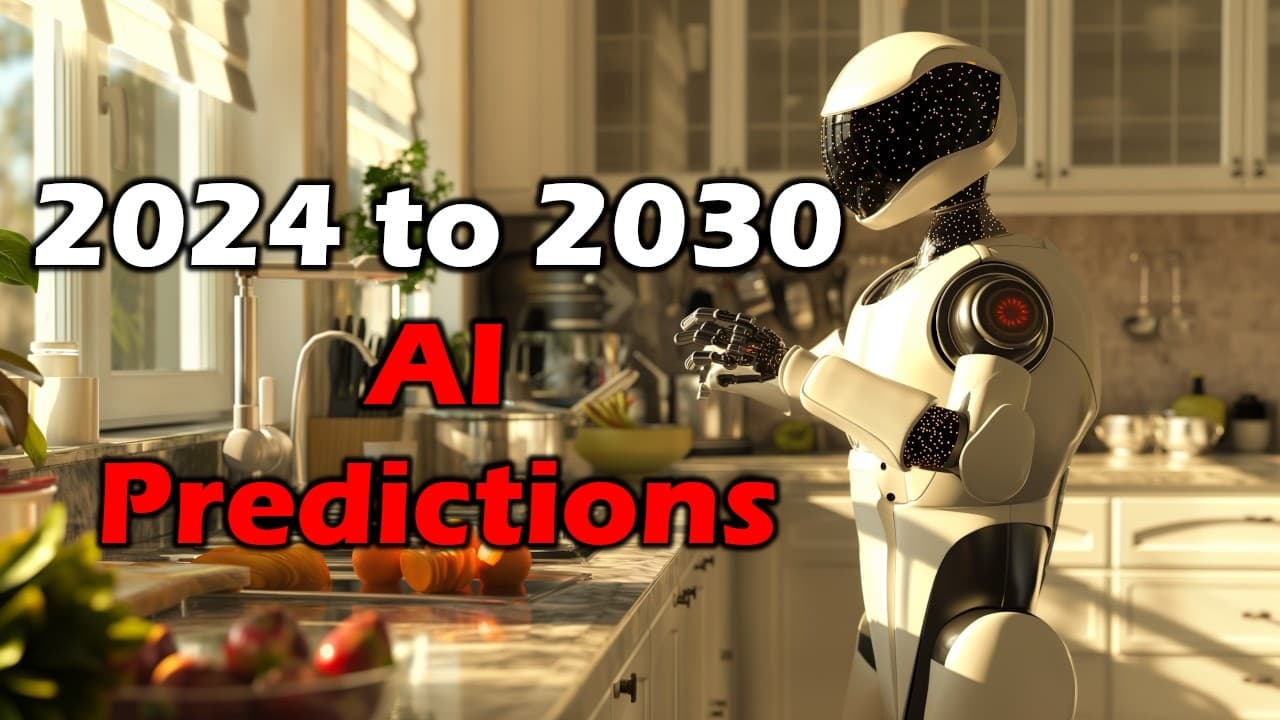
AI Forecast: What to Expect from 2024 to 2030
TL;DR
AI development will see a period of disillusionment but will eventually lead to significant advancements by 2030. While initial expectations for AGI are set around 2027, true enterprise readiness and broad adoption are expected by 2026. The integration of AI into various sectors will be gradual, with significant geopolitical and economic implications expected by 2028.
Transcript
so it's been a little while since I've done one of these prediction videos where I just kind of lay everything out and I realize that there's probably been a little bit of perceived inconsistency in my position lately so I wanted to take a moment to clear all that up and so what I mean is that you know like yes I am expecting a down term uh we're e... Read More
Key Insights
- AI advancements are expected to slow down due to increasing costs, despite faster model release cadences.
- The year 2025 is predicted to be one of disillusionment as AI models reach higher benchmarks but fall short of AGI.
- By 2026, AI models are anticipated to be enterprise-ready, marking a shift towards general-purpose models.
- The integration of AI into enterprises is expected to accelerate by 2026, with significant impacts on employment and geopolitics.
- AGI is expected around 2027, with varying confidence intervals among industry insiders.
- Mass layoffs and geopolitical tensions, particularly with China, are anticipated by 2028 due to AI integration.
- 2029 is predicted to be a pivotal year, marking the beginning of a new technological renaissance.
- By 2030, a new era, possibly termed the 'Intelligence Age,' is expected to emerge, characterized by significant socioeconomic shifts.
Install to Summarize YouTube Videos and Get Transcripts
Explore YouTube Video Summarizer or Get YouTube Transcript Extractor
Questions & Answers
Q: How will AI advancements progress between 2024 and 2030?
AI advancements are expected to progress through a period of disillusionment, with significant breakthroughs anticipated by 2030. While initial expectations for AGI are set around 2027, true enterprise readiness and broad adoption are expected by 2026. The integration of AI into various sectors will be gradual, with significant geopolitical and economic implications expected by 2028.
Q: What are the expectations for AGI?
Expectations for AGI are set around 2027, with varying confidence intervals among industry insiders. While models are expected to reach higher benchmarks by 2025, AGI is anticipated to emerge as AI models become more general-purpose and enterprise-ready by 2026. The definition of AGI may evolve as advancements continue.
Q: When will AI models be considered enterprise-ready?
AI models are anticipated to be considered enterprise-ready by 2026. This marks a shift towards general-purpose models that can be integrated into various sectors. The readiness will lead to broader AI adoption, impacting employment and geopolitics as enterprises begin to fully integrate AI into their operations.
Q: What geopolitical implications are expected from AI integration?
Geopolitical implications from AI integration are expected to become significant by 2028, particularly concerning tensions with China. As AI models become more integrated into enterprises, there will be potential for mass layoffs and economic shifts, driving geopolitical tensions and influencing political discourse, especially in election years.
Q: What are the anticipated economic impacts of AI by 2028?
By 2028, the economic impacts of AI are expected to include mass layoffs due to the integration of AGI and robotics into various sectors. This will coincide with geopolitical tensions, potentially leading to discussions on AI safety, job protection, and universal basic income. The economic landscape will be shaped by AI-driven disruptions and technological advancements.
Q: How will AI advancements affect employment?
AI advancements are expected to affect employment through mass layoffs as AI models become more integrated into enterprises. By 2028, the capabilities of AI and robotics may lead to job dislocation, prompting discussions on job protection and universal basic income. The employment landscape will be reshaped as AI-driven disruptions continue to unfold.
Q: What is the expected timeline for significant AI breakthroughs?
Significant AI breakthroughs are expected by 2030, with the period from 2024 to 2029 marking gradual advancements and integration. While initial expectations for AGI are set around 2027, true enterprise readiness and broad adoption are anticipated by 2026. By 2029, a new technological renaissance is predicted to begin, characterized by major shifts in various sectors.
Q: What is the 'Intelligence Age' and when will it begin?
The 'Intelligence Age' is a term used to describe the new era anticipated to begin by 2030, characterized by significant advancements in AI and related technologies. This era will mark the full integration of AI into various sectors, leading to socioeconomic shifts, new paradigms, and the establishment of a new normal in the fourth industrial revolution.
Summary & Key Takeaways
-
AI development is expected to face a period of disillusionment, with significant advancements anticipated by 2030. Initial expectations for AGI are set around 2027, with true enterprise readiness and broad adoption expected by 2026. The integration of AI into various sectors will be gradual, with significant geopolitical and economic implications expected by 2028.
-
The release cadence of AI models is accelerating, but breakthroughs are becoming more costly. By 2025, AI models are expected to reach higher benchmarks but will likely fall short of AGI. Enterprise readiness is anticipated by 2026, marking a shift towards general-purpose models and broader AI adoption.
-
Geopolitical tensions and economic shifts, driven by AI integration, are expected by 2028, particularly concerning China. The year 2029 is predicted to be pivotal, marking the beginning of a new technological renaissance. By 2030, a new era, possibly termed the 'Intelligence Age,' is expected to emerge, characterized by significant socioeconomic shifts.
Read in Other Languages (beta)
Share This Summary 📚
Summarize YouTube Videos and Get Video Transcripts with 1-Click
Try YouTube Summary with ChatGPT & Claude or YouTube Transcript Generator
Explore More Summaries from David Shapiro 📚
![Claude 3 Review - LLMs are finally good at fiction and prose! [Cyberpunk Fanfic] thumbnail](/_next/image?url=https%3A%2F%2Fi.ytimg.com%2Fvi%2F3anercD5sLA%2Fhqdefault.jpg&w=750&q=75)


Summarize YouTube Videos and Get Video Transcripts with 1-Click
Try YouTube Summary with ChatGPT & Claude or YouTube Transcript Generator