Data Analysis 9: Data Regression - Computerphile
TL;DR
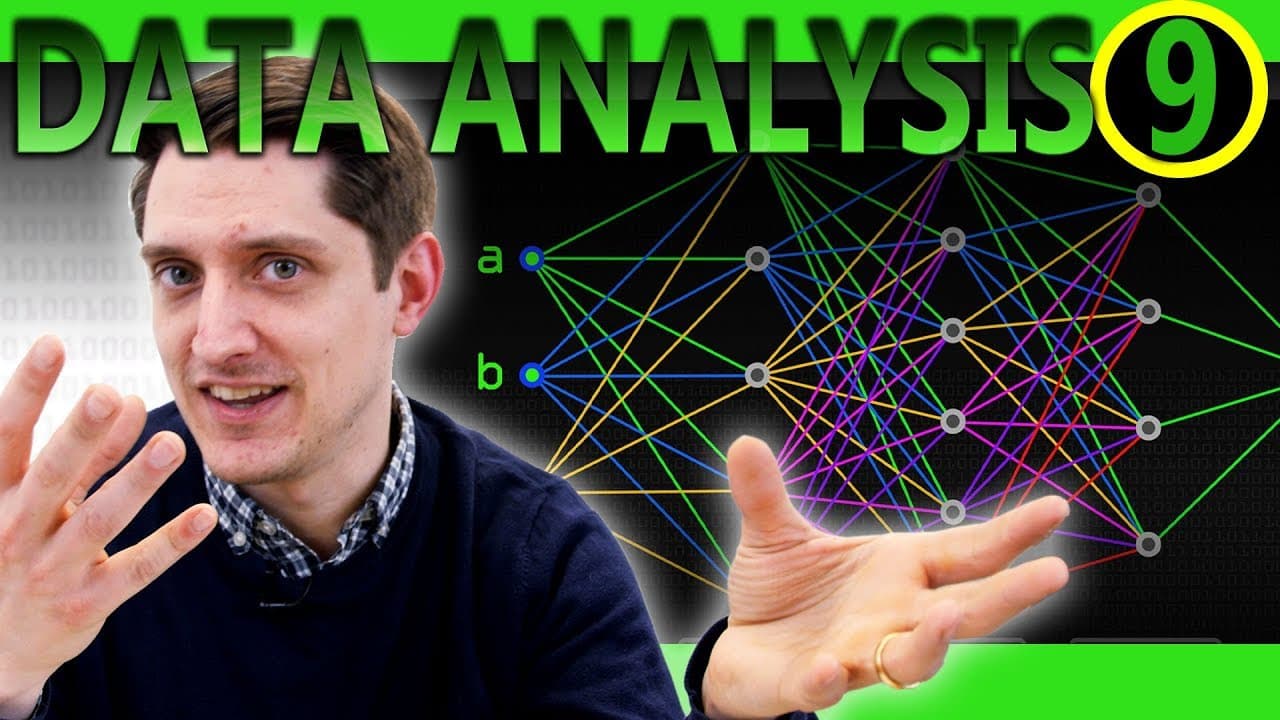
This content provides an analysis of regression algorithms, specifically focusing on linear regression and artificial neural networks, explaining how they are used to predict scalar data based on input variables.
Transcript
Classification lets us pick one or the other or some small number of labels for our data The problem is that real life doesn't fit into these neat little categories When we have label data there isn't yes or no or a B or C or some labels? Right, then we have what we call a regression problem. We're actually trying to predict actual outputs, right s... Read More
Key Insights
- 👻 Regression allows us to predict scalar outputs based on input variables, making it suitable for a wide range of scenarios.
- 🫥 Linear regression fits a line to the data, while multivariate linear regression deals with multiple input attributes.
- ❓ Logistic regression combines linear regression with a sigmoid function for classification purposes.
- 🛰️ Artificial neural networks are a more powerful regression algorithm that combines multiple linear regressions through nonlinear functions.
- ❎ Mean absolute error, mean squared error, root mean squared error, and R-squared are common measures used to evaluate regression models.
- 🛰️ Linear regression and artificial neural networks are both useful approaches to regression, with neural networks providing more flexibility and complexity.
- ❓ Predictions made by regression algorithms can be visualized through scatter plots to assess accuracy and identify potential areas of improvement.
Install to Summarize YouTube Videos and Get Transcripts
Explore YouTube Video Summarizer or Get YouTube Transcript Extractor
Questions & Answers
Q: What is the main difference between regression and classification?
The main difference is that regression predicts scalar values, while classification assigns labels to data. Regression models aim to predict continuous outputs, such as temperature or credit rating, while classification models aim to categorize data into classes or categories, like determining whether someone should be given credit or not.
Q: How does linear regression work?
Linear regression fits a straight line to the data by finding the optimal values for the slope (M) and intercept (C). It uses training data with known input-output pairs to minimize the prediction error and make accurate predictions for new inputs. The line equation, y = MX + C, allows for predictions based on the input variable.
Q: What is the role of an artificial neural network in regression?
Artificial neural networks combine multiple linear regressions through nonlinear functions to create a more powerful regression algorithm. They use hidden layers and weighted sums to calculate outputs based on multiple input attributes. The network is trained using gradient descent to adjust weights and biases until accurate predictions can be made.
Q: Can linear regression be used for classification purposes?
While linear regression is primarily used for regression tasks, it can be adapted for classification through the use of a logistic function or sigmoid curve. By passing the linear regression function through a sigmoid function, the outputs can be squashed between 0 and 1, allowing for classification between two classes.
Summary & Key Takeaways
-
Regression allows us to predict scalar outputs based on input variables, unlike classification which assigns labels to data.
-
Linear regression is a simple form of regression that fits a line to the data to make predictions.
-
Multivariate linear regression is used when there are multiple input attributes, while logistic regression combines linear regression with a sigmoid function for classification purposes.
-
Artificial neural networks, through nonlinear functions and weighted sums, can combine multiple linear regressions to create a powerful regression algorithm.
Read in Other Languages (beta)
Share This Summary 📚
Summarize YouTube Videos and Get Video Transcripts with 1-Click
Try YouTube Summary with ChatGPT & Claude or YouTube Transcript Generator
Explore More Summaries from Computerphile 📚




Summarize YouTube Videos and Get Video Transcripts with 1-Click
Try YouTube Summary with ChatGPT & Claude or YouTube Transcript Generator