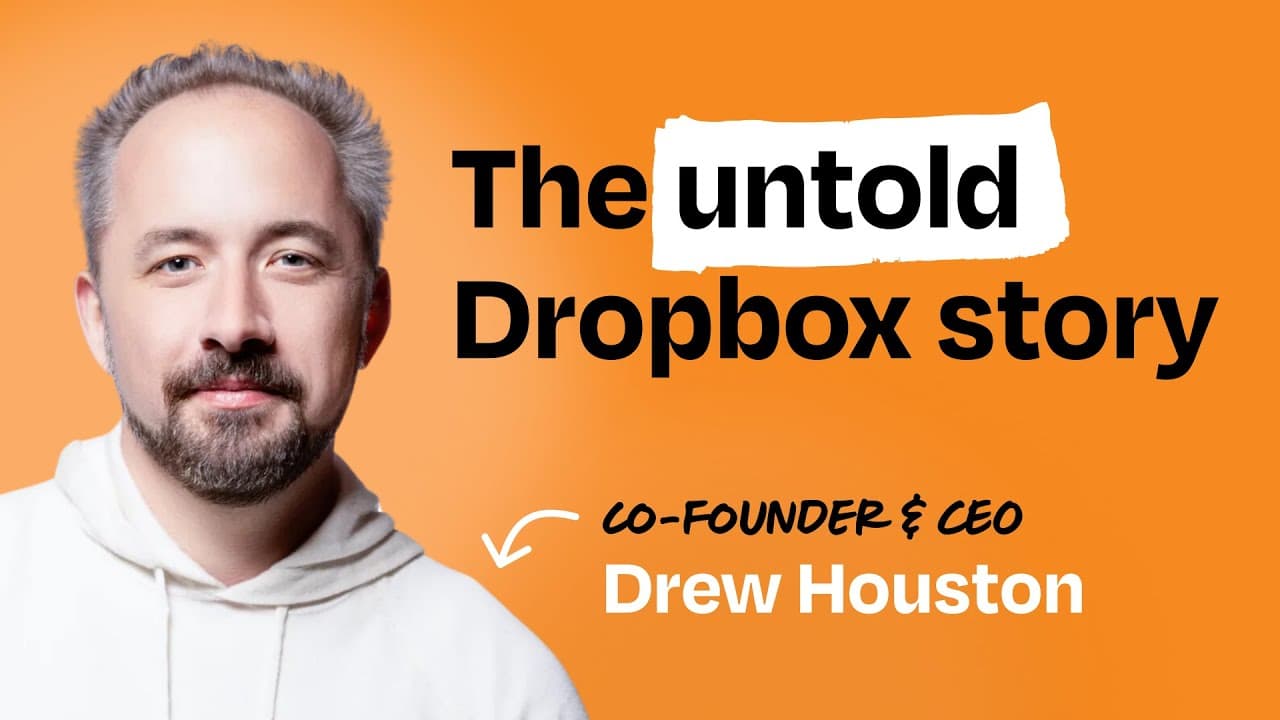
Drew Houston on Building Dropbox Through Three Eras
TL;DR
Dropbox went through three distinct eras: explosive viral growth doubling every year, a survival phase battling Apple, Microsoft, and Google at once, and a current reinvention phase. The turning point came in 2015 when Google Photos launched free unlimited storage for life, which nuked Dropbox's business model and forced Drew Houston to kill products and refocus.
Transcript
People just don't realize the wild journey that you have been on over the past 18 years building this company. It feels like there's almost been these three eras of Dropbox. The first era of you're killing it. For the first several years, it was doubling, 10-xing every year. Taping user counts that we printed out to the wall, and then running... Read More
Key Insights
- Dropbox's history breaks into three eras: an early viral-growth phase where the company was 'killing it,' a middle phase where every tech incumbent tried to kill it, and a current phase of rethinking what Dropbox could be.
- The first era lasted roughly seven years from 2007 to 2014, with the company doubling and 10-xing user counts every year, printing milestones like 100,000, 500,000, 1,000,000, and 10,000,000 users onto walls until they ran out of space.
- The second era began when Apple, Microsoft, and Google all launched competing products, described like seeing a distant mushroom cloud you notice but don't yet feel, signaling that 'winter was coming.'
- 2015 was the pivotal year when things shifted, with louder critics emerging inside and outside the company as the competitive threats intensified.
- Google Photos delivered a decisive blow by launching similar value plus free unlimited storage for life, which Houston says totally nuked Dropbox's business model.
- Facing wars on three or four fronts against rivals with infinite cash, Houston killed Carousel and Mailbox and went all-in on productivity, but the narrative flipped negatively rather than improving.
- Dropbox started from personal frustration over file syncing, with Houston initially focusing on one customer, himself, sparked by forgetting his thumb drive on a trip to New York.
- Houston engineered Dropbox's Y Combinator entry by reverse-engineering Paul Graham's habits, making a screencast demo video that hit the top of Hacker News for two days to grab his attention.
Install to Summarize YouTube Videos and Get Transcripts
Explore YouTube Video Summarizer or Get YouTube Transcript Extractor
Questions & Answers
Q: What are the three eras of Dropbox according to Drew Houston?
Drew Houston describes Dropbox's 18-year journey in three eras. The first is the 'you're killing it' era of explosive viral growth, up and to the right. The second is when 'everyone was trying to kill you,' as all the tech incumbents came after the company. The third is the current era of rethinking what Dropbox could be. Houston confirmed this framing roughly captures the company's arc from its founding through today.
Q: How fast did Dropbox grow in its early years?
In its first several years, roughly 2007 to 2014, Dropbox was doubling and 10-xing every year. The team physically printed out user counts and taped them to the wall, then ran out of wall space and moved to the ceiling. They tracked milestones of 100,000 users, then 200,000, 500,000, 1,000,000, and 10,000,000. Houston called it a crazy fever-dream .com experience that felt like a blur, like riding a tidal wave while trying to stay on.
Q: Why did Google Photos hurt Dropbox so badly?
Around 2015 things began to shift, and less than a year after critics grew louder, Google Photos launched. It not only provided a lot of the same value Dropbox offered, but Google also gave users free unlimited storage for life. Houston says this totally nuked Dropbox's business model. It was one of several fronts on which Dropbox was fighting big competitors that had infinite cash and could do whatever they wanted.
Q: What products did Drew Houston shut down and why?
Facing wars on three or four fronts against big competitors with infinite cash, Houston killed Carousel and killed Mailbox, and went all-in on productivity. He says he wished he could report that everything then got better, but it was the opposite. The narrative completely flipped on the company. Employees no longer wanted to wear the Dropbox T-shirt, and people looked to him wondering how he had gotten them into that situation.
Q: How did Drew Houston get into Y Combinator?
Houston reverse-engineered how to get Paul Graham's attention, hypothesizing that Graham hits refresh on Hacker News like everyone else. Inspired by the book Guerrilla Marketing about marketing with no money, he made a straightforward screencast video showing Dropbox working on his computer. It hit the top of Hacker News for two days, and Paul sent a note saying it was interesting but that Houston needed a co-founder, which led him to find Arash.
Q: What inspired Drew Houston to start Dropbox?
Houston started Dropbox out of personal frustration, and it felt like something only he was super interested in as far as file syncing. He focused on one customer, himself. A key origin moment was forgetting his thumb drive on a trip to New York, which pushed him toward building a syncing solution. He had many friends in Y Combinator and friends who had moved from Boston to California, and he felt left out while also holding this idea.
Q: When did Drew Houston start Dropbox and how old was he?
Houston started the company back in 2007, and he says he might have been 24 at the time when he moved to California. Before Dropbox, his first company was an online SAT prep business that he started when he was 21. He notes that Y Combinator has a lot in common with college admissions, with a million people applying for very few spots, which shaped how he thought about finding a hook or side door in.
Q: What was the challenge Paul Graham gave Drew Houston after the demo video?
After Houston's screencast video hit the top of Hacker News, Paul Graham sent a note saying the project was interesting but that he needed a co-founder. This was a problem because the YC application deadline for the next cycle was only a week or two away. Houston compared it to Paul telling him he needed to be married in the next two weeks even though he wasn't dating anyone. He ended up finding his co-founder, Arash, in that window.
Summary & Key Takeaways
-
An outsider view frames Dropbox's 18-year journey as three eras: a first era of pure up-and-to-the-right viral growth, a second era where all the incumbents came after the company at once, and a current third era of rethinking what Dropbox could become. Houston agrees this structure captures the arc accurately.
-
In the first era, from 2007 to 2014, Dropbox doubled and 10-xed every year in a fever-dream .com experience. The team printed rising user counts onto walls, moving to the ceiling after passing 100,000, 500,000, one million, and ten million users as growth felt like riding a tidal wave.
-
The second era brought existential competition. Apple, Microsoft, and Google launched competing products, and in 2015 Google Photos offered free unlimited storage for life, nuking Dropbox's business model. Houston killed Carousel and Mailbox, went all-in on productivity, and faced a flipped internal narrative and doubting employees.
Read in Other Languages (beta)
Share This Summary 📚
Summarize YouTube Videos and Get Video Transcripts with 1-Click
Try YouTube Summary with ChatGPT & Claude or YouTube Transcript Generator
Explore More Summaries from Lenny's Podcast 📚





Summarize YouTube Videos and Get Video Transcripts with 1-Click
Try YouTube Summary with ChatGPT & Claude or YouTube Transcript Generator