How to Use Will and Going To for Future Plans
TL;DR
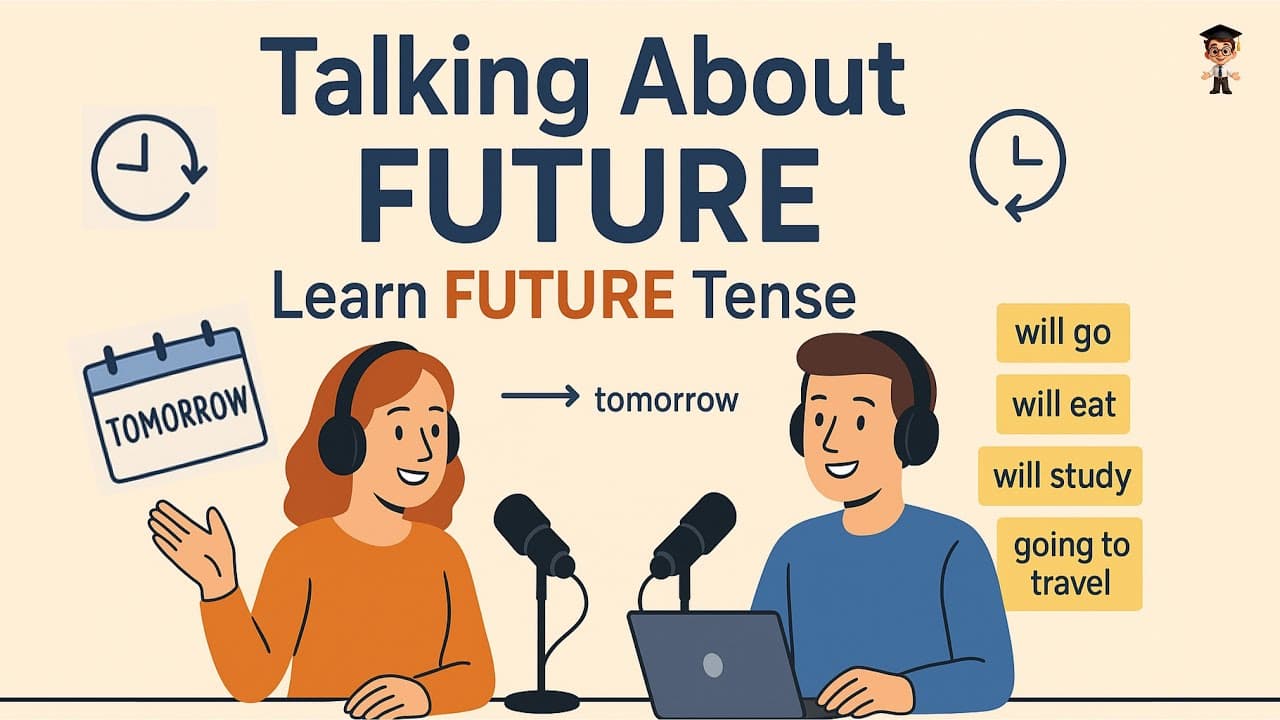
Use “going to” for plans decided earlier, “will” for immediate decisions and promises, and the present continuous for fixed arrangements. Informal speech often reduces “going to” to “gonna,” while time markers such as “tomorrow,” “next week,” and “on Monday” make the timing of future actions clear.
Transcript
[music] [music] Hello everyone and welcome back to Mr. English channel where learning English is easy and fun. [music] I'm Emily. >> Hello Emily. Hello to all our amazing listeners around the world. It is a beautiful day to learn English. It really is, Paul. The sun is shining and I am feeling very energetic today. How are you? >> I am fantastic, t... Read More
Key Insights
- “Going to” is used for plans that were decided before the current conversation. A speaker can say, “I am going to play tennis with my brother,” when the activity was considered and organized earlier rather than chosen at the moment of speaking.
- “Will” is used for decisions made at the moment of speaking. If a phone suddenly rings, “I will answer it” fits because the speaker responds immediately instead of describing something that had already been planned.
- “Will” is also used for promises, offers, and commitments. Statements such as “I will help you with your homework,” “I will call you later,” and “I will bring the cake” communicate a willingness or promise to take future action.
- “I’ll” is the contracted form of “I will” and sounds softer and faster in conversation. It appears naturally when ordering food, making offers, or promising help, as in “I’ll have the salad” and “I’ll help you.”
- “Gonna” is an informal spoken form of “going to” that is common in conversations and movies. It can help speech sound natural among friends, but the complete form “going to” should be used in formal writing, such as an email to a boss.
- The present continuous is used for fixed future arrangements, especially when another person, a specific time, or a confirmed schedule is involved. “I am meeting my friend at 5:00 p.m.” presents the meeting as a firm arrangement.
- Time markers are words and phrases that identify when a future action will occur. Examples from the lesson include “tomorrow,” “tonight,” “next week,” “next month,” “next year,” “soon,” “in 10 minutes,” “on Monday,” and “on July 4th.”
- The choice between future forms depends on how the action was decided. An earlier plan generally takes “going to,” a decision made now or a promise takes “will,” and a fixed arrangement can take the present continuous.
Install to Summarize YouTube Videos and Get Transcripts
Explore YouTube Video Summarizer or Get YouTube Transcript Extractor
Questions & Answers
Q: When should I use “going to” for future plans?
Use “going to” when you are describing a plan or intention that you decided before the moment of speaking. For example, “I am going to play tennis with my brother on Saturday” is appropriate when the activity was planned earlier. The same form works for holiday ideas, dinner plans, purchases, visits, and long-term goals such as writing a book.
Q: When should I use “will” for the future?
Use “will” when you make a decision at the moment of speaking or when you make a promise, offer, or commitment. If the phone rings and you immediately decide to respond, you can say, “I will answer it.” Other examples include “I will help you with your homework,” “I will call you later,” and “I will bring the cake.”
Q: What is the difference between “will” and “going to”?
The main difference is when and how the future action was decided. Use “going to” for a plan formed before the current moment, such as playing tennis after arranging it yesterday. Use “will” for an immediate decision, such as choosing spaghetti after reading a menu, or for a promise such as buying the first copy of a friend’s future book.
Q: How can I use “will” when ordering food?
Use “will” when you choose your food after looking at the menu and deciding at that moment. For example, you can tell the waiter, “I will have the spaghetti.” The contracted form is also common, so “I’ll have the salad” sounds natural. Although “going to” may be possible, “I’ll have” is presented as a common expression for ordering food.
Q: What does “gonna” mean in spoken English?
“Gonna” is an informal pronunciation of “going to” used frequently in fast, natural speech. A sentence such as “I am going to go home” may sound like “I’m gonna go home” in conversation. It is suitable when speaking casually with friends, but the lesson advises writing the complete form “going to” in formal communication, including emails to a boss.
Q: How is the present continuous used for future arrangements?
Use the present continuous for a future arrangement that is fixed, scheduled, or connected to a specific time or another person. Examples include “I am meeting my friend at 5:00 p.m.,” “I am flying to New York on Friday,” and “I am having dinner with my boss tonight.” This form makes the plan sound firm and strongly arranged.
Q: What time markers help clarify future plans in English?
Time markers specify when a future action or arrangement will happen. The lesson uses “tomorrow,” “tonight,” “next week,” “next month,” “next year,” “soon,” and “in 10 minutes.” Days and dates can also provide clear timing, as in “on Monday,” “on Sunday,” and “on July 4th.” Adding these expressions makes the future timing easier for a listener to understand.
Q: How can I practice talking about future plans naturally?
Practice by describing real plans for your weekend, dinner, holiday, work, or personal goals. Begin with “I am going to” for plans already considered, use “I will” for a decision or promise made now, and try the present continuous for fixed arrangements. Add a time marker, such as “tonight” or “next week,” to make each sentence clearer.
Summary & Key Takeaways
-
English commonly expresses future meaning through “going to,” “will,” and the present continuous. “Going to” describes plans formed before speaking, such as playing tennis on Saturday or visiting Italy next summer. “Will” suits decisions made at the moment of speaking, as well as promises, offers, and commitments.
-
Spoken English often uses contractions and reduced forms to sound more natural. “I will” becomes “I’ll,” as in “I’ll have the salad” or “I’ll help you.” Friends may pronounce “going to” as “gonna,” but the full written form remains appropriate in formal communication, including an email to a boss.
-
The present continuous can describe fixed future arrangements involving a specific time, appointment, ticket, or another person. Examples include meeting a friend at 5:00 p.m., flying to New York on Friday, and having dinner with a boss tonight. Time markers clarify exactly when each future action will happen.
Read in Other Languages (beta)
Share This Summary 📚
Summarize YouTube Videos and Get Video Transcripts with 1-Click
Try YouTube Summary with ChatGPT & Claude or YouTube Transcript Generator
Explore More Summaries from Mr. English Channel 📚


Summarize YouTube Videos and Get Video Transcripts with 1-Click
Try YouTube Summary with ChatGPT & Claude or YouTube Transcript Generator