What Is Historical Nihilism and Why the CCP Fears It
TL;DR
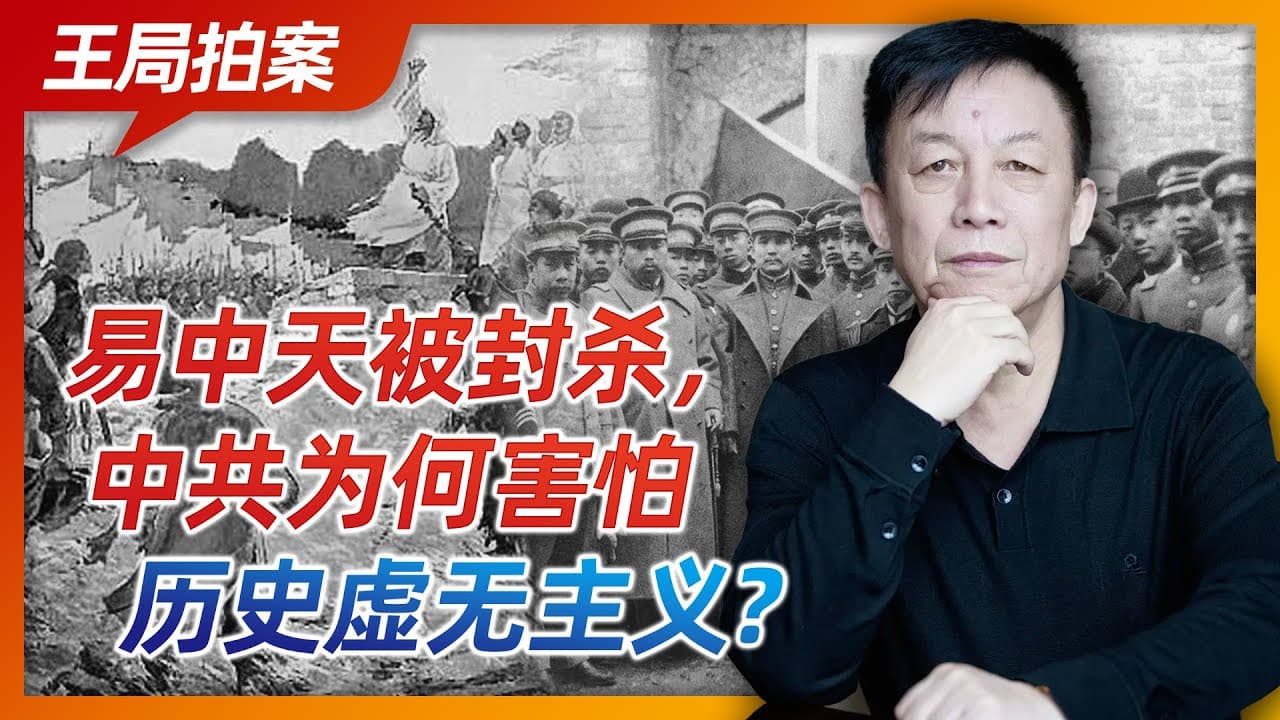
Historical nihilism, as defined by Fudan professor Ge Jianxiong, means two things: denying national history and culture, and using history to oppose the Chinese Communist Party. Its opposite is historical materialism, the Marxist claim that history moves inevitably toward communism. Because modern Chinese history functions as the argument for the Party's right to rule, revisiting any link in that chain becomes a political act, not a scholarly one.
Transcript
A while ago The education department of Shandong Province informed primary and secondary schools Take down Yi Zhongtian's books in the library Later it seems that Zhejiang is also following up When this story came out at the time I still have some amazement Why? Because Yi Zhongtian is a scholar of ancient history He became famous because of his ea... Read More
Key Insights
- Historical nihilism has two official definitions according to Fudan University professor Ge Jianxiong: the denial of national history and culture, and the use of history to oppose the Chinese Communist Party. He offered these in a university presentation on how to approach history.
- Denying the standard national timeline counts as nihilism. Saying Chinese history is only 3,700 years rather than 5,000 years of Xia, Shang and Zhou, or that the Xia did not exist, falls under denial of national history and culture.
- Chinese history museums still present Beijing Ape Man and Cave Man as ancestors even though molecular biology indicates humans all came out of Africa 50,000 or 100,000 years ago and Beijing apes have no blood relationship to present-day Chinese. The purpose is tracing an unbroken and distinct national lineage.
- Historical materialism is the antithesis of historical nihilism and one of the three cornerstone theories of Marxism. It applies matter determining consciousness, productivity determining relations of production, and superstructure over material base to the field of history.
- Marx's schema holds that human history moves independently of human will from primitive society through slave, feudal and capitalist stages to communism, with violent revolution required in the middle, the working class uniting to attack the capitalists and liberate all mankind.
- Chinese theorists Guo Moruo, Fan Wenlan and Jian Bozan Sinicized historical materialism. Their narrative starts modern Chinese history at the 1840 Opium Wars and the Treaty of Nanking, after which China was gradually reduced to a semi-colonial, semi-feudal society.
- In that narrative every pre-1921 revolt failed for the same reason. The Jintian Uprising, the Hundred Days Reform, the Boxer Rebellion and the Xinhai Revolution all fell short because there was no Chinese Communist Party yet, so history eventually chose the Party.
- Removing any single link in the historical materialist chain negates its final conclusion, per Ge Jianxiong. That is why re-evaluating a historical episode is not treated as a historical question in modern China but as a political one.
Install to Summarize YouTube Videos and Get Transcripts
Explore YouTube Video Summarizer or Get YouTube Transcript Extractor
Questions & Answers
Q: What is historical nihilism in China?
Fudan University professor Ge Jianxiong gave two definitions in a university presentation on how to approach history. The first is the denial of national history and culture, for example claiming Chinese history spans only 3,700 years rather than the standard 5,000 years of Xia, Shang and Zhou, or that the Xia dynasty never existed. The second is opposing the Chinese Communist Party through history. The video argues the boundaries of the term keep expanding, since Yi Zhongtian's work on ancient texts was labeled nihilist.
Q: Why were Yi Zhongtian's books removed from shelves?
The education department of Shandong Province told primary and secondary schools to take his books out of libraries, and Zhejiang appeared to follow. People in the publishing industry gave two reasons. First, vulgar content: illustrations in his book "Chinese Classic Stories" show Han Gaozu Liu Bang saying he could do nothing but pick up girls and so became founding emperor, an interpretation of ancient figures through modern behavior that some found suggestive of Mao. Second, suspicion of historical nihilism.
Q: Why is it surprising that a scholar of ancient history was censored?
Yi Zhongtian became famous through CCTV's "The Hundred Lectures" with "The Three Kingdoms by Yi Zhongtian", followed by lectures on the Han Dynasty and on the Hundred Schools and early Qin scholars. His focus is ancient history, and the further a period is from the present, the fewer taboos apply and the more freedom a scholar usually has. That is why the speaker found the removal of an ancient-history scholar's work strange enough to investigate.
Q: What is historical materialism and how does it relate to historical nihilism?
Historical materialism is the antithesis of historical nihilism and one of the three cornerstone theories of Marxism. It applies three relationships to history: matter determines consciousness, productivity determines the relations of production, and the superstructure rests on the material base. Marx held that history moves independently of human will from primitive society through slave, feudal and capitalist stages, requiring a violent revolution in which the working class unites against the capitalists, before arriving at communism and the liberation of all mankind.
Q: How did Chinese theorists adapt Marxist historical materialism?
Theorists including Guo Moruo, Fan Wenlan and Jian Bozan Sinicized the theory. Their construction begins modern Chinese history in 1840 with the Opium Wars, when Britain arrived with ships and fought China, leading to the Treaty of Nanking and China's gradual reduction to a semi-colonial, semi-feudal society. The sequence then runs through the Destruction of opium at Humen, the Jintian Uprising, the Hundred Days Reform, the Treaty of Maguan, the Boxer Rebellion and the Xinhai Revolution.
Q: Why does the narrative say earlier Chinese revolutions failed?
In the historical materialist account, the peasant class and the bourgeoisie repeatedly rose against feudal society and foreign imperialist powers, but every attempt failed because of their own class limitations. The underlying explanation offered is that there was no Chinese Communist Party at the time; had one existed, the Jintian Uprising would have succeeded. After the October Revolution delivered Marxism to China and the Party was founded in 1921, the narrative holds that the revolution went from one victory to another and history chose the Communist Party.
Q: How did the Qing dynasty justify its rule according to Ge Jianxiong?
Chinese dynasties normally claimed legitimacy through the transfer of destiny: the previous dynasty reigned in ignorance and wantonness, so the mandate passed on. That argument failed for the Qing because Chongzhen, the last Ming emperor, was famously diligent. So the Qing built a different story: the Ming was destroyed by Li Zicheng, and the Qing took the empire from Li Zicheng as revenge for the Ming. They maintained the Thirteen Tombs and buried Chongzhen with emperor's rites.
Q: When did the term historical nihilism appear and why?
The term dates from 1989 onward, prompted by the disintegration of the Soviet Union and Eastern Europe. That collapse confronted historical determinism and historical materialism with apparent disproof in the real world. The speaker argues a belief system can only function as faith if it cannot be falsified, the way the existence of God cannot be disproved. Once communism appeared disproved, it could no longer operate as belief, which is why the Party began examining why the Soviet Union fell.
Summary & Key Takeaways
-
Shandong Province's education department told primary and secondary schools to remove Yi Zhongtian's books from libraries, and Zhejiang appeared to follow. Friends checking in China found Xinhua Bookstore had also been notified, suggesting Yi Zhongtian's entire body of work in the mainland may face removal from shelves, not just school reading lists.
-
People in the publishing industry gave two reasons for the removal. First, the content is vulgar: illustrations in "Chinese Classic Stories" depict Han Gaozu Liu Bang saying he could do nothing but pick up girls and so became founding emperor. Second, Yi Zhongtian is accused of historical nihilism.
-
Ge Jianxiong argues that history in China has never really been history. Dynasties from the Qing onward constructed narratives to justify their right to rule, and modern Chinese history serves the same function for the Communist Party. He said he had only broken a layer of window paper, and wondered what the fuss was about.
-
The term historical nihilism appeared from 1989 onward, tied to the disintegration of the Soviet Union and Eastern Europe. That collapse posed a falsification problem for historical materialism, and belief systems, the speaker argues, require the quality of being unfalsifiable in order to function as faith.
Read in Other Languages (beta)
Share This Summary 📚
Summarize YouTube Videos and Get Video Transcripts with 1-Click
Try YouTube Summary with ChatGPT & Claude or YouTube Transcript Generator
Explore More Summaries from 王志安 📚



Summarize YouTube Videos and Get Video Transcripts with 1-Click
Try YouTube Summary with ChatGPT & Claude or YouTube Transcript Generator