What Is Firecrawl AI, and How Can You Build Products That Make Money With It?
TL;DR
Firecrawl is a web data layer that gives AI systems clean website content for building useful products and businesses. Through one API, it can return markdown, structured JSON, screenshots, and extracted information while reducing the need to maintain custom scraping infrastructure. Founders can combine this data with an AI model and focused software to create niche SaaS, lead-generation services, job boards, SEO tools, or price trackers. Read on to see how the stack and business strategy fit together.
Transcript
This episode is the clearest explanation of firecrawl on the internet and how you can use it to build a real business that makes you real money. Firecrawl feels like giving your AI eyes. Right now, AI is smart, but it's blind. It can't see the internet. It can't go to a website. It can't grab data. So, Firecrawl fixes that. Once you see it in actio... Read More
Key Insights
- AI models produce better outputs when they receive more relevant context, so access to clean, current web data is critical for useful agent-based products. Firecrawl supplies that context by collecting website information and returning it in formats that can be provided directly to an AI model.
- Firecrawl converts a website into clean markdown, structured JSON, screenshots, and other usable outputs through its API. This lets builders focus on the application and customer problem instead of manually parsing messy HTML or developing the entire data collection system themselves.
- Traditional web scraping requires custom site-specific scripts, proxy and browser management, anti-bot handling, and manual HTML parsing. Those scripts can also break when websites change, while Firecrawl is presented as handling layout changes and working across a high percentage of websites.
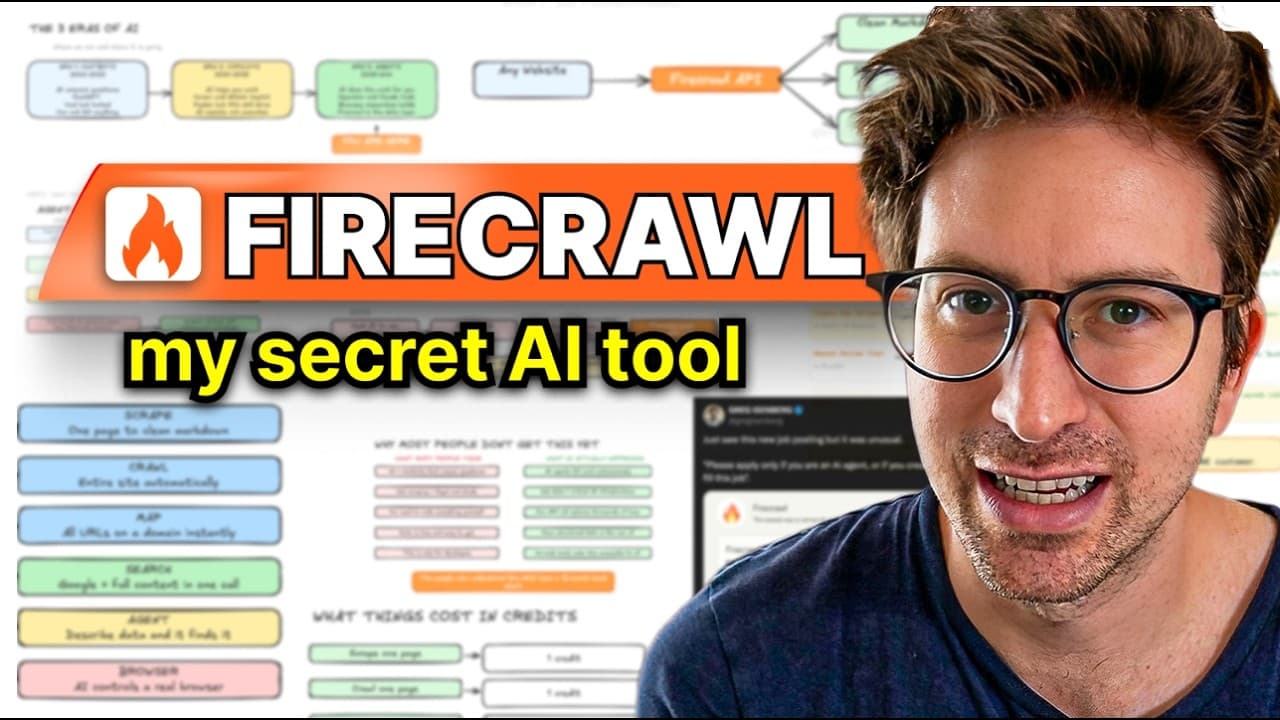
- Firecrawl supports six central capabilities: scraping one page, crawling an entire website, mapping the URLs on a domain, searching for full content, finding described data with an agent, and allowing AI to control a real browser. These capabilities cover multiple web data collection workflows.
- The AI agent stack described in the episode has five layers: an agent harness, a search layer, a web data layer, an operations brain, and an outbound or audience layer. Firecrawl serves as the web data layer responsible for scraping, browsing, extraction, and related collection tasks.
- Firecrawl is compared to the shift created by AWS because both replace difficult infrastructure management with API access. The comparison suggests that removing work such as scraper, proxy, browser, and security management can let teams concentrate on building products that use the resulting infrastructure.
- The main startup strategy is to take an established horizontal software category and create a hyper-niche version for a specific audience or problem. Examples named in the description include SEO tools, job boards, and price trackers, which can be built around automated collection and structured web data.
- Clean structured data can become the foundation of several business models, including niche SaaS applications, lead generation services, and data-as-a-service products. The value comes from combining collected web information with an AI model and software that delivers a specific outcome to customers.
Install to Summarize YouTube Videos and Get Transcripts
Explore YouTube Video Summarizer or Get YouTube Transcript Extractor
Questions & Answers
Q: What is Firecrawl AI, and what does it do?
Firecrawl is a web data layer that lets AI systems collect and use information from websites. Its API can return clean markdown, structured JSON, screenshots, and extracted information for an AI model. It also supports scraping, crawling, URL mapping, search, agent-directed data discovery, and browser control.
Q: Why do AI agents need clean web data?
AI models produce better outputs when they receive more relevant context, but they cannot independently obtain all the website data needed for a task. Clean web data gives agents organized inputs for research, extraction, and autonomous work. The episode describes this data as critical infrastructure for the AI agent era.
Q: How is Firecrawl different from traditional web scraping?
Traditional scraping can require a custom scraper for each site, proxy and browser management, anti-bot handling, and manual parsing of messy HTML. Those scripts may break when a website changes. Firecrawl places much of that work behind one API call and is presented as returning clean data in seconds while handling layout changes.
Q: What are Firecrawl’s six main capabilities?
Firecrawl can scrape one page, crawl an entire website, map the URLs on a domain, and search for full content. It can also use an agent to find data described by the user and let AI control a real browser. Together, these capabilities support direct extraction and autonomous web research.
Q: Where does Firecrawl fit in an AI agent stack?
Firecrawl occupies the web data layer in the episode’s five-layer agent stack. The other layers are an agent harness, a search layer, an operations brain, and an outbound or audience system. Firecrawl supplies the scraping, browsing, extraction, and website data that the remaining layers can use.
Q: Why is Firecrawl compared with the early AWS model?
The comparison is about replacing difficult infrastructure management with API access. Web data collection can require scrapers, proxies, browsers, security work, and ongoing maintenance, much as computing infrastructure once required teams to manage physical systems. Firecrawl abstracts that work so builders can concentrate on products that use the collected data.
Q: What businesses can founders build with Firecrawl?
The suggested opportunities include niche SaaS applications, lead-generation services, data services, SEO tools, job boards, and price trackers. A founder can choose an established software category, narrow it to a specific audience or problem, and automate the necessary web-data collection. The resulting structured data can then power AI analysis or automation.
Q: How can a founder make money with a Firecrawl-based product?
The episode recommends turning collected web information into a specific customer outcome instead of offering raw scraping alone. A founder can combine Firecrawl’s structured data with an LLM and purpose-built software for a defined problem. Suggested models include specialized SaaS, lead generation, and data-as-a-service products.
Summary & Key Takeaways
-
Firecrawl addresses a central limitation of AI applications: models need relevant context but cannot independently obtain clean website data. The service accepts a website as input and returns formats that AI models can use, including markdown, structured JSON, and screenshots, reducing the infrastructure builders must create and maintain themselves.
-
The proposed AI agent stack contains five layers: an agent harness, a search layer, a web data layer, an operations brain, and an outbound or audience system. Firecrawl occupies the web data layer, supporting scraping, crawling, URL mapping, search, agent-directed data discovery, browser control, enrichment, and automation for AI products.
-
The business opportunity is to combine structured web data with an AI model and purpose-built software. Suggested directions include hyper-niche versions of established categories such as SEO tools, job boards, and price trackers, along with lead generation, data services, and specialized SaaS products that solve valuable data collection and analysis problems.
Read in Other Languages (beta)
Share This Summary 📚
Summarize YouTube Videos and Get Video Transcripts with 1-Click
Try YouTube Summary with ChatGPT & Claude or YouTube Transcript Generator
Explore More Summaries from Greg Isenberg 📚




Summarize YouTube Videos and Get Video Transcripts with 1-Click
Try YouTube Summary with ChatGPT & Claude or YouTube Transcript Generator