How to Become an In-House AI Consultant
TL;DR
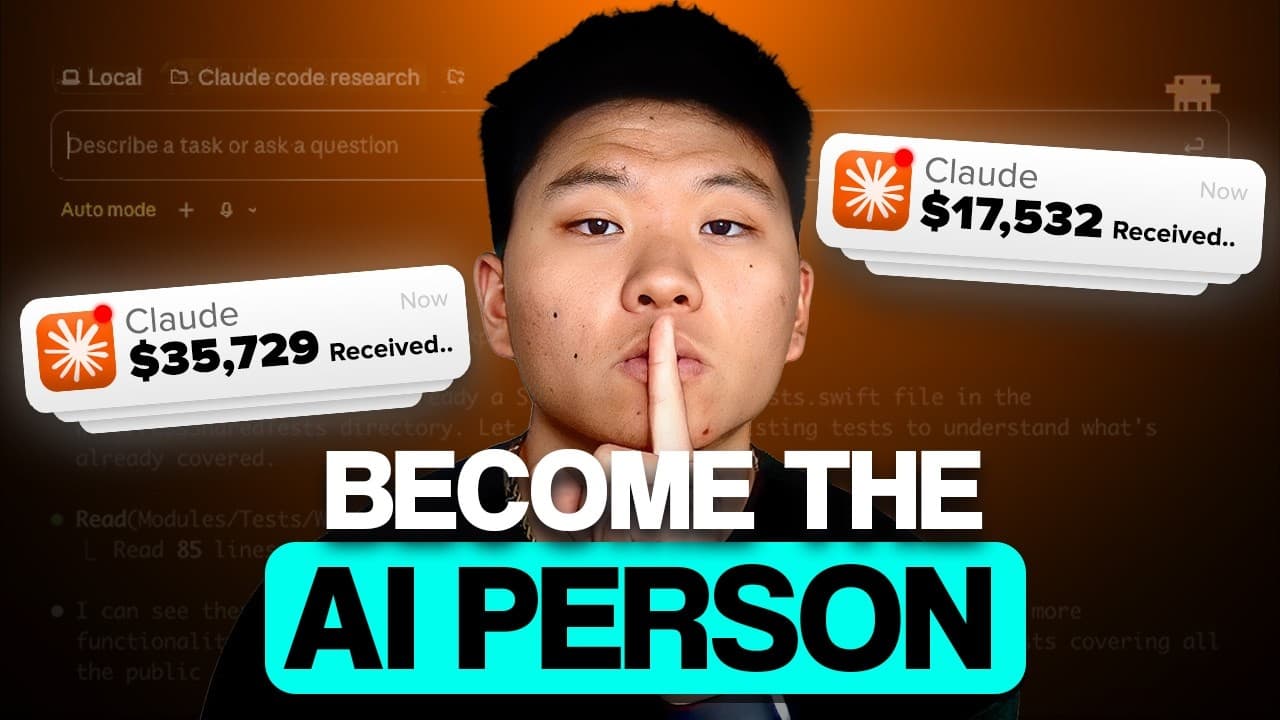
Start by auditing your own recurring work for time-consuming, low-risk tasks, then automate them and record the hours saved. Make those results visible, help coworkers adopt the workflows, and eventually shift from fixing minor annoyances to identifying business constraints where AI, human judgment, training, and stakeholder communication can create greater value.
Transcript
So, there's a new opportunity for the people who know how to use AI that nobody's really talking about. Specifically, if you have a corporate career or work a job, 12 months ago, this didn't really exist, but it's now turning into the next AI gold rush. This opportunity could genuinely make many of you career millionaires over the next few years, a... Read More
Key Insights
- AI-enabled productivity is the central reason the presenter gives for corporate disruption, because one person using AI can now perform work that previously required three to five people. Employees who learn to apply AI can therefore gain an advantage over colleagues who do not.
- Chegg is presented as an example of AI disrupting an established business. After ChatGPT made fast, inexpensive homework assistance broadly accessible, Chegg's stock fell almost 50% in a single day during 2023, and the company acknowledged that ChatGPT was harming its business.
- The AI automation market is described as reaching approximately $130 billion after companies hired experts, agencies, and consultants to diagnose operational problems and build solutions. These providers commanded premium prices because businesses understood their problems but did not know how to solve them.
- In-house AI implementation is becoming more attractive because AI tools are increasingly accessible and easier to use. As the cost and perceived value of development decline, companies can address more problems internally instead of paying an outside organization to build every solution.
- Human judgment is the most valuable skill in the proposed role. The presenter emphasizes taste, handling ambiguity, and deciding which problems should or should not receive AI solutions, rather than treating technical construction as the entire job.
- An in-house AI consultant is compared to a doctor rather than a pharmacist. A builder supplies what is requested, while the consultant diagnoses what the organization actually needs, audits workflows, chooses suitable interventions, and helps employees adopt the resulting systems.
- A safe first automation is both time-consuming and low-risk. Suitable examples include weekly status reports, meeting notes, inbox sorting, data cleanup, and basic research, where a person can remain involved, correct mistakes, and continue working without serious harm.
- Measured business results make AI work credible and visible. Employees should record time saved, demonstrate wins during team meetings, help coworkers with repetitive tasks, and document prompts and workflows while describing outcomes in business terms instead of merely naming the AI tool used.
Install to Summarize YouTube Videos and Get Transcripts
Explore YouTube Video Summarizer or Get YouTube Transcript Extractor
Questions & Answers
Q: How can I become an in-house AI consultant?
Begin by auditing your daily and weekly responsibilities, then identify tasks that consume real hours and remain safe when AI produces a correctable mistake. Automate those tasks, document the time saved, and repeat the process. Next, demonstrate the results in team meetings, help coworkers improve their workflows, create shared internal documentation, and gradually expand into business-wide operational constraints.
Q: What does an in-house AI consultant do?
An in-house AI consultant audits how teams work, finds tasks consuming the most time, builds automations for suitable tasks, and trains employees to use the resulting workflows. The role also involves adoption, change management, and stakeholder communication. Its central responsibility is exercising judgment about what should be built and which problems should not be assigned to AI.
Q: Which workplace tasks should be automated first with AI?
The first tasks should satisfy two conditions: they consume meaningful time every week, and an imperfect AI result would not hurt anyone because a person can review and correct it. The presenter identifies weekly status reports, meeting notes, inbox sorting, data cleanup, and basic research as examples of low-risk work suitable for early experiments.
Q: How should AI automation results be measured at work?
Measure the time required before and after introducing the automation. The example given is a weekly report that once required two hours but later required only 10 minutes. Recording that difference turns a general claim about AI into concrete proof. Repeating this measurement across several workflows creates a documented record that managers and coworkers can understand.
Q: How can employees make their AI work visible to managers?
Employees can demonstrate successful workflows during team meetings, volunteer to improve a coworker's repetitive task, and document every implementation. They should describe the business result, such as saving eight hours before a quarterly report, rather than simply saying they used ChatGPT. A shared internal document containing effective prompts and workflows can make the employee's contribution broadly useful.
Q: Why is judgment important for an AI career?
Judgment determines what should be built, where AI should be applied, and where it should not be used. The presenter argues that development is becoming easier and less expensive, so technical construction represents only a small part of the opportunity. Handling ambiguity, diagnosing needs, exercising taste, and selecting valuable business problems are therefore the differentiating human capabilities.
Q: Why are companies moving AI automation in-house?
Companies previously knew their operational problems but often lacked the knowledge needed to solve them, which allowed AI agencies and consultants to charge premium prices. AI tools have since become accessible enough for executives and employees to use directly. As development becomes easier and less costly, businesses increasingly seek internal ways to build solutions and retain practical knowledge.
Q: When should AI work expand beyond personal productivity?
Expansion should begin after several low-risk automations have produced documented results and coworkers start seeking assistance. At that stage, the employee can move from fixing personal annoyances to examining constraints across the business. The presenter distinguishes these categories because minor automation saves time, while addressing organizational constraints has a stronger connection to business growth and higher-value consulting work.
Summary & Key Takeaways
-
AI is changing corporate work by allowing one person using the technology to complete work that previously required three to five people, according to the presenter. As building becomes easier and less expensive, companies increasingly want employees who can identify worthwhile AI applications and implement solutions internally rather than relying entirely on outside agencies.
-
The proposed career opportunity is an in-house AI consultant who audits workflows, identifies costly tasks, builds appropriate automations, trains coworkers, manages adoption, and communicates with stakeholders. The presenter argues that judgment matters more than technical construction alone because the valuable decision is increasingly what should be automated, not merely how to build an automation.
-
The roadmap begins with documenting recurring responsibilities and selecting tasks that consume meaningful time but create little harm if AI makes a correctable mistake. After automating these tasks, employees should measure time savings, demonstrate results in team meetings, assist coworkers, document reusable workflows, and progress toward business-wide constraints that affect growth.
Read in Other Languages (beta)
Share This Summary 📚
Summarize YouTube Videos and Get Video Transcripts with 1-Click
Try YouTube Summary with ChatGPT & Claude or YouTube Transcript Generator
Explore More Summaries from Nate Herk | AI Automation 📚




Summarize YouTube Videos and Get Video Transcripts with 1-Click
Try YouTube Summary with ChatGPT & Claude or YouTube Transcript Generator