How to Build an AI-Native Organizational Brain
TL;DR
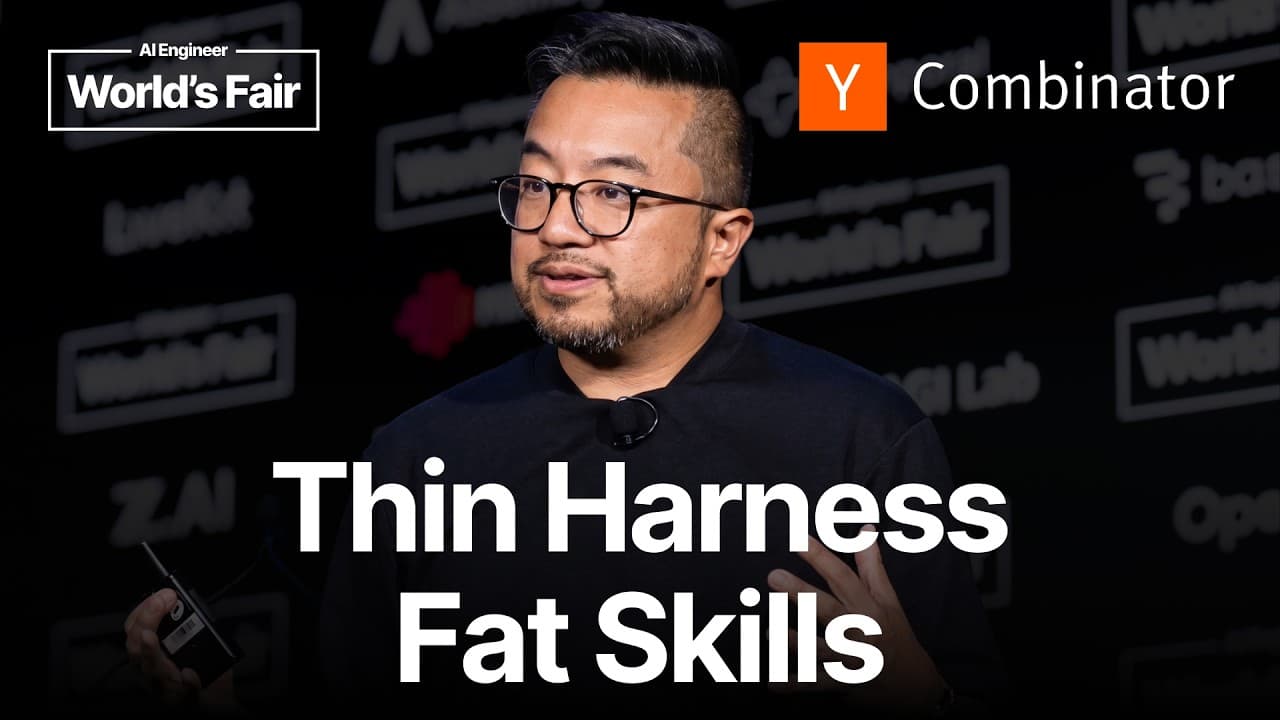
Treat AI as a managed workforce, not as autocomplete, by encoding roles, procedures, routing rules, and evaluations into reusable files that agents can execute. A company brain gives agents the right context while separating judgment in the language model from deterministic computation in software, allowing small teams and nonprogrammers to perform work previously requiring much larger organizations.
Transcript
[music] >> Okay, great. Hey everyone. How's everyone doing? All right. Are we ready for the revolution? Okay, Theo just asked the right question. What do we build now? I'm going to answer it from the other side of the table. Uh I'm a founder, I'm an investor, and I run a 20-year-old institution that is becoming AI native right now, which is a stran... Read More
Key Insights
- AI productivity is determined by workflow design, not simply model access. Tan says people achieving twofold and hundredfold gains can use the same Claude model, weights, context window, and API, while producing different results because they structure and route the work differently.
- AI should be treated as a workforce rather than as autocomplete. The fastest-growing founders observed by YC assign agents structured responsibilities, supply reusable procedures, and manage their output instead of using models only to suggest individual lines of code.
- A skill file is the agent equivalent of an employee with one clearly documented capability. It defines a job precisely enough for an agent to execute it repeatedly, while engineers maintain those skills and handle work the encoded procedures cannot yet complete.
- A resolver table functions like an organizational chart by deciding which instructions and context apply to an incoming task. Filing rules define internal processes, while trigger evaluations test whether the correct files were loaded and serve a role comparable to performance reviews.
- AI-native companies can achieve high revenue with lean teams. Tan cites Emergence reaching nine figures of annual recurring revenue within eight months of public launch and having 15 people at $15 million ARR, while Retail reached $60 million with about 40 people.
- AI-native work extends beyond software engineering. YC staff in media, events, and finance create skill files and scheduled jobs, and one finance employee reportedly consolidated about 100 Excel workbooks into a single application despite not being a programmer.
- Latent space is appropriate for taste, judgment, vague human intent, and other nondeterministic decisions. Deterministic space is appropriate for reliable computation and storage, so data structures such as an 800-seat arrangement should remain in software rather than inside the model's context window.
- A company brain acts as both a library and a librarian by preserving organizational knowledge and selecting relevant context. Reusable skills prevent the company from beginning each day with amnesia, making every completed task an opportunity to improve future execution.
- More videos with Garry Tan:
Install to Summarize YouTube Videos and Get Transcripts
Explore YouTube Video Summarizer or Get YouTube Transcript Extractor
Questions & Answers
Q: How do you build an AI-native company brain?
Build a company brain by recording repeatable capabilities as skill files, creating resolver tables that route tasks to the appropriate instructions, defining filing rules for internal processes, and adding trigger evaluations that verify whether the correct context was loaded. The resulting system should preserve reusable organizational knowledge and provide agents with the right material when they need to perform a task.
Q: Why should companies treat AI as a workforce instead of autocomplete?
Treating AI as a workforce changes the unit of work from isolated suggestions to complete, managed responsibilities. Tan says the fastest-growing YC founders do this by wiring tasks, context, procedures, and evaluations around agents. The same model can produce very different productivity gains, so the important advantage comes from organizing how agents receive assignments and execute repeatable work.
Q: What does a skill file do in an AI-native organization?
A skill file documents one capability or job clearly enough for an agent to execute it. Tan compares it to an employee because it defines a specific responsibility within a larger organization. Companies can maintain collections of these written procedures, improve them after each task, and employ engineers to update the skills or complete work that the existing instructions cannot yet handle.
Q: How do resolver tables and trigger evaluations manage AI agents?
A resolver table routes an incoming task to the appropriate skill or context, which makes it comparable to an organizational chart that determines who handles a request. Trigger evaluations then test whether routing worked, such as checking that test instructions load when a test file must change. Tan compares these evaluations to performance reviews because they measure whether the system followed its intended process.
Q: What is the difference between latent space and deterministic space?
Latent space is the language model's domain for taste, judgment, interpretation, and understanding vague human requests. Deterministic space is conventional software used for dependable calculation, storage, and structured operations. Tan argues that many AI engineering problems occur when computation is placed on the wrong side, so systems should let the model handle human judgment while code manages exact state and execution.
Q: Can nonprogrammers manage AI agents in a company?
Nonprogrammers can manage agents by expressing their work as skill files, procedures, and scheduled jobs. At YC, Tan says people in media, events, and finance who had never opened a terminal began building these systems. One finance employee reportedly transformed about 100 Excel workbooks into one application using YC's internal tooling and company brain, becoming a manager of agents rather than a traditional programmer.
Q: How can small AI-native teams produce unusually high revenue?
Small teams can encode work in sales, support, operations, and finance as procedures that agents execute instead of hiring hundreds of people for every function. Tan cites Emergence reaching nine figures of annual recurring revenue eight months after public launch and having 15 employees at $15 million ARR. He also cites Retail reaching $60 million with roughly 40 people.
Q: Why should companies turn one-off tasks into reusable skills?
Turning a completed task into a reusable skill preserves the instructions, decisions, and context needed to perform similar work again. The description characterizes this as preventing a company from waking up with amnesia each day. By refining work into reusable procedures, the company brain accumulates operational knowledge, gives future agents consistent guidance, and makes each execution a foundation for later improvement.
Summary & Key Takeaways
-
AI-native productivity depends less on access to a particular model than on how work is organized around it. Garry Tan estimates that his coding output increased roughly 400 times, with a conservative floor of eight times, because he shifted from manually producing code to directing agents through structured instructions and reusable workflows.
-
An AI-native organization can represent employee capabilities as skill files, task allocation as resolver tables, internal procedures as filing rules, and performance reviews as trigger evaluations. These components turn markdown files and supporting code into a management layer through which people can hire, train, route, assess, and improve an agent workforce.
-
A company brain prevents organizational amnesia by storing reusable knowledge and delivering relevant context when needed. Effective systems separate latent-space judgment, such as interpreting vague human intent, from deterministic-space operations, such as calculation and data storage. This structure lets engineers, finance staff, media teams, and event staff manage agents at unusual scale.
Read in Other Languages (beta)
Share This Summary 📚
Summarize YouTube Videos and Get Video Transcripts with 1-Click
Try YouTube Summary with ChatGPT & Claude or YouTube Transcript Generator
Explore More Summaries from AI Engineer 📚


Summarize YouTube Videos and Get Video Transcripts with 1-Click
Try YouTube Summary with ChatGPT & Claude or YouTube Transcript Generator