How to Build Effective AI Agents for Business
TL;DR
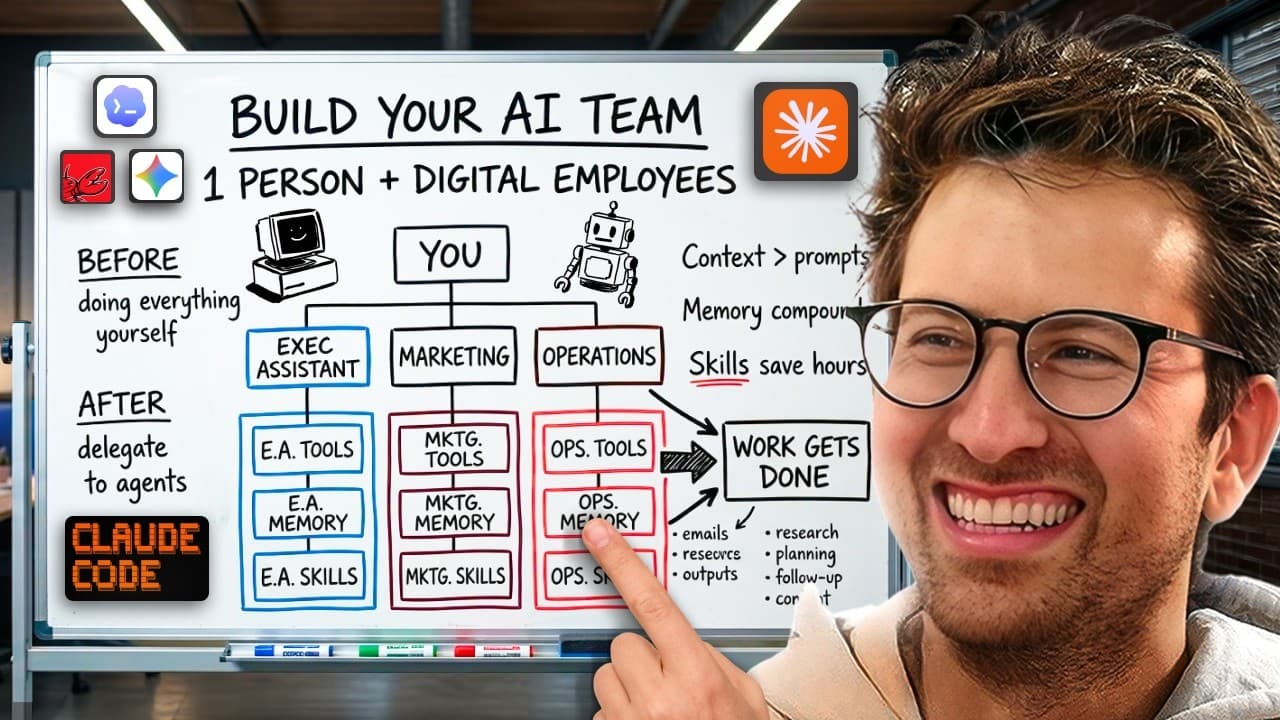
AI agents can transform business operations by automating tasks across departments. They operate using an 'observe-think-act' loop, enhanced by context and memory files that store preferences and processes. By connecting tools via MCP and creating skills for repetitive tasks, businesses can significantly increase efficiency and productivity.
Transcript
I think AI is confusing. There, I said it. I think there's a lot of terms, skills, MCPs, agent harnesses that are difficult concepts to understand. So, I had my friend Remy come on the podcast and explain it in the most simple terms possible. In this free course on how to master AI agents, he breaks down exactly what each piece is, how they connect... Read More
Key Insights
- Agent platforms like Claude Code and Codex use the observe-think-act loop, making them interchangeable once learned.
- Transitioning from chat to agents involves context engineering, where rich context enables simple prompts to yield excellent results.
- A memory.md file helps agents learn preferences over time, reducing errors and improving output consistency.
- MCP (Model Context Protocol) allows seamless integration of tools like Gmail and Notion, acting as a universal translator.
- Skills are reusable SOPs in markdown files, enabling repeated invocation of processes to save time.
- Scheduled tasks automate workflows, running skills like morning briefs without manual triggers.
- An agents.md file acts as a persistent context document, loaded at the start of each session to inform agent outputs.
- Building skills for repetitive tasks and connecting tools maximizes productivity, allowing agents to manage entire departments.
Install to Summarize YouTube Videos and Get Transcripts
Explore YouTube Video Summarizer or Get YouTube Transcript Extractor
Questions & Answers
Q: How do AI agents differ from chat models?
AI agents differ from chat models in that they operate on an 'observe-think-act' loop, focusing on achieving goals rather than just responding to queries. This allows them to execute tasks independently and deliver results, as opposed to the back-and-forth interaction typical of chat models.
Q: What is the role of a memory.md file in AI agents?
A memory.md file is used to store preferences and corrections made during interactions with AI agents. This file helps the agent remember user preferences across sessions, leading to fewer errors and more consistent outputs over time, as it learns and adapts to user needs.
Q: What is MCP and how does it work?
MCP, or Model Context Protocol, acts as a universal translator between AI agents and various tools like Gmail, Calendar, and Notion. It allows agents to communicate with these tools without needing custom development, facilitating seamless integration and enhancing the agent's functionality.
Q: How can skills be used in AI agents?
Skills in AI agents are reusable standard operating procedures (SOPs) packaged as markdown files. Once a process is explained to the agent, it can be invoked repeatedly as a skill, saving time and ensuring consistency. Skills can be created for any repetitive task, significantly increasing efficiency.
Q: What is context engineering in AI agents?
Context engineering involves loading AI agents with rich, detailed context so that simple prompts can produce excellent results. This shift from traditional prompt engineering allows agents to operate with a deeper understanding of tasks, leading to more accurate and useful outputs.
Q: How do scheduled tasks work with AI agents?
Scheduled tasks allow AI agents to run skills automatically at set intervals, turning them into automated workflows. This can include tasks like morning briefs or regular data analyses, running without manual triggers and freeing up time for users to focus on more strategic activities.
Q: What is the purpose of an agents.md file?
An agents.md file serves as a persistent context document for AI agents, loaded at the start of each session. It includes information about the user's role, business details, tools, and preferences, ensuring the agent can produce fully informed outputs even from simple prompts.
Q: Why is it important to connect tools to AI agents?
Connecting tools to AI agents via MCP is crucial because it enhances the agent's functionality by enabling seamless communication with applications like Gmail, Calendar, and Notion. This integration allows agents to perform tasks across different platforms without manual intervention, increasing productivity and efficiency.
Q: How does the AI agent loop work?
The AI agent loop repeatedly observes, thinks, and acts until it determines that the task is complete. After each action, the resulting research, plan, code, or other output is fed back into the loop so the agent can decide what to do next.
Q: What is an AI agent harness?
An AI agent harness is a platform that enables an agent to run its loop until a task is finished. Popular AI agent platforms are applications that facilitate this process by bringing together the model, loop, tools, and context.
Q: How does an AI agent know when a task is complete?
An AI agent decides that a task is complete based on the parameters in the user's prompt. For example, it can finish a research task after compiling the requested sources and creating the specified PowerPoint report.
Summary & Key Takeaways
-
Agent platforms like Claude Code and Codex run the same observe-think-act loop, making them interchangeable. The demo shows how each platform can build a portfolio site using this loop.
-
Without context, agents struggle to perform tasks. An agents.md file provides necessary context, including business details and preferences, enabling informed outputs.
-
Memory.md files allow agents to learn and retain preferences, reducing errors over time. This intentional memory building is crucial for effective agent performance.
Read in Other Languages (beta)
Share This Summary 📚
Summarize YouTube Videos and Get Video Transcripts with 1-Click
Try YouTube Summary with ChatGPT & Claude or YouTube Transcript Generator
Explore More Summaries from Greg Isenberg 📚





Summarize YouTube Videos and Get Video Transcripts with 1-Click
Try YouTube Summary with ChatGPT & Claude or YouTube Transcript Generator