How to Choose Between Karpathy's Wiki and OpenBrain
TL;DR
Choose Karpathy's Wiki for persistent, evolving synthesis and OpenBrain for structured data operations; a hybrid combines both strengths. The wiki compiles knowledge when sources are added, preserving cross-references and flagged contradictions instead of rederiving them with every query. OpenBrain can also add a plugin that brings the wiki approach to its structured data. Read on to compare where each architecture works and breaks.
Transcript
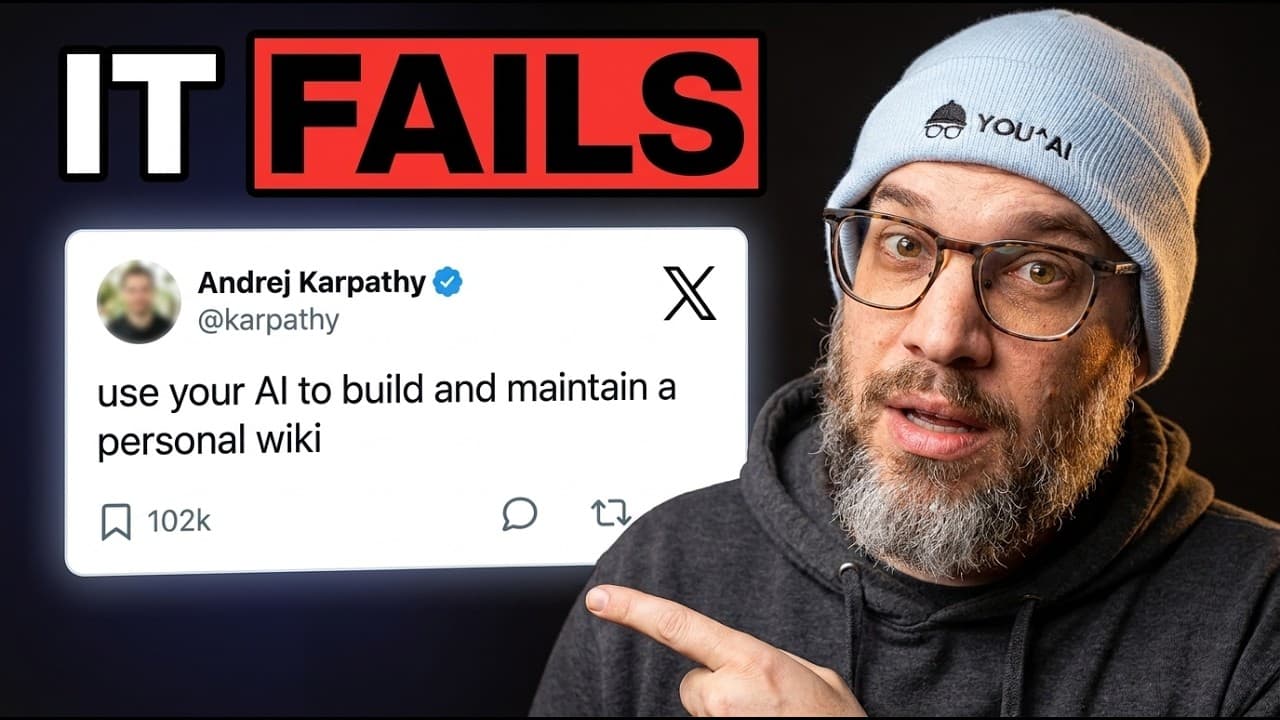
Everybody is going nuts about the wiki idea that Andre Carpathy posted a couple of days ago. 41,000 people have bookmarked it. And on the surface, it sounds ridiculously simple. You use your AI to build and maintain a personal wiki. As someone who launched something somewhat similar with OpenBrain, I have gotten hundreds of DMs and emails saying, "... Read More
Key Insights
- Karpathy's wiki compiles understanding at write time, creating a persistent knowledge base.
- OpenBrain synthesizes information at query time, providing precise answers when needed.
- Wiki systems can bake errors into understanding due to editorial synthesis decisions.
- OpenBrain excels in structured operations, supporting complex queries and multi-agent access.
- Wiki systems may struggle at scale, especially with multiple users or high-frequency updates.
- OpenBrain handles high volumes and precise queries, ideal for large-scale operations.
- Hybrid solutions can leverage both systems, using OpenBrain for storage and a wiki for synthesis.
- Choosing the right memory architecture impacts AI's ability to provide accurate, reliable information.
Install to Summarize YouTube Videos and Get Transcripts
Explore YouTube Video Summarizer or Get YouTube Transcript Extractor
Questions & Answers
Q: How should you choose between Karpathy's Wiki and OpenBrain?
Choose Karpathy's Wiki when you want AI to compile sources into persistent notes that track connections, contradictions, and evolving understanding. Choose OpenBrain when structured data and structured operations matter more, or use its plugin to combine OpenBrain's structured data with the wiki approach.
Q: How does Karpathy's Wiki work?
The system uses folders and text files, with an AI agent maintaining the notes and Obsidian serving as the viewing app. When a source is added, the AI identifies what matters, updates organized notes, creates cross-references, and flags contradictions.
Q: What problem does Karpathy's Wiki solve?
Typical AI tools may rediscover knowledge from scratch whenever a question is asked, even after performing the same synthesis before. Karpathy's Wiki records what the AI learned so that its synthesis and connections persist for later questions.
Q: What does it mean to compile knowledge instead of rederiving it?
Compiling means the AI processes knowledge once, writes its understanding into the wiki, and keeps that artifact current. Rederiving means repeatedly finding relevant document chunks and chats, reading them, and reconstructing an answer for each query.
Q: How does Karpathy's Wiki preserve connections between sources?
The AI updates an existing collection of notes whenever a new source arrives. Those notes can include cross-references, contradictions, and changes in understanding, allowing later questions to use relationships that have already been recorded.
Q: What roles do the AI agent and Obsidian play in Karpathy's setup?
The AI agent writes and edits the wiki based on its conversations and collected source documents. Obsidian is the note-viewing app where the user can browse updated pages, follow links, inspect the graph view, and read the results in real time.
Q: Why can fragmented AI documents and chats be inefficient?
A question might require the AI to connect five documents across six chats, determine how they relate, and synthesize an answer. If that synthesis is not saved, a similar question the next day can require the AI to repeat the work and spend more compute and tokens.
Q: Can Karpathy's Wiki and OpenBrain be used together?
Yes. OpenBrain includes a plugin intended to provide the wiki approach alongside OpenBrain's structured data. This hybrid is presented as a way to get persistent synthesis and structured storage rather than treating the two approaches as identical or declaring one universally better.
Summary & Key Takeaways
-
Karpathy's wiki approach compiles knowledge at the point of writing, maintaining a persistent artifact that evolves over time. This system excels in research settings where understanding develops incrementally. However, it can introduce errors through editorial synthesis and may struggle with scale and multi-agent access.
-
OpenBrain, on the other hand, stores data in a structured format, synthesizing information at the point of query. This allows for precise, on-demand retrieval and is suited for environments requiring structured data operations, high volume management, and concurrent multi-agent interactions.
-
A hybrid approach, combining OpenBrain's structured storage with a wiki's synthesis capabilities, offers the benefits of both systems. This setup ensures reliable data retrieval and evolving understanding, catering to diverse needs from individual research projects to large-scale organizational operations.
Read in Other Languages (beta)
Share This Summary 📚
Summarize YouTube Videos and Get Video Transcripts with 1-Click
Try YouTube Summary with ChatGPT & Claude or YouTube Transcript Generator
Explore More Summaries from AI News & Strategy Daily | Nate B Jones 📚




Summarize YouTube Videos and Get Video Transcripts with 1-Click
Try YouTube Summary with ChatGPT & Claude or YouTube Transcript Generator