What Is Optical Activity and How Is It Measured?
TL;DR
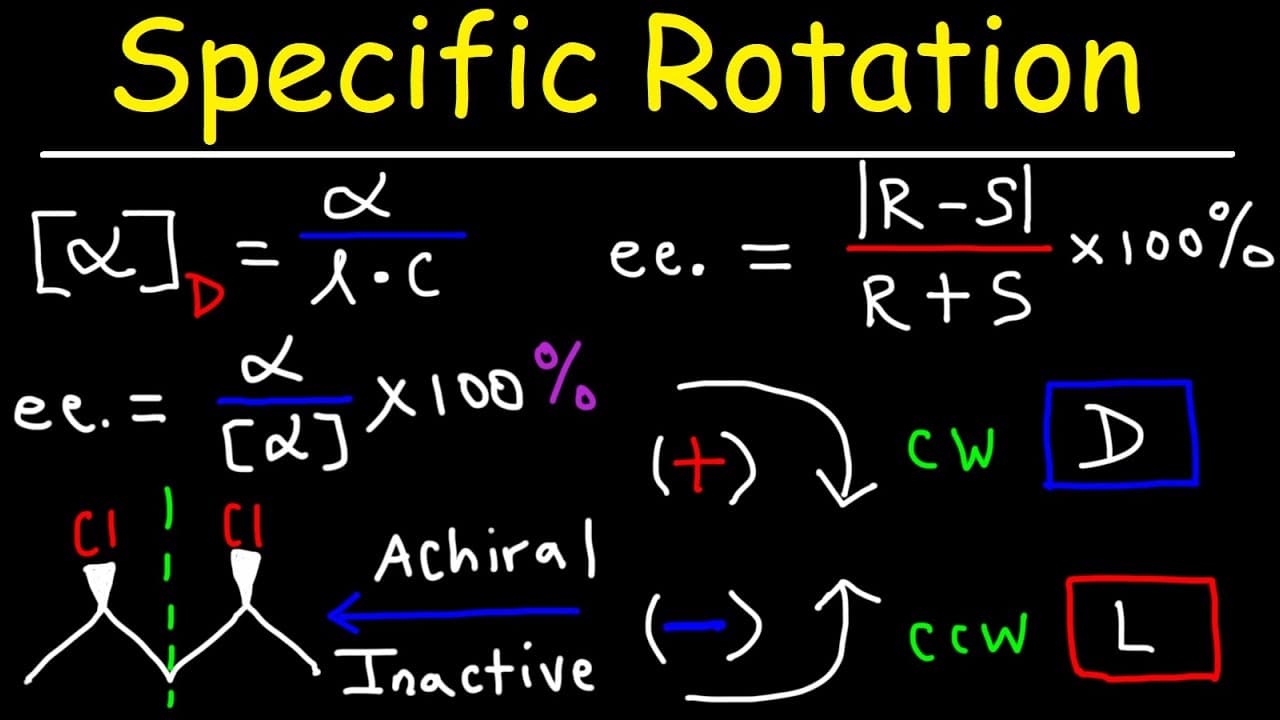
Optical activity refers to the ability of chiral molecules to rotate plane polarized light, which can be measured using specific rotation. Chiral molecules have unique configurations (S or R) and can rotate light in either a positive (dextrorotatory) or negative (levorotatory) direction, independent of their configuration. Enantiomeric excess and optical purity can be calculated using observed rotation and concentration values.
Transcript
in this video we're going to talk about optical activity we're going to discuss whether a molecule is optically active or optically inactive and we're going to talk about specific rotation and how to get it from observed rotation we're going to discuss terms such as optical purity and enantiomeric excess so let's begin our discussion with enantiome... Read More
Key Insights
- 🪩 Enantiomers are mirror images of each other and have the same physical properties but different optical properties.
- ✈️ Optical activity is the ability of a molecule to rotate plane polarized light.
- ☢️ Chiral molecules are optically active, while achiral molecules are optically inactive.
- ❓ The specific rotation formula relates observed rotation, path length, and concentration of a sample.
Install to Summarize YouTube Videos and Get Transcripts
Explore YouTube Video Summarizer or Get YouTube Transcript Extractor
Questions & Answers
Q: What is a chiral carbon?
A chiral carbon is a carbon atom in a molecule that has four different groups attached to it.
Q: Do enantiomers have the same physical properties?
Yes, enantiomers have the same physical properties, such as boiling point, melting point, density, and solubility.
Q: Can the S isomer always rotate plane polarized light towards the right?
No, the S isomer can rotate plane polarized light towards the right or the left, depending on the molecule. The S configuration of a chiral center only determines its spatial arrangement, not its optical activity.
Q: How can we determine if a molecule is optically active or inactive?
Molecules with chiral centers are optically active and can rotate plane polarized light, while molecules without chiral centers are optically inactive and do not rotate plane polarized light.
Q: What is the specific rotation formula?
The specific rotation (α) is equal to the observed rotation divided by the path length (l) times the concentration (c) of the sample. It is represented as α = α/(l x c).
Q: How can we calculate enantiomeric excess?
Enantiomeric excess can be calculated by dividing the observed rotation by the specific rotation of one of the enantiomers and multiplying it by 100.
Q: Can you calculate enantiomeric excess using relative percentages?
Yes, if the relative percentages of the enantiomers are known, the enantiomeric excess can be calculated by subtracting the lower percentage from the higher percentage.
Q: What is the relationship between enantiomeric excess and optical purity?
Enantiomeric excess is equivalent to the optical purity but in decimal form. In percentage form, enantiomeric excess represents the absolute difference between the percentages of the enantiomers.
Summary & Key Takeaways
-
Enantiomers are molecules with a chiral carbon, which is a carbon with four different groups attached to it.
-
Enantiomers are mirror images of each other and have the same physical properties, but different optical properties.
-
The rotation of plane polarized light by enantiomers can be positive (dextro rotatory) or negative (levo rotatory).
-
The configuration of chiral centers (S or R) does not determine the direction of optical rotation.
Read in Other Languages (beta)
Share This Summary 📚
Summarize YouTube Videos and Get Video Transcripts with 1-Click
Try YouTube Summary with ChatGPT & Claude or YouTube Transcript Generator
Explore More Summaries from The Organic Chemistry Tutor 📚



Summarize YouTube Videos and Get Video Transcripts with 1-Click
Try YouTube Summary with ChatGPT & Claude or YouTube Transcript Generator