How Qatar Segregates Migrant Workers in Doha | World Cup 2022
TL;DR
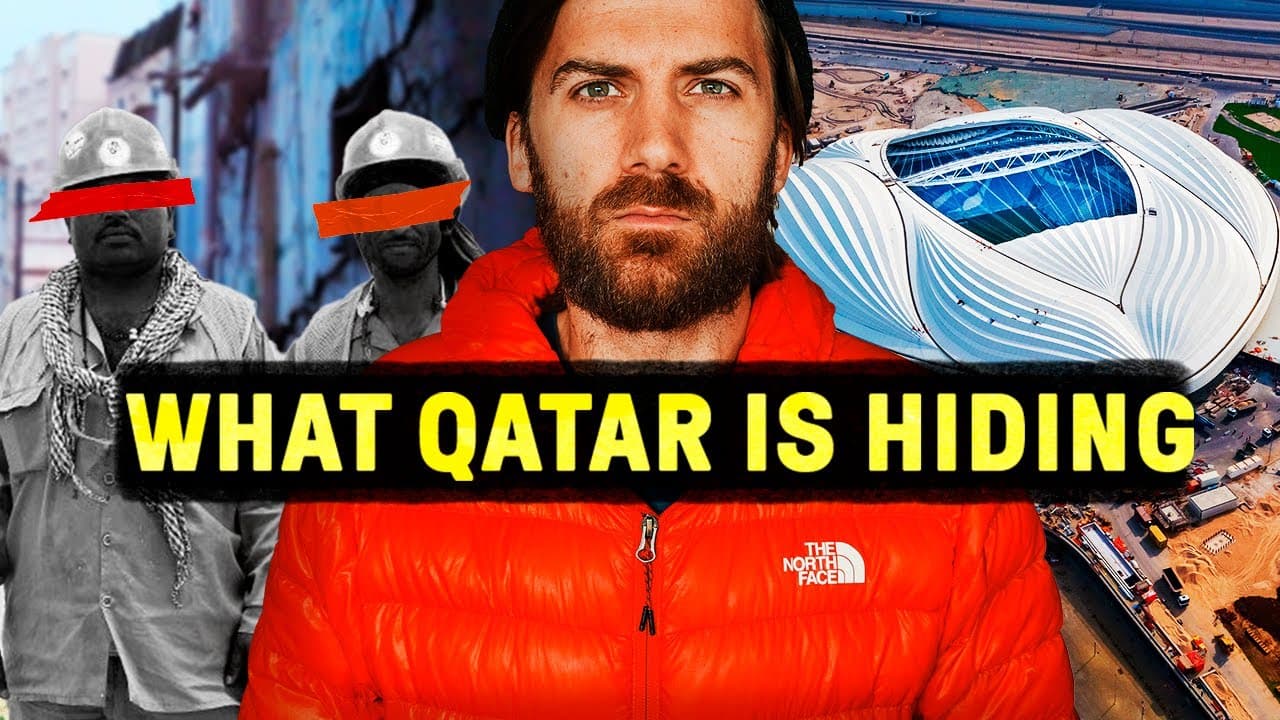
Qatar separates many migrant workers from central Doha through the unusually bounded and differently zoned Doha Industrial Area. Government maps showed the district cut off from much of the city, while a local fixer warned that informers, internal security forces, and Al-Fazaa police made open filming risky. Read on to see how the team used undercover footage and interviews in rural Nepal to investigate.
Transcript
(crowd cheering) - [Announcer] And it's a good shot. - We found something in our reporting, something happening here in the one big city in Qatar, a place the whole world is looking at right now, (dramatic music) an invisible border drawn to trap human beings, to make them work, to make them build. I wanna show this to you. So, let me take you back... Read More
Key Insights
- Qatar is a small, wealthy country whose rapid economic growth was powered by revenue from a vast natural gas field. The transcript says this wealth enabled the government to provide citizens with free healthcare, education, guaranteed jobs, subsidized housing, and direct payments.
- Doha Industrial Area is shown on Qatar’s government zoning maps as a differently classified section of the capital. Its unusual boundaries and separation from central Doha prompted the investigation into whether urban planning was being used to conceal the migrant workforce.
- Qatar’s workforce depends heavily on migrants recruited for construction, hospitality, manual labor, caregiving, and food services. The investigation links this reliance to Qatar’s need for lower-paid workers after nearby countries also became wealthy and could not supply the required labor.
- Filming inside the Industrial Area is presented as dangerous for an obvious foreign journalist carrying professional equipment. A local fixer warned that the journalist’s appearance and camera would attract attention from informers, internal security forces, and Al-Fazaa police.
- Local workers are difficult for foreign journalists to reach because potential participants fear speaking or appearing on camera. Several fixers could not find anyone willing to cooperate, demonstrating how surveillance concerns and personal risk can obstruct reporting on labor conditions.
- The reporting strategy relied on separating evidence collection across countries. A person inside Qatar could record the restricted district undercover, while camera operators in Nepal or Bangladesh could interview former workers who had returned home and might speak more freely.
- The 2022 World Cup created both urgency and heightened restrictions for the investigation. The team began working only weeks before the tournament, while Qatar and assisting NATO countries were also preparing anti-drone measures that ruled out ordinary aerial filming.
- Independent investigative journalism is described as resource intensive because sensitive stories require producers, local fixers, camera operators, factual review, and security planning. The creator says community funding allows stories to follow the available evidence without an institution dictating their direction.
Install to Summarize YouTube Videos and Get Transcripts
Explore YouTube Video Summarizer or Get YouTube Transcript Extractor
Questions & Answers
Q: How does Qatar separate migrant workers from central Doha?
Qatar’s government zoning maps show Doha Industrial Area as a differently classified section of the capital with unusual boundaries. It is cut off from much of Doha, with another municipality positioned between the district and the rest of the city, creating what the investigation describes as an invisible border around workers.
Q: What did Qatar’s zoning maps reveal about Doha Industrial Area?
Most of Doha appeared yellow on the government maps, while Doha Industrial Area appeared as one small blue shape. Its separate classification and disconnected location led the journalist to investigate whether the zoning was related to Qatar’s labor conditions.
Q: Why was Doha Industrial Area investigated before the World Cup 2022?
The journalist found the zoning anomaly while examining Qatar shortly before the World Cup, which was only weeks away. Because labor-condition concerns had followed Qatar since it was awarded the tournament in 2010, he suspected that the Industrial Area’s unusual boundaries were connected to migrant workers.
Q: Why couldn’t the journalist openly film in Doha Industrial Area?
A locally connected fixer said the journalist’s camera and skin color would attract undue attention. He warned that informers, internal security forces, and Al-Fazaa police controlled the Industrial Area and Asian worker districts, making open filming unsafe.
Q: Why was it difficult to interview workers in Doha Industrial Area?
Multiple fixers struggled to find anyone in the Industrial Area willing to speak with the reporting team. The difficulty of securing participants, combined with warnings about surveillance and police attention, made conventional interviews impractical.
Q: How did the team plan to document the Industrial Area?
The team planned to send a camera to someone inside Qatar and teach that person to film undercover. At the same time, camera operators would capture interviews with returned workers in rural Nepal or another country where they might speak more freely.
Q: Why couldn’t the team use a drone to film Doha?
The team was told that NATO countries were helping Qatar deploy anti-drone measures because of concerns about terrorist drones during the World Cup. Those systems included anti-drones designed to net other drones, ruling out the journalist’s DJI drone.
Q: What role did local fixers play in the Qatar investigation?
The team needed a local producer who could provide contacts, assess risks, and help them avoid arrest. Fixers searched for workers willing to talk and explained why a foreign journalist carrying a visible camera would draw attention inside Doha Industrial Area.
Summary & Key Takeaways
-
A government zoning map revealed that Doha Industrial Area was classified differently from most of the capital and physically separated from it. Suspecting a connection to Qatar’s labor conditions, the reporting team began investigating the district shortly before the 2022 World Cup, when global attention was focused on the country.
-
Attempts to enter and film the Industrial Area encountered serious obstacles. Multiple local fixers struggled to find workers willing to participate, while one warned that a foreign journalist carrying a camera would attract attention from informers, internal security forces, and Al-Fazaa police operating around industrial and Asian worker districts.
-
Unable to film safely in person, the team developed a distributed reporting strategy. Someone inside Qatar would record the Industrial Area undercover, while camera operators interviewed returned workers in rural Nepal or other countries. This approach aimed to document both the hidden geography of migrant labor and workers’ personal experiences.
Read in Other Languages (beta)
Share This Summary 📚
Summarize YouTube Videos and Get Video Transcripts with 1-Click
Try YouTube Summary with ChatGPT & Claude or YouTube Transcript Generator
Explore More Summaries from Johnny Harris 📚


Summarize YouTube Videos and Get Video Transcripts with 1-Click
Try YouTube Summary with ChatGPT & Claude or YouTube Transcript Generator